The world of SEO is changing. It’s changing faster than ever before. This massive shift is all thanks to a new feature from Google. We call this feature Google’s AI Overviews. It’s much more than just a small update. It is fundamentally transforming how people search for information.
Google’s AI Overviews are summaries powered by AI. You might be seeing these summaries right at the top of the search results page. Basically, it’s a way to provide a direct, concise answer to the queries and questions of the users. Naturally, this has caused a lot of concern for websites. There is a significant drop in organic traffic for websites. Everyone is worrying if they could survive. Or if they would get the visibility that they used to get before.
The simple searching has changed into providing direct answers. For brands to survive and thrive, they must adapt. Old SEO tactics are not enough. They need to incorporate AI-driven results, voice search optimization, and generative search strategies. This is the new reality. Today, we are going to see what AI search results actually mean to organic traffic and more.
So, what exactly are Google’s AI Overviews? They are AI-generated answers, often called AI Snapshots. You can see these answers above the traditional “blue links” you are used to seeing. They provide a synthesized answer by pulling information from multiple websites.
Google wants to provide the fastest, most satisfactory answers. They want to understand a user’s intent better. This feature is also perfectly compatible with voice search assistants. Imagine asking your smart speaker a question. The AI Overview is the perfect format for that spoken answer.
The AI Overviews are not just making things up. They are drawing data from specific kinds of content:
Also Read – AI Text Humanizer, Its Use, and Benefits
This is where the complex technology comes into play. But we can simplify it.
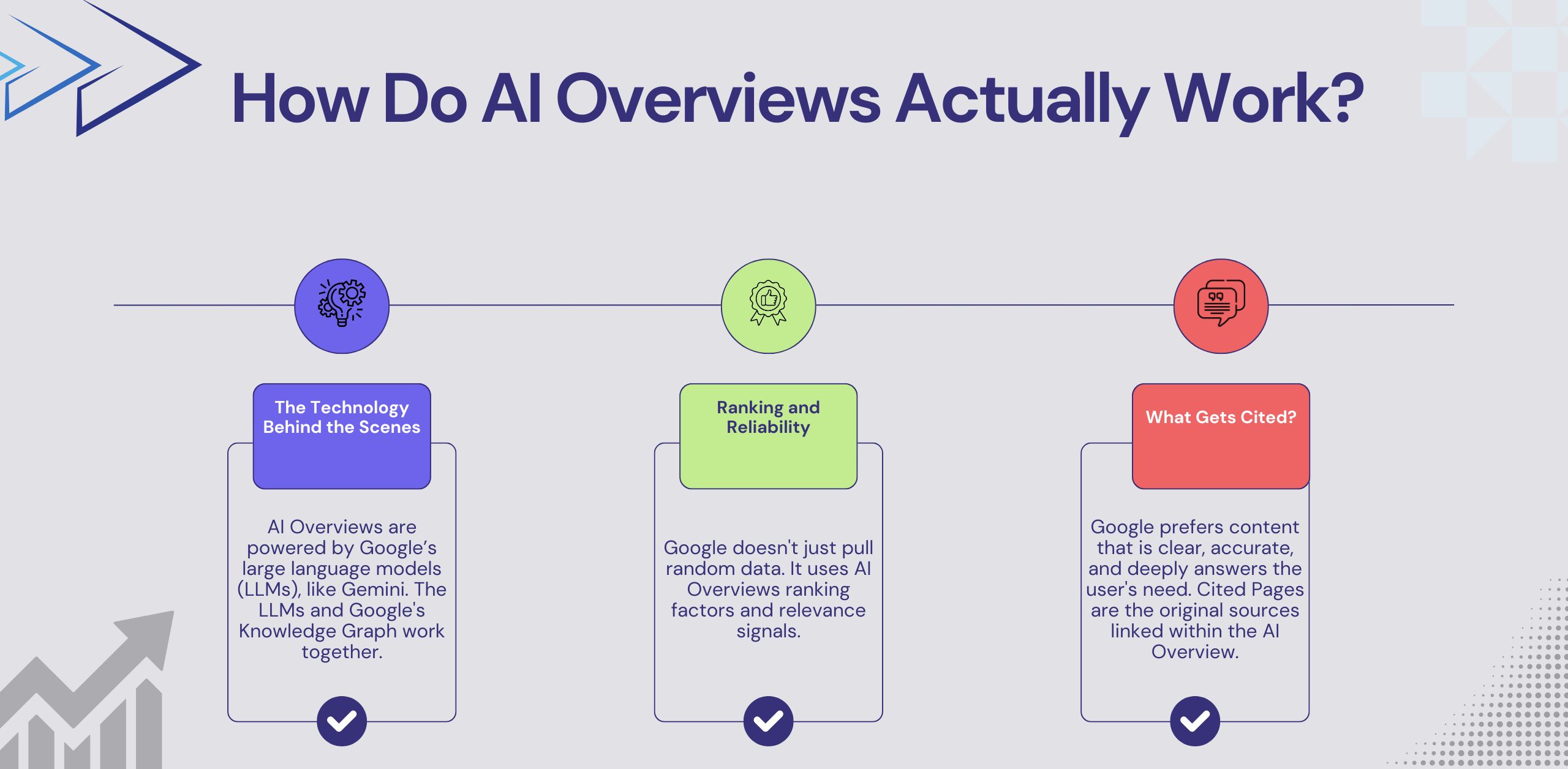
AI Overviews are powered by Google’s large language models (LLMs), like Gemini. The LLMs and Google’s Knowledge Graph work together. The Knowledge Graph is basically Google’s huge database that contains real-world entities. It is good at understanding the relationships between people, places, and things. First, LLM creates content from the web. Then, it is cross-referenced with the factual data from the Knowledge Graph.
Google doesn’t just pull random data. It uses AI Overviews ranking factors and relevance signals. They also have strong reliability filters and factual checks built in. This is crucial for maintaining trust.
Google prefers content that is clear, accurate, and deeply answers the user’s need. Cited Pages are the original sources linked within the AI Overview. Being a Cited Page is the new gold standard in SEO. Google is more likely to cite:
The most immediate and concerning effect is the potential drop in traffic. So, how do AI Overviews affect SEO and the bottom line?
When a user gets their AI-generated answer directly on the search page, they don’t click. This leads to a massive growth in zero-click searches. Your website may still get impressions. People see your page ranking in the results. But the Click-Through Rate (CTR) significantly decreases.
For example, studies show that informational queries can decrease the CTR of even the #1 website by 30% all because of the presence of an AI Overview.
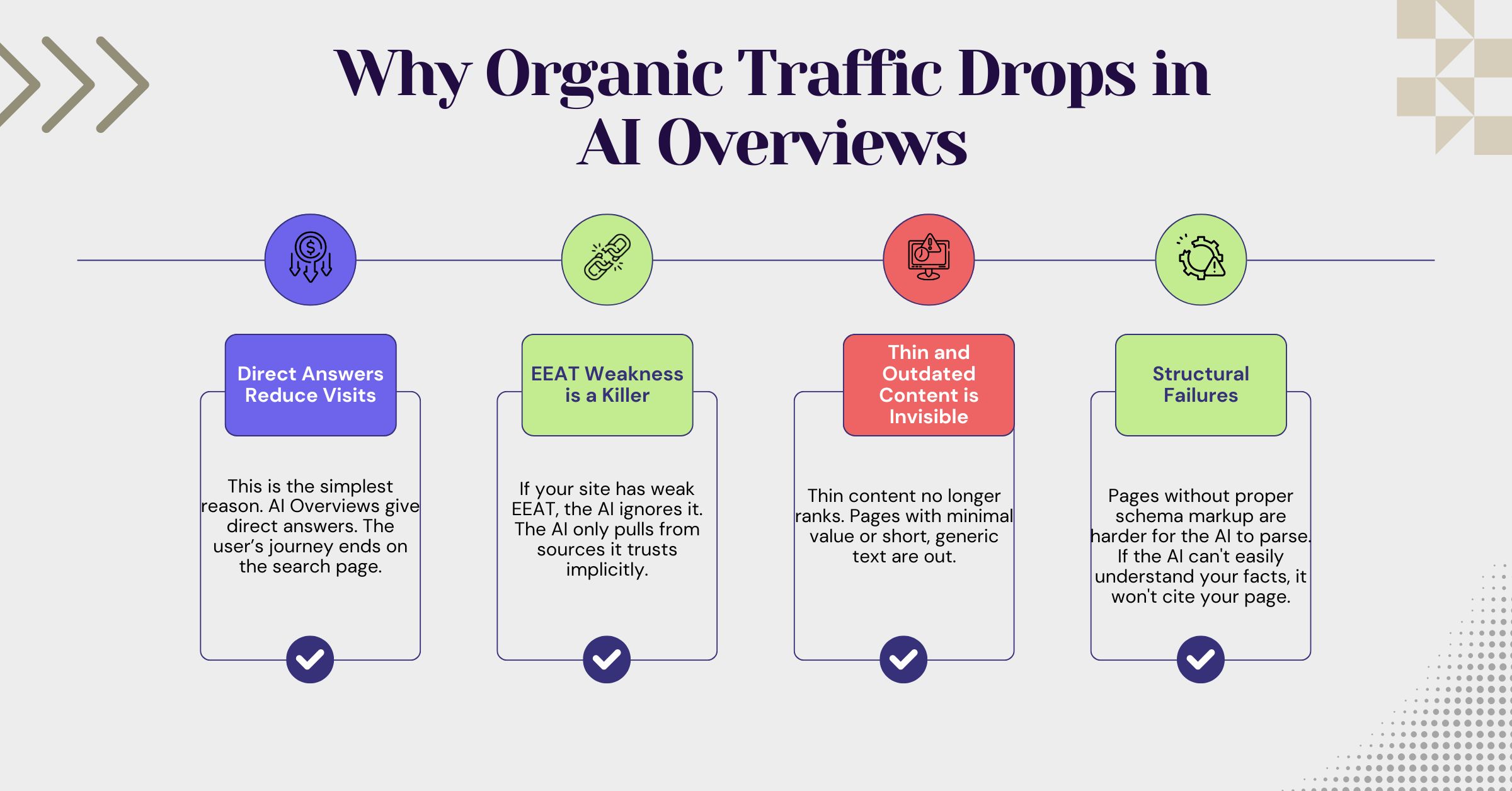
The traffic drop isn’t random. It follows clear logic based on the Google AI search update.
This isn’t all bad news. Google’s AI Overviews create new, valuable opportunities.
Also Read – Using AI-Generated Content
The key to succeeding with the new Google AI search update is to shift your focus. You need to focus on Answer Engine Optimization (AEO) and Generative Engine Optimization (GEO).
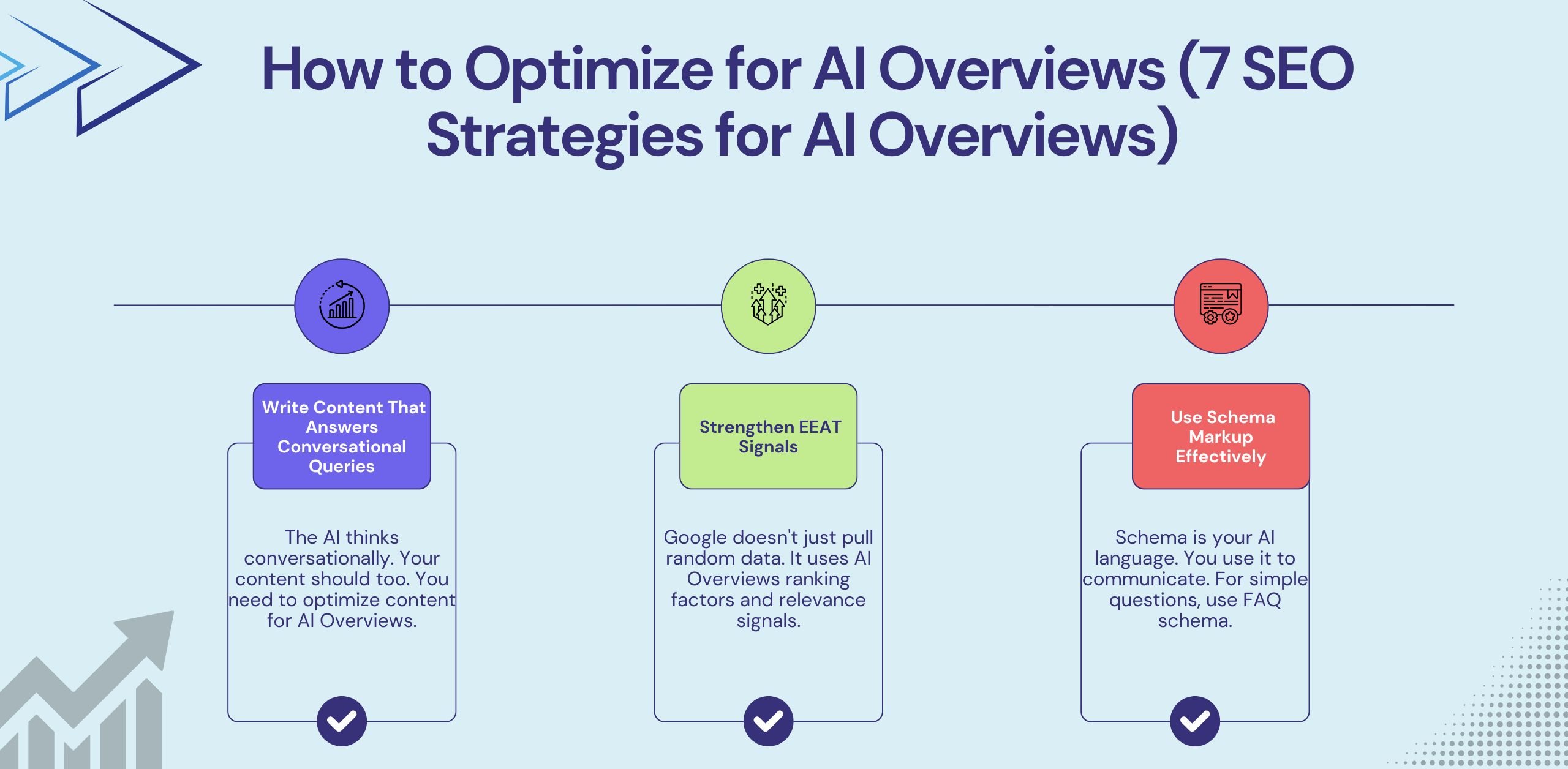
The AI thinks conversationally. Your content should too. You need to optimize content for AI Overviews. Follow the “Ask → Answer → Additional Value” format. Start every key section with a clear answer. Use natural language, mimicking voice search patterns. Format all key headings as user-focused questions. It can maximize engagement also.
This is non-negotiable. The AI will not cite content without strong proof of credibility.
Schema is your AI language. You use it to communicate. For simple questions, use the FAQ schema. For detailed instructions, use the How-to schema. This is for step-by-step guides. If content is location-specific, add the LocalBusiness schema. You must fill all required fields. Accuracy is critical. The AI needs to comprehend your information fully.
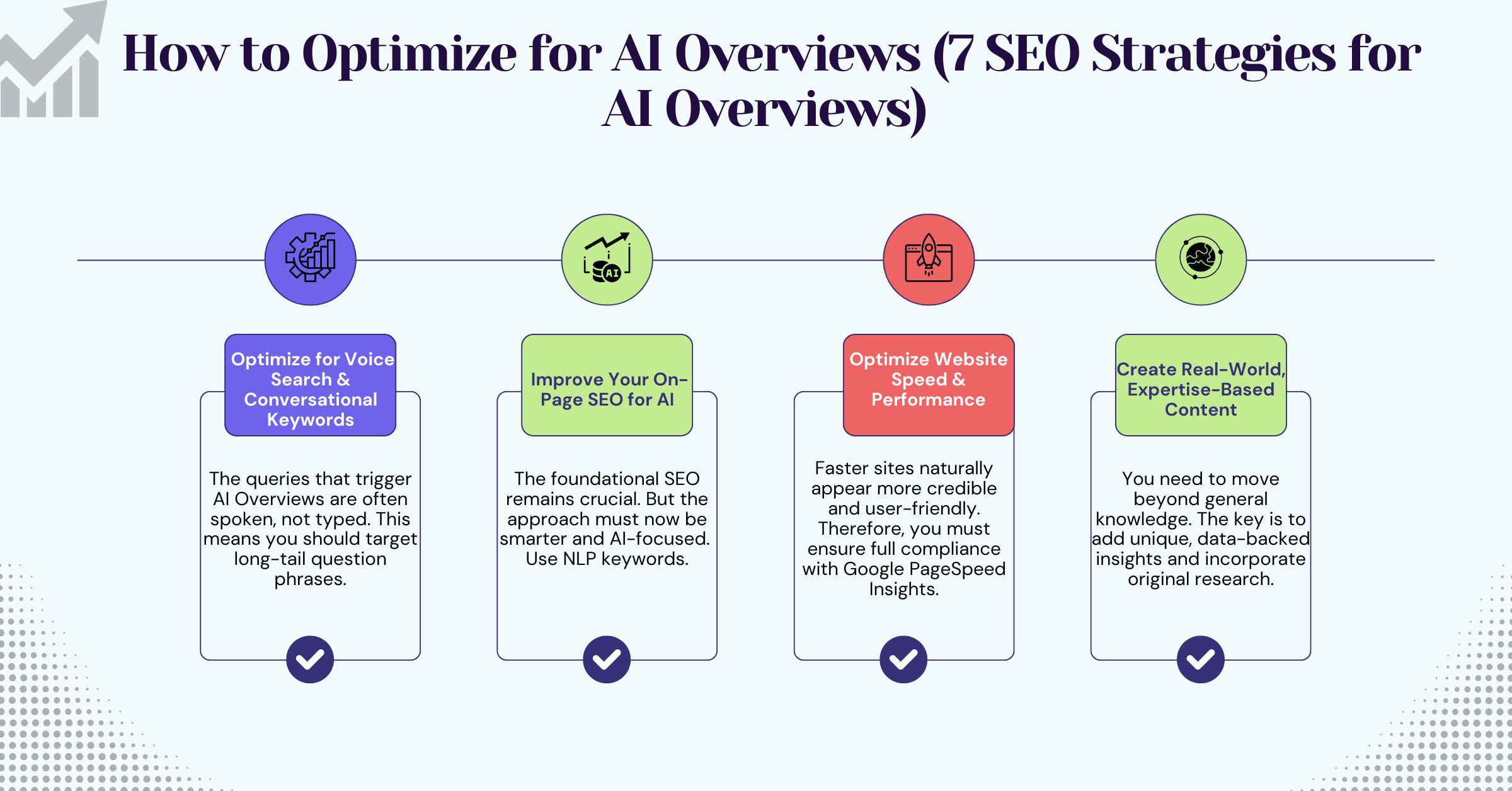
The queries that trigger AI Overviews are often spoken, not typed. This means you should target long-tail question phrases. E.g., “How long does it take to learn coding?” Your content must be highly scannable. It can be achieved through very short paragraphs and lists. Add a concise, 40-60-word direct answer block right after the main heading.
The foundational SEO remains crucial. But the approach must now be smarter and AI-focused.
Use NLP keywords. Means you need to focus on the overall semantics and related concepts of your topic. Improve your internal linking by using explicit anchor text—like “SEO Services” or “Digital Marketing Services“. It logically builds out topical clusters. The goal is to create main hub pages that link out to multiple, detailed sub-topics.
Faster sites naturally appear more credible and user-friendly. Therefore, you must ensure full compliance with Google PageSpeed Insights. A fast-loading page acts as a subtle signal of quality. This significantly improves your overall AI credibility score.
You need to move beyond general knowledge. The key is to add unique, data-backed insights and incorporate original research. Make sure you showcase your brand’s Experience (the ‘E’ in E-E-A-T) through detailed, first-hand accounts.
Also Read – Future of AI in E-commerce – A Complete Guide
If your traffic has already dropped, you need an aggressive recovery plan.
Recovery Strategies:
Use this quick checklist to optimize your most important pages.
Also Read – Top 10 Generative Engine Optimization (GEO) Strategies
Voice search and AI Overviews are two sides of the same coin. They are fully merging.
Voice queries are inherently conversational. They are longer and sound like a question. This is exactly what the AI Overview is designed to answer. By optimizing for one, you optimize for the other.
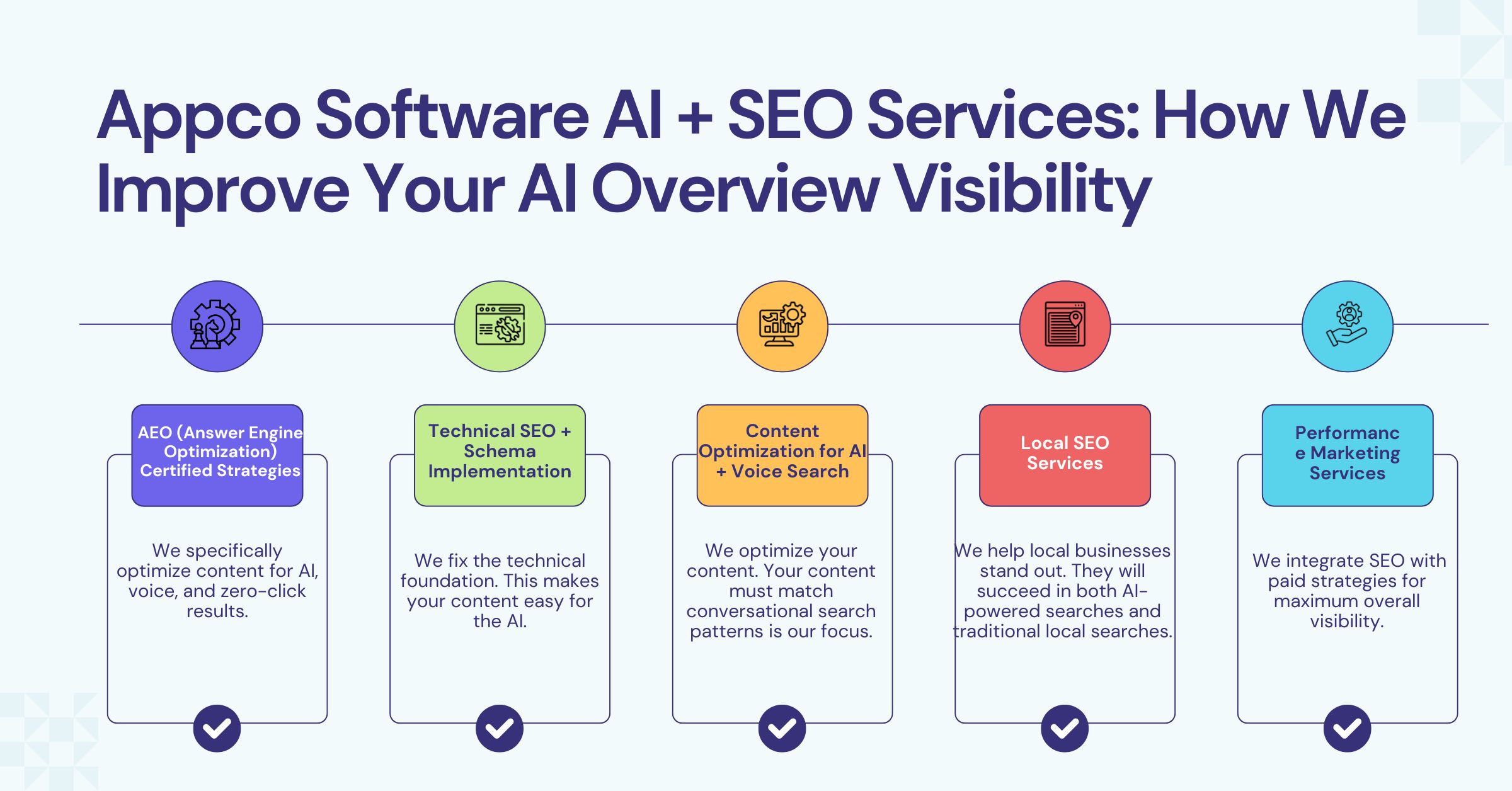
Navigating this new AI-driven landscape requires specialized expertise. That’s where a dedicated AI SEO agency in India comes in. Being a web development company and marketing agency, Appco Software has been helping brands boost AI visibility. We don’t just do traditional SEO. We specialize in AI-optimized SEO services. Our SEO experts ensure your business is visible in the future of search.
Also Read – SEO vs AEO vs GEO: Key Differences
Google’s AI Overviews are here to stay. They represent the single biggest shift in search behavior in a decade. Yes, they impact organic traffic. This impact can be negative for businesses that don’t adapt. However, this change is not a death sentence for SEO. It is an evolution.
The future of organic search is about quality, trust, and direct answers. Businesses must adopt new AI + SEO strategies now. They must prioritize being a cited source over just being a ranked link. By focusing on EEAT, clear content structure, and AEO, you can turn this challenge into your greatest advantage. The time to adapt is now.
Yes, absolutely. Voice search and AI Overviews connect closely. Voice queries are conversational. They often phrase questions exactly. The AI is designed to answer these. Optimize for conversational keywords. Add direct answer blocks. This improves your chances. You appear in the AI Overview. You appear in voice search results.
The fastest recovery involves a targeted content audit. First, update and refresh old, high-value pages with recent data. Second, immediately implement or fix missing schema markup (like FAQ and How-to) to make your content machine-readable. Third, insert clear, concise, 40-word direct answer blocks right under your headings.
Strong EEAT signals quality. It shows reliability to Google’s AI. AI models prioritize trustworthy sources. This is key for YMYL topics. Websites with weak EEAT are rarely cited. You must use expert authors. Add proper citations. Use experience-based insights. This optimizes your content for AI Overviews.
AI Overviews can hurt your traffic. They increase “zero-click searches.” The AI gives a direct answer. Users often don’t click links. This causes a big drop. Organic traffic will fall. CTR will also fall. This is true for informational content. AI Overviews affect all SEO efforts.
AEO is Answer Engine Optimization. It is an advanced SEO strategy. It focuses on creating content. This content is for generative AI tools. It is also for voice assistants. AEO focuses on concise, direct answers. Use 40-60 words. Use conversational language. Implement rich schema markup. This helps the AI understand and cite your information easily.
Strong EEAT is critical. Clear, structured data is important. Use Schema markup. Content must answer conversational queries. Use long-tail queries. AI prioritizes authoritative content. It also prefers recently updated content.