

Keyword research is the starting point of SEO. If you learn keyword research, your SEO game will be a lot easier for you. For beginners, keyword research usually sounds technical, confusing, or expensive. But the truth is simple. You can learn how to do keyword research for beginners using free tools and basic logic.
In this guide, we will be talking about keyword research for beginners. As a new prof. In SEO, you will learn:
Keyword research is nothing complicated. It is just the process of understanding what people search for on Google before you write anything. Instead of assuming what users want, you look at real words and real questions. Any useful SEO keyword research guide begins here because search engines only rank content that matches actual searches.
For keyword research for beginners, this step becomes even more important. Most beginners make one common mistake. They write content based on what they think is important. If you write your opinions, you won’t get there. Google tends to push user-friendly content. This is why, if you do proper keyword research, you will not waste time writing content that no one wants to read. Or keywords that are totally irrelevant to your niche.
Now, search is no longer limited to blue links. AI-driven systems like Google SGE, Gemini, and ChatGPT try to understand meaning, intent, and context. When your content is built around clear keywords and real user questions, these systems can easily process and surface it in AI-generated answers.
Voice search adds another layer. People speak differently from how they type. They ask full questions, not short phrases. Keyword research helps identify these natural queries so content can appear in voice-based search results and smart assistants.
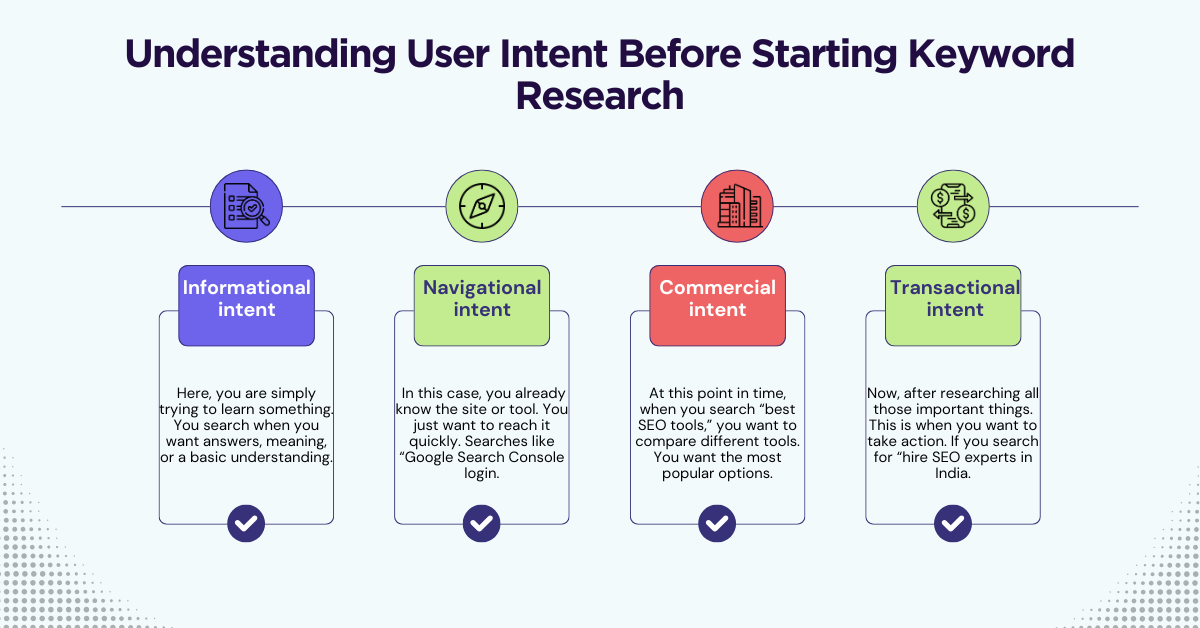
Before you pick any keyword, you need to stop and think about why someone is searching. Every search has a purpose. If your content does not match that purpose, Google usually ignores it. This is why user intent matters so much, especially when you are just starting with keyword research.
Here, you are simply trying to learn something. You search when you want answers, meaning, or a basic understanding. For example, when you type “what is SEO”, you are not planning to buy anything. You only want information. These searches belong to the early stage, where learning comes first.
In this case, you already know the site or tool. You just want to reach it quickly. Searches like “Google Search Console login” happen when you know where you want to go, but you use Google to get there.
At this point, when you search “best SEO tools,” you want to compare different tools. You want the most popular options for keyword research. You are checking tools, services, or choices before deciding. At this stage, you are not supposed to buy anything yet, but you are close to making a decision.
Now, after researching all those important things. This is when you want to take action. If you search for “hire SEO experts in India”, your intent is very clear: you want to contact or purchase the service.
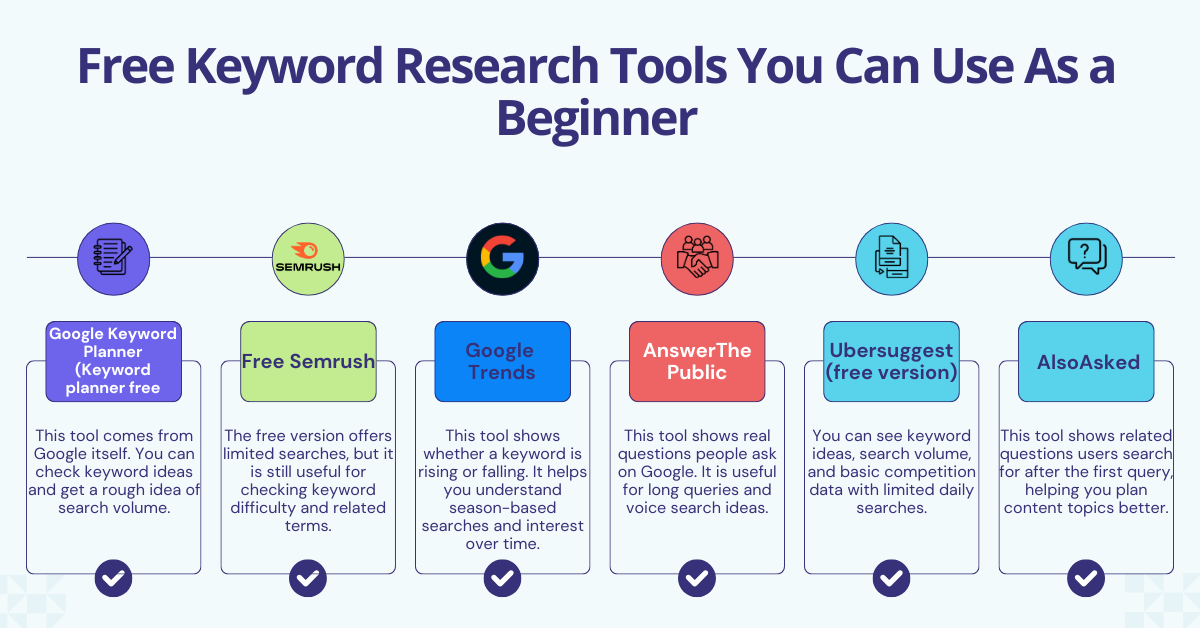
For anyone who doesn’t have much knowledge about SEO, you might get into a paid tools trap. You do not need them at the start. Many free keyword research tools are enough to help you understand search demand and keyword ideas. If you use them in the right way, they give clear direction without extra cost. These are some of the best free SEO tools beginners can rely on.
This tool comes from Google itself. You can check keyword ideas and get a rough idea of search volume. It helps you see which terms people search for more often.
The free version offers limited searches, but it is still useful for checking keyword difficulty and related terms.
This tool shows whether a keyword is rising or falling. It helps you understand season-based searches and interest over time.
This tool shows real questions people ask on Google. It is useful for long queries and voice search ideas.
You can see keyword ideas, search volume, and basic competition data with limited daily searches.
This tool shows related questions users search for after the first query, helping you plan content topics better.
| Tool | Best For | Cost | Difficulty |
| Keyword Planner | SEO planning | Free | Easy |
| Trends | Topic demand | Free | Easy |
| ATP | Questions | Free | Medium |
| Ubersuggest | Volume ideas | Free | Medium |
When you start learning how to choose keywords for SEO, you should focus on your brand. You are not trying to find perfect keywords. You are trying to find useful keywords that match what people search and what your page offers.
Ask yourself one simple question: Does this keyword match your page topic fully? If someone searches this keyword and lands on your page, will the answer be complete? If yes, the keyword is relevant.
This tells you whether people search for this keyword or not. As a beginner, you do not need very high numbers. Even low to medium volume keywords are fine, as long as searches happen regularly.
High competition keywords are usually dominated by big websites. You should look for keywords where ranking looks possible. When it comes to technical SEO optimization, long phrases bring better results.
SERP Analysis: Type the keyword in Google and check:
If you want long-term results, along with keyword research, you should also take the link-building services.
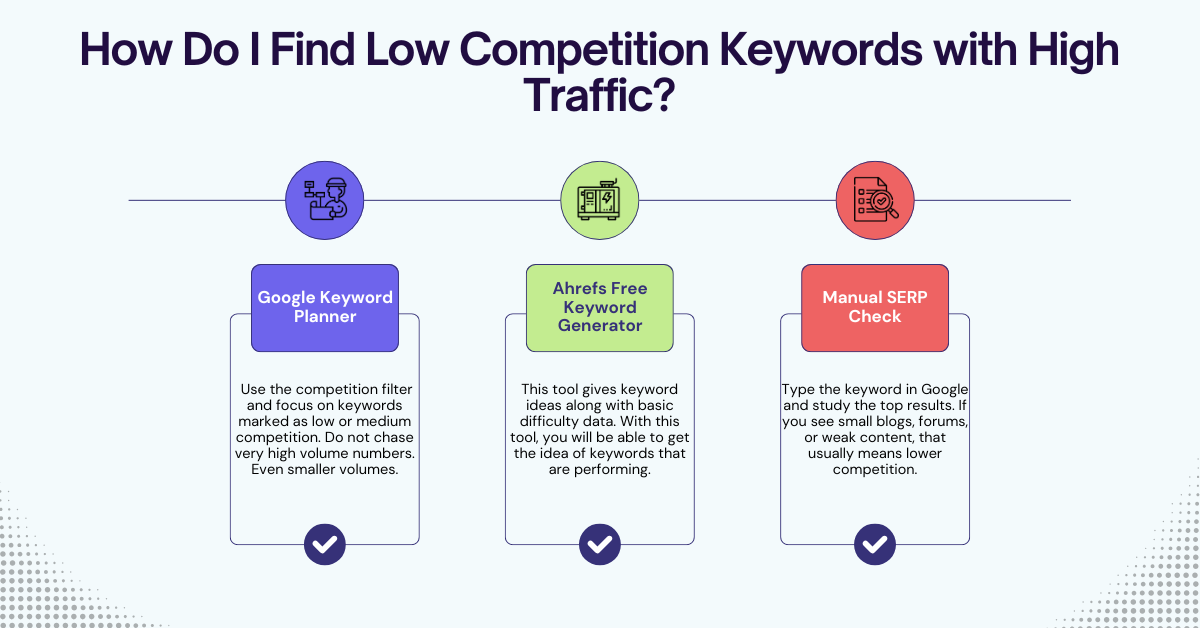
When you are starting, this is the most common doubt. The simplest way to do keyword research for beginners is to look for balance, not perfection. You want keywords that people search for, but where ranking still looks possible. This approach is useful whether you are planning to take content writing services or website development services.
Use the competition filter and focus on keywords marked as low or medium competition. Do not chase very high volume numbers. Even smaller volumes are fine if competition stays low.
This tool gives keyword ideas along with basic difficulty data. With this tool, you will be able to get the idea of keywords that are performing well or keywords that can help you grow.
Type the keyword in Google and study the top results. If you see small blogs, forums, or weak content, that usually means lower competition.
You can also do basic competitor checks. Look at what keywords similar websites rank for using Google results or free tools. This often reveals missed opportunities. Apart from all of this stuff, focus on long-tail and voice-style phrases. As we said above, full questions and natural sentences usually have less competition and clearer intent.
| Keyword Type | Difficulty | Traffic Potential | Example |
| Long-tail | Low | Medium | Best seo tools for beginners |
| Question keywords | Low | High | How to find keywords for free |
If you are new to SEO, you do not need complex methods to do keyword research. Your keyword research strategies for beginners should be easy and practical. Because your goal should be to find target keywords.
SEO is changing fast, and SEO keyword research now goes beyond normal typing searches. AI-based systems and voice assistants read context, questions, and location before showing results. To stay visible in AI-based search, your keywords need to sound natural and clear.
Start using conversational keywords. These look like how people talk in daily life. For example:
Next, focus on question keywords. AI tools prefer direct questions because answers are easier to pull.
Use Google’s People Also Ask section. It shows real follow-up questions users search for. These are useful for AI answers and voice results.
Add GEO-modified keywords if your business targets a location.
Apart from the keywords, good content is also important. Nobody’s going to read your blog if it’s not good. This is why you should use clear headings, short answers, and proper formatting so AI tools can understand your content. That said, you must always match search intent. AI answers appear when content solves a clear query, not when keywords are forced.
As an expert SEO agency in Jaipur, we are pretty much aware of the most common mistakes people make. In fact, these mistakes are very common. Once you learn, you will easily fix them.
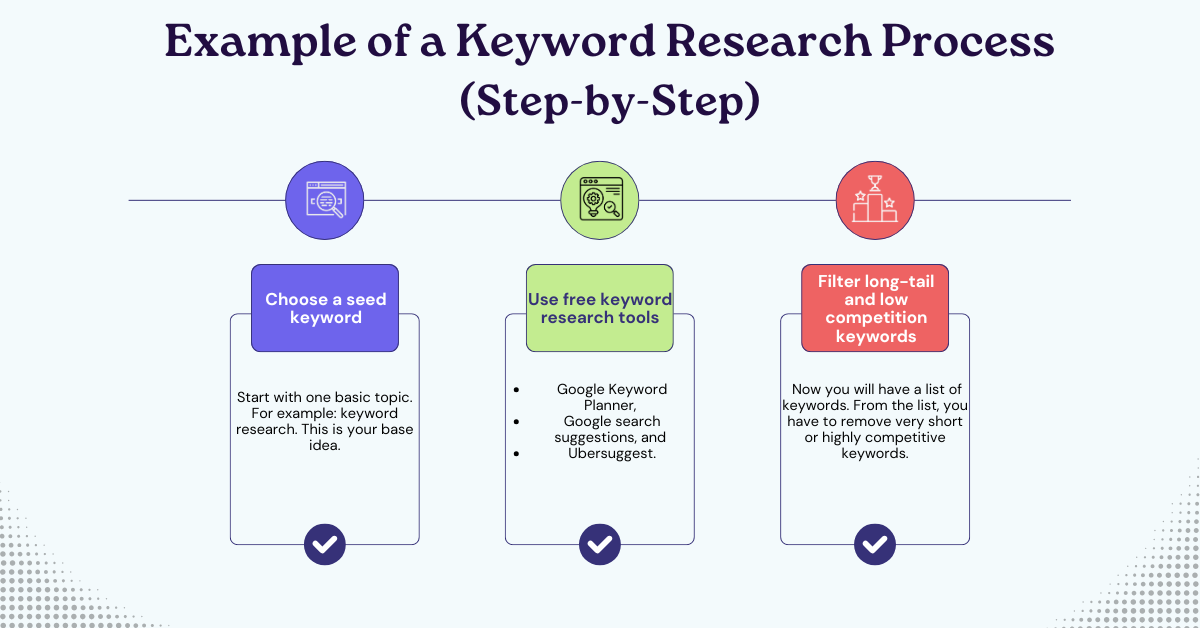
Now we will understand the process of keyword research. In simple terms, keyword research is a process of finding, analyzing, and finalizing words or phrases that people search on Google. And then, after finalizing the relevant keywords, you create content around them. And that’s what helps your content rank in the search engine result pages (SERPs).
Step 1: Choose a seed keyword: Start with one basic topic. For example: keyword research. This is your base idea.
Step 2: Use free keyword research tools: Now, take this seed keyword and check it in free tools like:
And by using these tools, you will be able to find so many related keywords around the main topic.
Step 3: Filter long-tail and low competition keywords: Now you will have a list of keywords. From the list, you have to remove very short or highly competitive keywords. And focus on longer phrases that clearly show intent. For this, if you are not that tech-savvy, you can go with keyword research services in India. And the expert team will help you find the targeted keywords for your business.
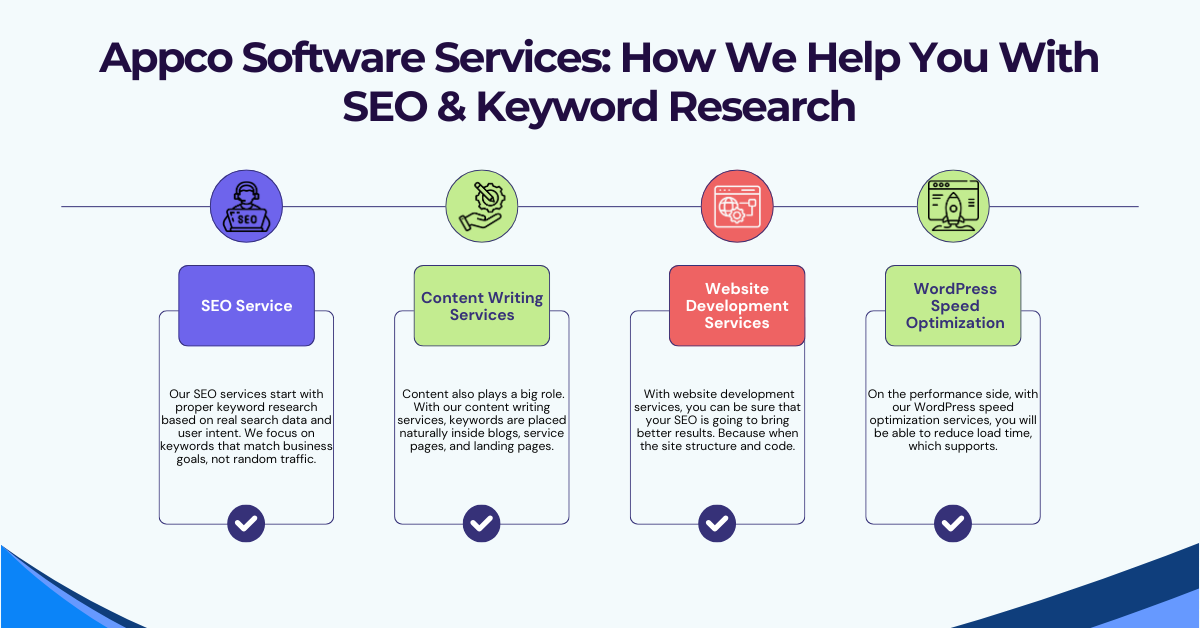
At Appco Software, keyword research is not treated as a separate task. It is connected with the full SEO and website structure. When you plan keywords the right way, everything else becomes easier to manage and improve.
Our SEO services start with proper keyword research based on real search data and user intent. We focus on keywords that match business goals, not random traffic. Along with this, our technical SEO support helps search engines read your site better by fixing structure, speed, and indexing issues.
Content also plays a big role. With our content writing services, keywords are placed naturally inside blogs, service pages, and landing pages, without forcing them.
With website development services, you can be sure that your SEO is going to bring better results. Because when the site structure and code are written with SEO in mind, you are going to get double benefits. If you have an eCommerce store, we also handle Shopify store optimization to improve product visibility and search performance.
On the performance side, with our WordPress speed optimization services, you will be able to reduce load time, which supports better rankings. This service is combined with performance marketing; keyword data is also used to plan ads and campaigns that bring targeted traffic.
Keyword research means finding out what words people use on Google when they search for something, and then creating content around those keywords or phrases.
You can start with Google Keyword Planner, Google search suggestions, Google Trends, the Ubersuggest free version, and AnswerThePublic. As a beginner, these tools are enough for you.
For one page, one main keyword is enough. Along with that, you can use a few LSI or secondary keywords. But do not stuff the content with keywords only.
Short-tail keywords are very general. On the other hand, long-tail keywords are longer, specific, and easier to target for beginners.
Check if people search for it, see who already ranks on Google, and confirm whether your content can answer that search properly.
Use Google search, Keyword Planner free tool, Trends, and basic competitor checks. You do not need paid tools to start.
You can rank faster by choosing low competition keywords and writing good content that directly answers what users search for.
As a beginner, you should avoid chasing big keywords, skipping Google checks, ignoring user intent, and using the same keywords repeatedly without updates.