These days, running a fashion or apparel eCommerce store is not easy. You’ve got hundreds of product sizes, different colors, seasonal trends changing every few months, and customers who expect fast delivery and easy returns. Additionally, if you’re selling globally, you need to manage multiple warehouses, currencies, and languages. If you don’t manage this well, your sales graph drops faster than you think.
This is where Odoo fashion eCommerce comes in. Unlike using ten different tools for sales, stock, accounts, and customer service, Odoo consolidates everything into a single system. From Odoo product variants for fashion (sizes, colors, fabrics) to Odoo inventory management for apparel, it gives you one dashboard to control your entire clothing business.
If you’re running a clothing store without Odoo, you’re probably juggling Excel sheets, third-party apps, and manual tracking. Mistakes happen. Stockouts kill your sales. Wrong inventory updates lead to returns. And customers don’t come back. With Odoo for the apparel industry, you cut all that mess.
In this article, we’ll show you exactly how Odoo clothing store management works and why more fashion brands are shifting to Odoo ERP. We’ll cover how it helps in product management, inventory, customer experience, and even marketing. And if you’re running a startup or scaling into a global fashion label, you’ll see how Odoo makes it possible to grow without chaos.
By the end, you’ll know whether Odoo is the right choice for your apparel eCommerce business, and how to get started with it in India or anywhere in the world.
Also Read – E-Commerce Business Ideas for Beginners & Students
Running an apparel store online is not the same as selling electronics or books. The challenges are bigger, and if you don’t manage them well, your profit goes down. Let’s break it down.
Fashion changes fast. What’s trending this summer may not sell at all next season. That means you’re always adding new SKUs and removing old ones. Without proper clothing eCommerce management software, you’ll lose track of what’s in demand and what’s stuck in stock.
A single T-shirt design can have 5 sizes, 6 colors, and 3 fabrics. That’s already 90 variations. Multiply this across your full collection, and you’ll see why managing stock manually becomes a nightmare. These fashion inventory issues directly impact sales if not handled properly.
Unlike gadgets, clothes often get returned because of the wrong size, color mismatch, or fitting issues. The fashion industry sees one of the highest return rates in eCommerce. If you don’t have a system to track returns, exchanges, and refunds, you’ll waste time and frustrate customers.
Today’s fashion brands are not selling in just one place. You may have your Shopify store, list products on Amazon, and still sell in physical outlets. Managing all this manually creates errors. That’s why businesses are moving to apparel eCommerce challenges solutions like Odoo, which syncs everything in one dashboard.
If you run a fashion store, you already know how tough it is to manage stock, sales, marketing, and customers in one place. That’s where Odoo ERP for fashion makes things simple. It’s not just another tool. But it’s a full package that covers everything from inventory to online sales.
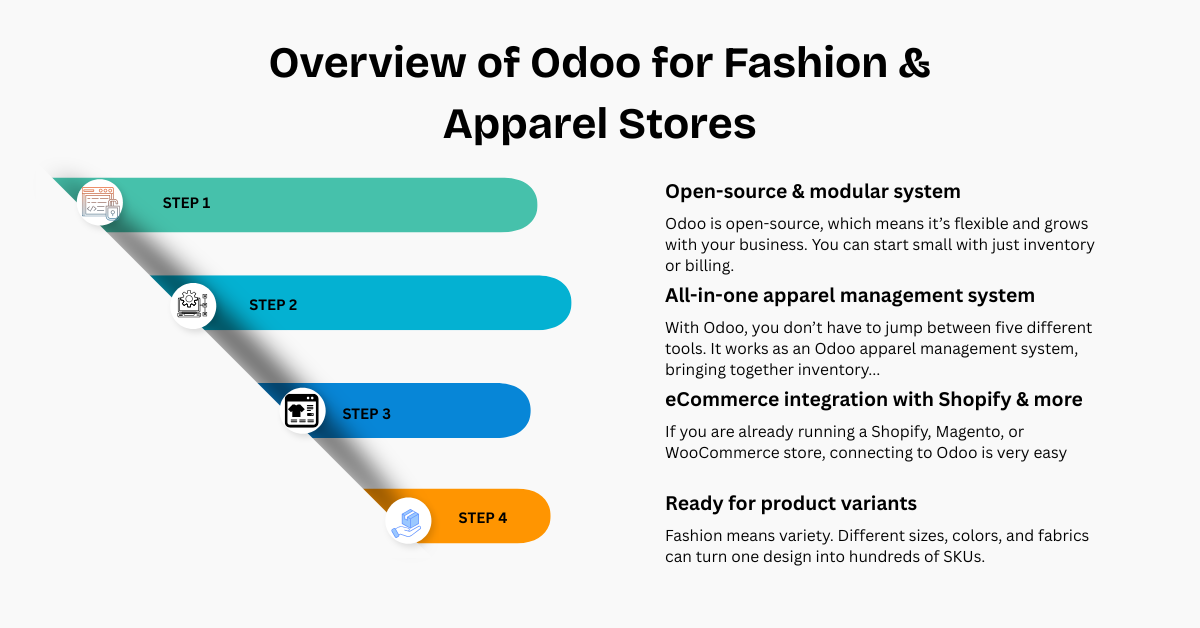
Odoo is open-source, which means it’s flexible and grows with your business. You can start small with just inventory or billing. And later, you can add modules like POS, CRM, or even marketing automation. This way, you only pay for what you need.
With Odoo, you don’t have to jump between five different tools. It works as an Odoo apparel management system, bringing together inventory, eCommerce, accounting, POS, and customer data. For a clothing brand, this means you can track which product sells fast, which size gets returned the most, and which channel gives better sales.
If you are already running a Shopify, Magento, or WooCommerce store, connecting to Odoo is very easy. This Odoo eCommerce integration helps sync your orders, stock levels, and customer details automatically. No more manual updates or overselling products that are already out of stock. In case you need professional help, you can always choose Shopify development services.
Fashion means variety. Different sizes, colors, and fabrics can turn one design into hundreds of SKUs. Odoo handles this smoothly with Odoo product variants for fashion, so you don’t mess up stock management.
Also Read – Start an Ecommerce Business in India
Running a fashion business is not just about launching new collections. Behind every product sold, there’s inventory to manage, returns to process, customers to engage, and reports to study. This is where Odoo fashion eCommerce makes your life easier.
Let’s break down the main features that matter the most for clothing and apparel stores:
When it comes to fashion, you have a lot of options like sizes, colors, fabrics, and styles. One kurta design can easily become 20 SKUs. And if you don’t manage it properly, stockouts or overselling happen. With Odoo product variants, you can track every single variation under one product. Along with Odoo, you can choose to go with a Shopify custom theme development company to make your store beautiful.
Returns are very common in fashion eCommerce, wrong size, wrong color, or just customer preference. If you don’t manage them well, it kills trust.
With Odoo order management, the whole process from “order placed” to “order delivered” is tracked in one place. And when returns or exchanges come, you can process them with a few clicks.
Most fashion businesses don’t sell on just one channel. You might have a Shopify store, a physical outlet, and maybe you’re also on Amazon or Myntra. Managing all separately is a headache.
With Odoo omnichannel, you connect POS, online stores, and marketplaces. Inventory, sales, and customer data are synced. This way, you don’t oversell online while your physical store is also taking orders. Through Odoo eCommerce integration, you get one unified system, making multi-channel sales simple.
Fashion buyers are not all the same. Some are loyal, some only buy once, and some keep returning products. If you treat them all the same, you lose money. With Odoo CRM fashion, you can segment your customers easily. For example, first-time buyers, frequent shoppers, or high-value ones. Then, you can target them differently. No doubt, Odoo helps you with the marketing part to a little extent, but you can also choose the best digital marketing company in Jaipur to reach more customers.
Using Odoo customer segmentation, you make sure your marketing hits the right person at the right time.
Fashion trends change so fast. You can’t always run manual campaigns for every product launch. That’s where fashion marketing Odoo automation steps in.
With Odoo marketing automation, your campaigns run in the background while you focus on new collections.
In fashion, you need to be sure about your business. You need numbers to guide decisions. With Odoo analytics fashion, you can see sales by product, category, or even region. For example, maybe red kurtas sell better in Delhi but black ones in Mumbai. This data helps you plan future collections.
Using Odoo reports eCommerce, you know exactly what’s working and what’s not, no guesswork.
Running a fashion brand in India today is not easy. You’re dealing with new trends every month, bulk inventory, online marketplaces, and impatient customers who want same-day delivery. Managing all this with spreadsheets or basic tools is a recipe for chaos. That’s where the Odoo ERP fashion industry steps in.
Let’s see why it’s becoming the go-to choice for clothing and apparel stores.
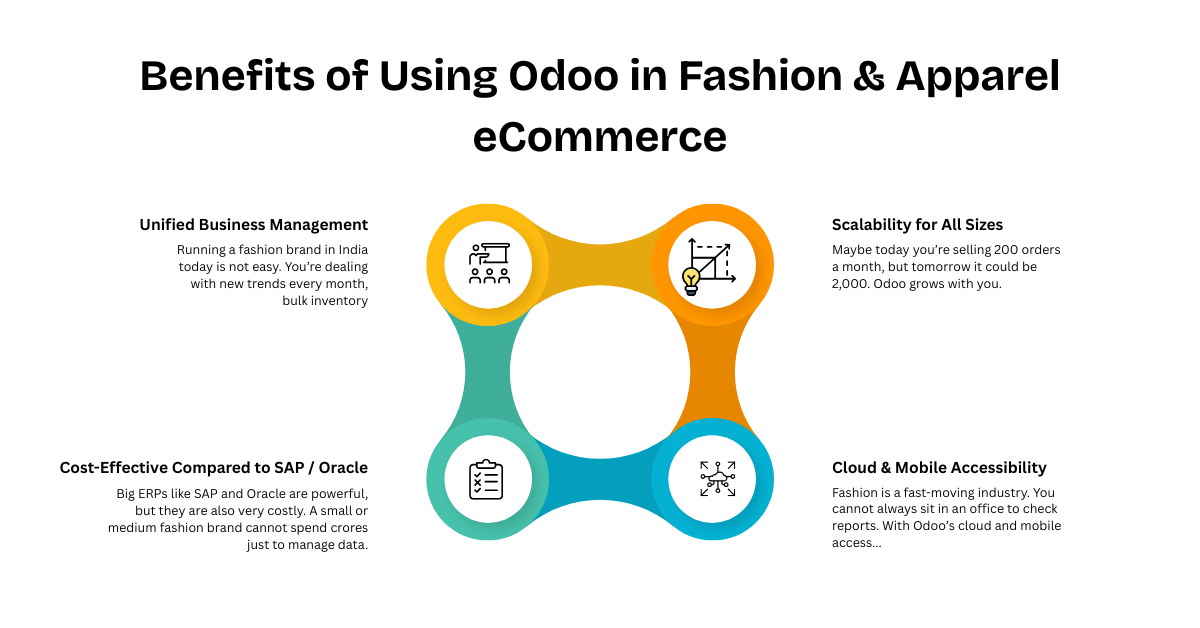
Most fashion brands juggle between multiple tools—one for inventory, another for sales, another for marketing, and one more for accounts. Switching between them is not only tiring but also risky because the data never matches. With Odoo, you don’t need 5–6 systems. It combines everything in one place. For example: inventory, POS, marketing, CRM, and eCommerce. This unified system means less confusion and more focus on sales. And many brands use ERP with Shopify store speed optimization in order to make sure that customers are comfortable using their stores.
Big ERPs like SAP and Oracle are powerful, but they are also very costly. A small or medium fashion brand cannot spend crores just to manage data. Here’s where Odoo gives you the edge. It offers almost the same benefits but at a fraction of the cost. You can start small with only the modules you need and expand later. This flexibility makes Odoo for eCommerce stand out, especially for Indian startups and mid-size brands.
Maybe today you’re selling 200 orders a month, but tomorrow it could be 2,000. Odoo grows with you. A startup can begin with basic inventory and sales modules, while a large enterprise can add advanced analytics, supply chain, and even AI-driven automation. This scalability is the reason why both small D2C brands and big apparel houses rely on Odoo. You don’t have to switch systems as you grow; just add more modules.
Fashion is a fast-moving industry. You cannot always sit in an office to check reports. With Odoo’s cloud and mobile access, you can track stock, orders, or customer activity anytime, anywhere. For example, a store manager can check stock levels from a phone before confirming an order. Or a business owner can view yesterday’s sales report while travelling. This flexibility ensures decisions are faster and more accurate.
Also Read – eCommerce Platforms to Build Your Online Store
When it comes to software, you don’t just want promises, but you want proof. Fashion is a tough business, and unless a tool works in real life, nobody wants to risk their brand with it. That’s why real examples matter.
Let’s look at how Odoo has already made a big difference in the apparel industry.
A mid-size fashion label in India was struggling with inventory. They had 10,000+ SKUs—different sizes, colors, fabrics, and styles. On Excel sheets, it was impossible to track what was in stock, what was out, and what needed to be reordered.
After switching to Odoo inventory management for apparel, the brand could see real-time stock levels across all warehouses and online channels. Automated reordering kicked in for bestsellers, which reduced stockouts by 40%. Their team said the biggest relief was not wasting hours every week on manual updates. Orders became smoother, customers got faster deliveries, and return handling was also simplified.
Another brand, focused on exports, used Odoo ERP clothing business to handle everything. Earlier, their sales, CRM, and accounts teams worked separately. With Odoo, all data was unified.
Within the first year, they reduced order errors by 30% and improved their delivery timelines by almost 20%. For them, the real benefit was global visibility. Every SKU, every customer detail, and every shipment was tracked in one dashboard. That’s how Odoo in Apparel eCommerce helps brands not just in India but worldwide.
These are not just numbers. They are Odoo success stories that apparel brands can relate to. Whether you’re a local boutique or a scaling fashion house, Odoo adapts to your needs. From handling Odoo product variants for fashion to running smooth return cycles, it’s already proven to save time, money, and customer headaches.
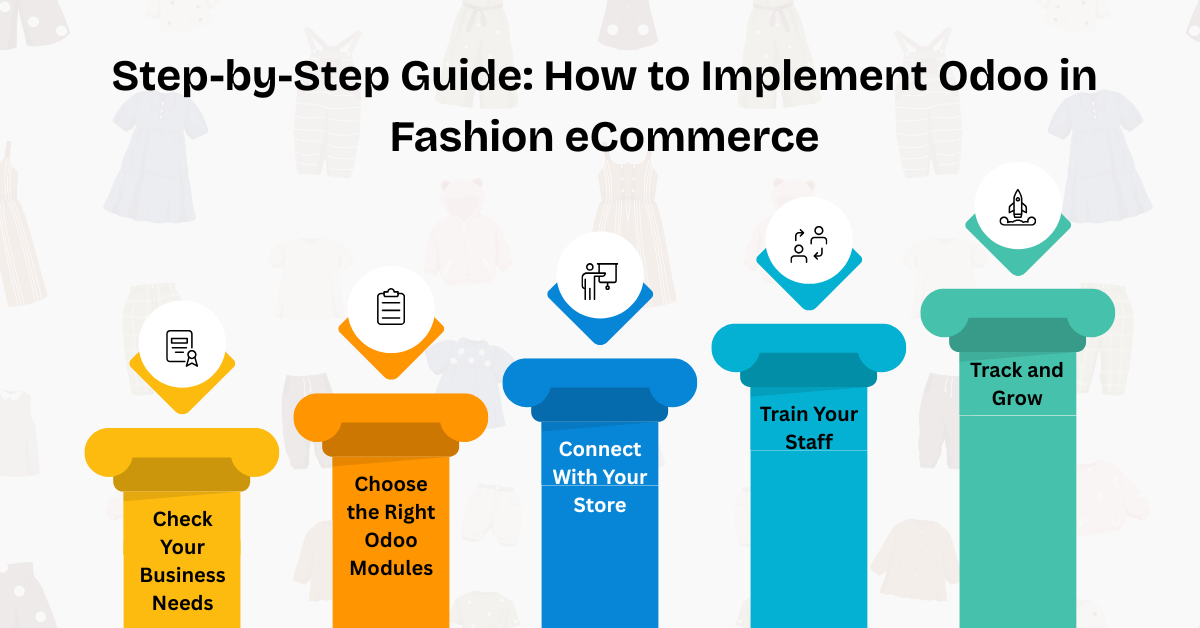
If you’re into fashion eCommerce, you can’t just install Odoo one day and expect magic to happen. You need a proper step-by-step plan. We believe that Odoo is here to help you manage things easily, but you can also work with a Shopify website design company to ensure your store is great when it comes to design.
Here’s how you can bring Odoo fashion eCommerce into your business without getting stuck midway:
Before doing anything, you should sit with your team and write down the main problems. For example: stock running out, no proper customer records, too many returns, or payment issues. Once you know what’s broken, you’ll know which Odoo module will fix it.
You don’t need to buy all modules on day one. Start small. For a clothing business, the most useful ones are inventory, sales, CRM, and eCommerce. Later, you can add things like marketing automation or reports. This is how you keep your Odoo setup appealing and smooth.
Most of you may already be running Shopify, Magento, or WooCommerce. But don’t worry, Odoo connects with them. Once linked, you don’t have to update stock or orders in two places. Whatever sells online gets updated in Odoo automatically.
Software will not work if your people don’t know how to use it. You should train warehouse guys to check stock, the sales team to handle orders, and customer service to manage returns inside Odoo. Training saves a lot of confusion later.
Once Odoo is live, don’t leave it alone. Keep checking reports like what’s selling fast, which items are returned more, and which customers are regular. If you see gaps, add another module or adjust settings. The good thing is, Odoo grows with you, whether you sell 100 products or 10,000.
Also Read – Reasons to Choose Shopify for Your eCommerce Store
In India, the fashion industry is challenging thing. You deal with hundreds of SKUs, fast-changing trends, constant returns, and customers who want everything quick and smooth. If you try to manage all this with scattered tools, you will keep struggling. That’s where Odoo fashion eCommerce makes a real difference.
With Odoo, you don’t have to jump between five different systems. Your stock, orders, returns, marketing, and customer data all stay in one place. For this very reason, many brands are now moving to Odoo instead of heavy and costly tools like SAP. It gives you clarity, saves time, and makes scaling easier. If you’re serious about growth, you should not delay this. Whether you’re a small clothing label or a growing apparel company, Odoo can handle it.
At Appco Software, we are Odoo experts for fashion eCommerce. From setup to custom modules, integrations to training, we make sure Odoo works the way your business needs it. Our Odoo eCommerce services are built for Indian and global fashion brands who want speed, control, and long-term results.
Also Read – eCommerce Website Designs That Boost Sales
Yes, it can. That’s the beauty of Odoo product variants for fashion. You can create all variations, and still manage them under one product. So instead of having 200 separate items, you manage one product with variants. It saves time and avoids stock errors.
Fashion has one of the highest return rates: wrong size, wrong fit, or simply a customer change of mind. With Odoo returns for eCommerce, you can process exchanges, refunds, or credits quickly. The system updates inventory automatically, so you don’t oversell or lose track.
For small and mid-sized brands, yes. SAP and Oracle are powerful but also very expensive and complex. Odoo ERP clothing business is cost-effective, modular, and easy to scale. You pay for the modules you use, and later add more as you grow. That makes it practical for Indian and global fashion startups.
Of course. With Odoo eCommerce integration, you can link to Shopify, Magento, or WooCommerce. And you can also manage orders, payments, and stock moves automatically between systems. That means no double entry, no manual syncing, and less chance of mistakes.
Managing stock in fashion is tough. With Odoo inventory management apparel, you can track real-time stock across warehouses, set auto reordering, and see which products sell best.
Not really. You’ll need experts to set it up properly, but once live, you can manage daily tasks easily. If you work with Odoo experts for fashion eCommerce, they can train your team and customize modules. After that, you run it just like any other software.
With Odoo marketing automation, you can run email campaigns, SMS offers, loyalty points, and personalized promotions. You also track who opens, clicks, and buys. This way, you don’t just sell once, but you bring customers back again and again.
Yes. Many global fashion brands use Odoo in apparel eCommerce because it supports multi-currency, multi-language, and multi-warehouse operations. If you’re planning to sell worldwide, Odoo is future-ready with built-in tools for international trade.