Free Audit Report →
⚡ eCommerce Growth Case Study · India · Jan–Mar 2026

From ₹0 to ₹1.62 Crore in One Quarter.

How we scaled a D2C clothing brand on Shopify to 3,619 orders, 24% revenue growth, and a 25% returning customer rate — using performance marketing, CRO, and smart funnel strategy.

D2C clothing brand on Shopify
₹1.62 Cr +24% Gross Sales
3,619 +14% Total Orders
₹69.5L +28% Net Sales
25% Returning Customers
02 · CLIENT OVERVIEW

The Brand Behind the Numbers

Before we get into the numbers, here is who we are talking about.

This d2c clothing brand case study is about an Indian women's wear label that operates online only. There are no physical stores. They sell ethnic and fusion outfits through their Shopify store. Mostly to urban women between 22 and 40 years old. The catalog goes from kurtas to co-ord sets to occasion wear, priced anywhere between ₹800 and ₹4,500.

What you have here is basically a d2c fashion brand that figured out the product side early. The styles connected with customers. Fit was on point. Repeat customers were coming back without much push from the brand. So on paper, things were going well.

But here is where it got messy. Being a direct to consumer clothing brand on Shopify was working for them, just not at the scale they were aiming for. The growth chart remained flat in places it should have been climbing. That is when they came to us.


D2C Ecommerce Women's Fashion Shopify India Performance Marketing Meta Ads Google Ads
IndustryFashion / Apparel (D2C)
PlatformShopify
LocationIndia (PAN India Delivery)
Target AudienceUrban Women, 22–40 yrs
Avg Order Value₹1,920
Campaign PeriodJanuary – March 2026
Channels ManagedMeta · Google · Email · SEO
03 · THE CHALLENGE

Good Product. But Broken Funnel.

When this d2c clothing brand came to us, the product was already doing its job. The catalogue was solid. Organic traction was building on its own. But the revenue side of things was leaking from too many places at once.

Here is what we found when we opened the hood.

↩️

Alarming Return Rate

Returns were running neck and neck with gross sales. That gap was eating into net revenue and killing the margin completely.

📉

Revenue Inconsistency

Sales spiked around every promotion, then dropped off right after. Too much reliance on discounts. No organic engine running underneath.

👤

Low Customer Retention

First-time customers were not coming back. There were no email flows, no loyalty hooks, and no system in place to re-engage them later.

🔧

Inefficient Ad Funnel

Ad spend was scattered with no real structure. Cold traffic landed straight on the homepage. Landing pages were not built to convert.

04 · Our Strategy

A 6-Pillar Growth Blueprint for D2C Brands

This d2c clothing brand case study walks through the exact plan we used. We built a full-funnel growth strategy where every pillar fixed one specific revenue leak or pushed one specific growth lever. The same playbook works for most d2c clothing brands in India when scaling becomes the goal.

01

Performance Marketing

  • Restructured Meta Ads into full TOFU–MOFU–BOFU funnel
  • Launched Google Shopping campaigns with feed optimisation
  • Deployed Advantage+ Shopping campaigns for scale
  • Weekly creative testing with a defined kill-rule framework
02

SEO & Organic Growth

  • Category and collection page SEO for high-intent d2c fashion brand keywords
  • Schema markup for product rich snippets on Google
  • Long-tail blog content targeting searches around indian d2c fashion brands
  • Technical Shopify SEO audit and site speed improvements
03

Funnel & CRO Optimization

  • Dedicated landing pages for paid traffic
  • Exit-intent pop-ups to reduce drop-off
  • Sticky add-to-cart and mobile UX improvements
  • Size guide optimisation to reduce returns (a known issue for any d2c apparel brand
04

Retargeting & Retention

  • Warm audience retargeting via Meta
  • Post-purchase email flows
  • Loyalty programme setup
  • Cart recovery via SMS and WhatsApp
05

Return Rate Management

  • Return analysis by SKU
  • Improved product photography
  • Pre-shipment quality checks
  • Clear size charts
06

Discount & Offer Strategy

  • Value-based discount strategy
  • Bundle offers to increase AOV
  • Seasonal sale planning
  • Free shipping thresholds
05 · Execution

From Strategy to Sales: Our 90-Day Playbook

Strategy is empty without execution. Here is how this d2c clothing brand case study moved from diagnosis to results across 90 days.

  1. 01

    Full Audit & Baseline Benchmarking (Week 1)

    We dug into Shopify analytics, Meta Ads Manager, Google Analytics, and returned dashboards line by line. Pulled out the top 3 return-causing SKUs and worst drop-off pages in this clothing brand's checkout. Locked KPI benchmarks for 90 days.

  2. 02

    Campaign Restructuring & Creative Refresh (Week 2–3)

    Shut down 11 ad sets that were burning money. Rebuilt Meta campaigns with proper cold, warm, and retargeting audiences. Made 18 new creatives across static, carousel, and Reels. Plugged Google Shopping in with an optimised product feed.

  3. 03

    Landing Page & Shopify CRO (Week 3–5)

    Built 4 new collection-specific landing pages so paid traffic stopped going to the homepage. Installed heat-maps to spot friction. Added urgency cues, trust badges, and tightened the 3-step mobile checkout.

  4. 04

    Return Rate Intervention (Ongoing from Week 3)

    Went through 1,200+ return reasons. Found 47% were size mismatch issues, a known pain for any d2c clothing brand. Reworked every size guide, added fit model images on top SKUs, and rolled out pre-dispatch quality checks with fulfillment.

  5. 05

    Email & WhatsApp Retention Automation (Week 4–6)

    Built a 7-step post-purchase email flow, abandoned cart SMS, and browse abandonment WhatsApp triggers. Set up a loyalty tier with early drop access, like top d2c fashion brands in India . Returning customer rate climbed from 18% to 25%.

  6. 06

    Scale & Optimise Loop (Week 6–12)

    With fundamentals stable, we doubled the budget on winning ad sets weekly. Brought in Google Performance Max. Ran a festive collection mid-quarter that pulled 22% of the clothing brand's quarterly orders in a single 9-day window.

06 · RESULTS

From Plan to P&L: The Q1 Outcome

Here is what Q1 2026 looked like for this d2c clothing brand after a full quarter with us, compared to the prior quarter.

Use all the stats as it is here

₹1.62 Cr
↑ +24% YoY
GROSS SALES
₹72.9L
↑ +28% Growth
TOTAL SALES
3,619
↑ +14% Orders
TOTAL ORDERS
₹69.5L
↑ Strong Net
NET SALES
25%
↑ From 18%
RETURNING CUSTOMERS
₹4.99L
Controlled Spend
DISCOUNTS GIVEN

UNDERSTANDING GROSS VS NET SALES: A NOTE ON TRANSPARENCY

You may notice gross sales (₹1.62 Cr) and returns (₹1.61 Cr) are close to each other. Gross sales reflect full GMV, while returns hold the cumulative value across the catalogue history. Net sales of ₹69.5L is the real revenue this d2c apparel brand kept after returns and discounts.

WHY THE RETURN RATE SIGNALS OPPORTUNITY, NOT FAILURE

A high return rate is not unusual for a d2c fashion brand. What matters is the trajectory. Better size guides, sharper visuals, and tighter QC systems will keep compounding results quarter after quarter for any Indian d2c fashion brand at this stage.

07 · KEY INSIGHTS

What the Data Taught Us

Beyond the headline numbers, here is what this d2c clothing brand case study revealed. These learnings are now shaping our growth playbook for d2c clothing brands in India.

🛍️

Discount Discipline Drives Healthier Growth

₹4.99L in discounts pulled in 3,619 orders, which is disciplined spending. Brands that lean on blanket discounts see order spikes and margin collapse together. Our offer calendar was tied to collection launches, not desperation. So this d2c apparel brand ended up with higher net revenue per order and better customers, not just deal-hunters jumping in for the lowest price.

🔁

25% Returning Customer Rate

One in four customers came back inside the same quarter. With CAC climbing every month, the returning customer rate is the single most honest profitability number. We pushed it from 18% to 25%, almost fully through the post-purchase email flows and WhatsApp reactivation sequences set up in month one.

📦

Returns Are a Product Page Problem

Our return analysis showed 47% of returns came from size expectations not lining up with reality. This is a content and UX issue, fixable on the product page , not in the warehouse. For a direct to consumer clothing brand, better photography, sharper size charts, and real social proof are the highest-leverage tools to bring returns down.

📈

Jan–Mar Seasonality Creates a Natural Growth Window

Q1 is an underrated window in Indian fashion D2C. Brands that plan ad spend and inventory for this stretch outperform the ones treating Jan–Mar as a recovery quarter. Top d2c fashion brands in India already lean into this seasonality early.

08 · BEFORE VS AFTER

The Transformation at a Glance

A detailed side-by-side of where this d2c clothing brand started and where our Shopify growth strategy took them in just one quarter.
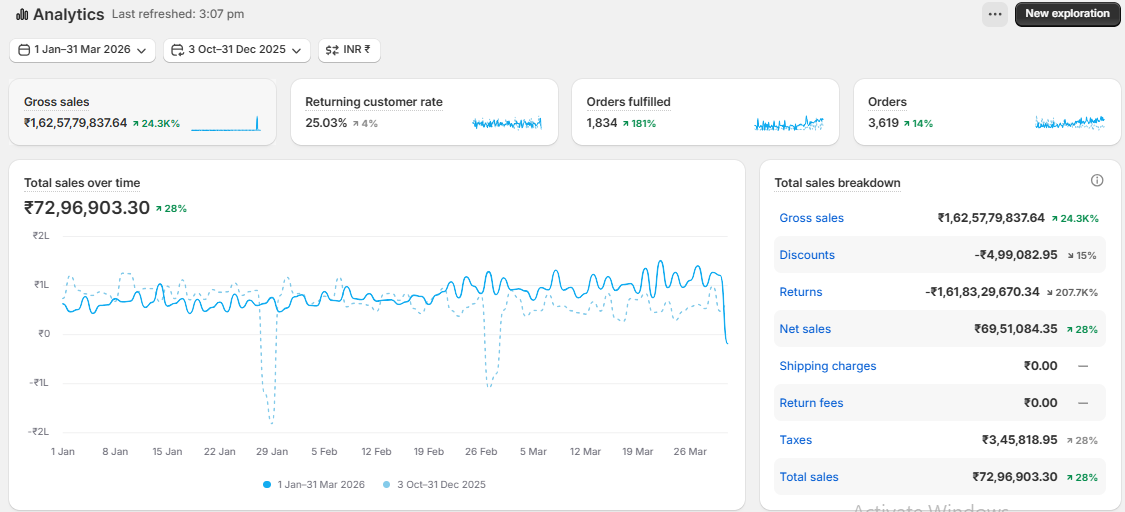
Analytics Report
METRIC / AREA ❌ BEFORE ✅ AFTER
Gross Sales ~₹1.3 Cr (est.) ₹1.62 Cr (+24%)
Net Sales ~₹54L (est.) ₹69.5L (+28%)
Orders Per Quarter ~3,180 3,619 (+14%)
Returning Customer Rate ~18% 25% (+7 pts)
Ad Campaign Structure Scattered, no funnel Structured TOFU–MOFU–BOFU
Post-Purchase Flow None 7-step email + WhatsApp automation
Landing Pages Homepage only 4 collection-specific pages live
Return Root Cause Analysis Not tracked Tracked, size guide improved
SEO Visibility Minimal Schema, collections + blog SEO live
9 · READY TO SCALE?

Want Similar Growth for Your Brand?

We help Indian d2c fashion brands turn good products into Shopify businesses that truly scale. Performance marketing, CRO, and retention systems that compound quarter after quarter. Same playbook we used in this d2c clothing brand case study.

🚀 Book Your Free Growth Strategy Call
No-obligation consultation D2C & Shopify specialists Data-driven, transparent reporting Results or we don’t celebrate

FAQs: D2C Clothing Brand Case Study

To start a clothing brand in India, register your business, find fabric vendors, build a Shopify store, run small ad tests. Most d2c clothing brands in India begin this way.

Scaling a d2c clothing brand generally takes 6 to 12 months of steady work. Performance marketing, retention flows, and CRO need time to compound before real revenue stability shows up.

You need around ₹3 to ₹5 lakhs to launch a small d2c fashion brand. In this budget, you will cover inventory, Shopify setup, photography, and the first round of paid ad testing on Meta.

Most direct to consumer clothing brands lean too hard on discounts. It spikes orders short term but kills margin. Build retention systems first, then run promotions tied to drops only.

Not always, but a d2c apparel marketing agency case study shows the difference. Agencies bring structured ad funnels, retention setups, and CRO systems that solo founders rarely build alone successfully.

Top d2c fashion brands in India focus on retention, not just acquisition. They invest in email flows, WhatsApp loyalty, sharper product pages, and a steady drop calendar over short-term spikes.