India’s ecommerce industry crossed ₹10.82 lakh crore in 2024 and is projected to grow at 17% to 22% annually through 2026. That means there has never been a better time to sell online in India.
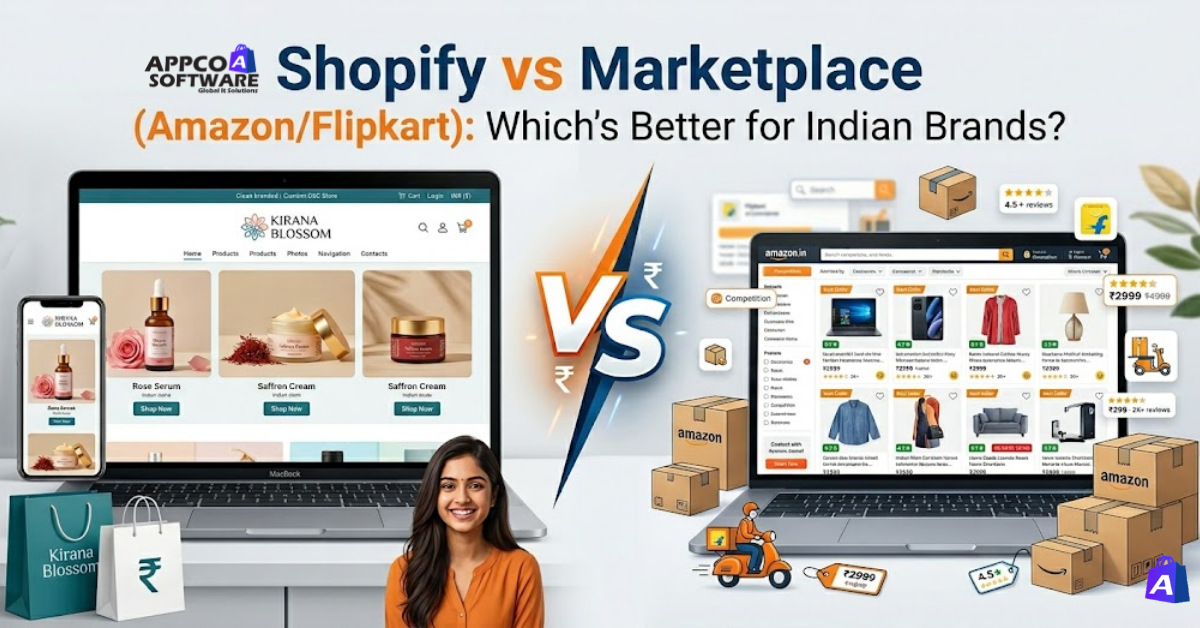
But here is the question every brand eventually faces: should you build your own store or sell on Amazon and Flipkart? The Shopify vs marketplace debate is one that thousands of Indian brand owners are having right now, and getting it wrong is expensive either way.
The D2C sector is growing at 40% CAGR and is expected to cross $60 billion by 2027. D2C vs marketplace in India is not just a platform question. But it is a business model question.
One path gives you control, data, and margin. The other gives you traffic and logistics support. Both have trade-offs. And the decision you make early shapes how your brand grows for the next three to five years.
Shopify is a hosted ecommerce platform that lets you build and run your own online store. Which is completely branded, fully under your control. You own the website, the customer data, the checkout experience, and the relationship with the buyer. Nobody else’s logo is in your store. Nobody else’s algorithm decides who sees your products.
Our Shopify store development services set up everything a brand needs to launch properly. Like custom design, payment gateway integration for Indian customers, product catalogue structure, and a checkout flow built to convert. Shopify is the platform of choice for D2C brands precisely because it gives you a real business asset. Not just a seller account someone else controls.
The benefits of Shopify for brands are most visible in the long run. You build a mailing list. You retarget your customers. You control your pricing without worrying about a competitor undercutting you by two listings below yours. Shopify is not just a store. But it is the foundation of brand-building ecommerce that compounds over time.
A marketplace, on the other hand, is a platform that hosts many sellers and buyers in one place. Amazon and Flipkart are two great examples in India. As a seller, you list your products on their platform, they handle the discovery and often the logistics, and in exchange, they take a commission on every sale plus additional fees.
The appeal of the ecommerce marketplace vs the own website model is clear for new sellers. You do not have to drive your own traffic. Amazon and Flipkart have hundreds of millions of active users. Your product can be found by someone who has never heard of your brand. There is a built-in trust factor. And with Fulfilment by Amazon (FBA) or Flipkart’s own fulfilment network, logistics is largely handled for you.
The challenge is that Amazon seller vs own website economics are very different. On Amazon, you are one of many listings for the same category. You compete on price, rating, and ad spend. Not on-brand story or design. Flipkart is similar. You are a supplier to their platform, not a brand building a direct relationship with your customer.
Read More – How to Build a Website Like Amazon?
Before going deeper, here is the side-by-side view. This is the ecommerce platform comparison in India that matters most for brand owners in 2026:
| Feature | Shopify | Amazon / Flipkart |
| Ownership | Full control | No control |
| Branding | Strong, fully custom | Platform branding dominates |
| Traffic source | Self-generated (SEO, ads) | Built-in marketplace traffic |
| Fees | Monthly subscription plus apps | Commission 5% to 35% per sale |
| Profit margins | Higher (no per-sale cut) | Lower (fees reduce margin) |
| Customer data | Full access | Restricted or zero access |
| Brand building | High | Very limited |
| Long-term asset | Yes | No |
Also Read – How Much Does It Cost to Build an eCommerce Platform on Shopify Plus?
This is where the difference starts. On Shopify, your store is your identity. You decide how everything shows up. Like logo, colours, product layout, and even checkout. People remember your brand. On marketplaces, things change. In Flipkart vs Shopify for brands, the platform always comes first. The customer says, “I bought it on Amazon,” not your brand name. That’s where the Flipkart seller’s disadvantages begin. You don’t control the presentation fully. You’re just one seller in a list.
Now, when you compare sales on Amazon vs Shopify in India, traffic works very differently. Amazon and Flipkart already have millions of buyers. You can list a product today and get orders tomorrow without a single rupee spent on ads. Though in practice, you almost always need to spend on sponsored listings to get meaningful visibility. Our performance marketing services handle exactly this. Our team can help you in setting up Meta Pixel, Conversions API, and Google Ads correctly so every rupee you spend on driving traffic to your Shopify store is tracked accurately and optimized properly.
This is where marketplace fees in India hit hard. You have to pay referral fees, closing fees, ads and logistics; everything cuts your margin. When you do a Shopify vs Amazon profit margin comparison, Shopify normally costs less per order if ads are managed well. You pay the payment gateway and marketing, but you avoid heavy platform cuts. Over time, this difference becomes huge.
This is where D2C vs marketplace in India becomes serious. On Shopify, you get customer data like email, phone and order history. You can retarget, send offers and build loyalty. On marketplaces, you get none of this. You know an order was placed. You do not know who placed it, how to contact them, or what else they might want to buy from you. That’s why Amazon seller vs own website is not just about sales, it’s about ownership. With proper Shopify conversion rate optimization services, that data turns into repeat sales.
Flipkart vs Shopify for brands looks very different when you consider what happens when a competitor enters your category. On Flipkart or Amazon, a new seller can undercut your price by ₹50 and steal your Buy Box or your top listing position overnight. You have no defence except matching their price or spending more on ads. The race to the bottom on marketplaces is real, and many Indian brands have felt it. On Shopify, you control your pricing completely. You are not listed next to twenty competitors selling the same thing. A customer who opens your store came there because of your brand, your content, or your ad. Brand-building ecommerce on Shopify means you compete on value and trust, not just price.
The Amazon seller vs own website logistics comparison is fair. Amazon and Flipkart make fulfilment much easier, especially at the start. FBA and Flipkart Advantage handle warehousing, picking, packing, and delivery. Returns are also managed by the platform. On Shopify, you need a third-party logistics partner. Companies like Shiprocket, Delhivery, or Pickrr that integrate directly with Shopify. It is more work to set up, but it is also not complicated once it is running. And you get full control over how orders are packed, how they are presented to the customer, and how returns are handled.
Read More – The 10 Best Warehouse Management Systems for Shopify Stores
The most important question in the ecommerce marketplace vs own website debate is not which one gets you sales faster. It is which one builds something that compounds? A Shopify store is a business asset. Every customer you acquire, every email you collect, every SEO article that ranks and every returning buyer. All of these belong to your brand and increase in value over time. A marketplace seller account is not an asset in the same way. It depends entirely on the platform’s algorithm, fee structure, and policies. All of which can change without notice.
Read More – Top 10 Ecommerce Website Design Trends for 2026
| Pros | Cons |
| Full brand ownership and control | You generate your own traffic |
| Higher profit margins. No per-sale platform cut | Set up effort upfront (development, payment gateway, logistics) |
| Complete customer data access for retention and retargeting | Takes time to build organic SEO traffic |
| Builds a long-term business asset | |
| Pricing control with no competitor pressure on the same page |
| Pros | Cons |
| Built-in traffic from day one | High Flipkart seller disadvantages on margins, fees eat 25% to 35% of revenue |
| Logistics support through FBA and Flipkart Advantage | Zero customer data access for retention |
| Built-in trust, buyers already trust the platform | Platform controls your brand identity, pricing environment, and listing visibility |
| Dependency risk, algorithm changes and policy shifts can impact sales overnight |
This is the most practical path for Amazon vs Shopify for beginners in India.
This is TOFU. The top of the funnel market testing with the platform’s traffic doing the heavy lifting.
Once you know the product sells and you understand who your buyer is, build your Shopify store. Our Shopify store rebuild and redesign services are specifically useful here. If you have been selling on marketplaces and are finally building your own store, we start from your brand identity and build a store that converts cold traffic. You now own the customer relationship and can invest in building something that does not disappear if your Amazon ranking drops.
If you want to sell on Amazon vs Shopify in India, it depends on where you are right now, not where you want to be.
And for Flipkart vs shopify which is better for D2C brands specifically, Shopify is the right long-term answer almost every time. D2C brands that stay on marketplaces permanently give up margin, data, and brand control. The ones that win build their own Shopify store and use marketplaces as one of several acquisition channels, not the only one.
Here is the most important thing you need to understand. That ecommerce growth in India in 2026 is increasing a lot. But not every brand will benefit the same way. You will notice that brands that own their customers are the ones growing stronger. Others stay dependent on platform rules.
You should think in a practical way here. Instead of choosing one side, you use both. Amazon and Flipkart help you get visibility and test demand. Shopify helps you build repeat buyers, better margins, and your own brand space. That’s how Shopify vs marketplace pros and cons balance out. One brings volume, the other builds long-term value.
You can also simplify operations if the setup is done properly. With our Shopify custom app development, you can connect your store with marketplace accounts. You can sync inventory, manage orders in one place, and handle follow-ups automatically.
If you have decided Shopify is the right option for you. Or if you are running both channels and need your own store to finally perform, Appco Software is the team built for this.
For brands rebuilding or launching from scratch, our Shopify store rebuild and redesign services start with your brand identity and build a store that looks like a brand.
And for brands that need custom functionality, marketplace inventory sync, WhatsApp integration, or a loyalty engine built for your product catalogue, our Shopify custom app development team builds exactly that.
You need to look at your goal first. If you want quick sales, Amazon helps because traffic is already there. But if you want control, better margins, and your own customer data, Shopify is the perfect choice then.
You can, and in fact, you should. Because marketplaces bring new customers. Shopify helps you turn them into repeat customers. With proper setup, inventory and orders can be managed together.
You will see better margins on Shopify. Marketplace fees can go up to 25% to 35%. On Shopify, costs are lower if ads are handled properly.
You can start easily on Flipkart. But long-term, fees and a lack of customer data become a problem here. But as a new seller, you can go with Flipkart.
On the marketplaces, you don’t get customer data, margins are low, and platform rules can change anytime.
Appco Software has been around for a very long time, helping startups and established brands build iconic websites and apps. For your unique idea to be presented in a beautiful way, contact us now!