Running a wholesale business is not like running a D2C store. Your buyers are completely different. And the order quantities are much larger. Pricing is always fixed in advance. And your relationship with the buyer lasts for months or years. So basically, one single order is never the full picture here.
B2B Shopify store development completely changes how your wholesale buying happens. And Shopify B2B website development is exactly what people search for when they want this setup. You give them approved buyer accounts. And you set per-account pricing. Bulk order forms and payment terms are handled right on the platform, actually.
So if you are already planning to build this, talking to a custom Shopify development services team early saves you from doing things twice. Basically, this guide covers 10 features every wholesale Shopify store needs. And how you can make the right decision for your build.
A standard Shopify store is built for consumers. One price for everyone. A B2B Shopify store is built for businesses. The difference goes deeper than a gated catalog.
Buyers register and wait for approval before they see pricing or place orders. Once approved, each account logs in and sees their agreed price and their assigned catalog. Order history is right there too. Self-service is the point. Reordering and shipment tracking happen without your sales team involved every time.
Makers selling to retailers. Firms managing accounts across cities. Importers handling bulk corporate buyers. Any business where the buyer is also a business and pricing varies by account. If your current process runs on email threads and manual price calls, a B2B eCommerce website development project is worth your time.
Fewer manual orders means less admin work. Self-service reordering means buyers come back on their own. And with stock and buyer data on one platform, you stop doing manual data matching every week.
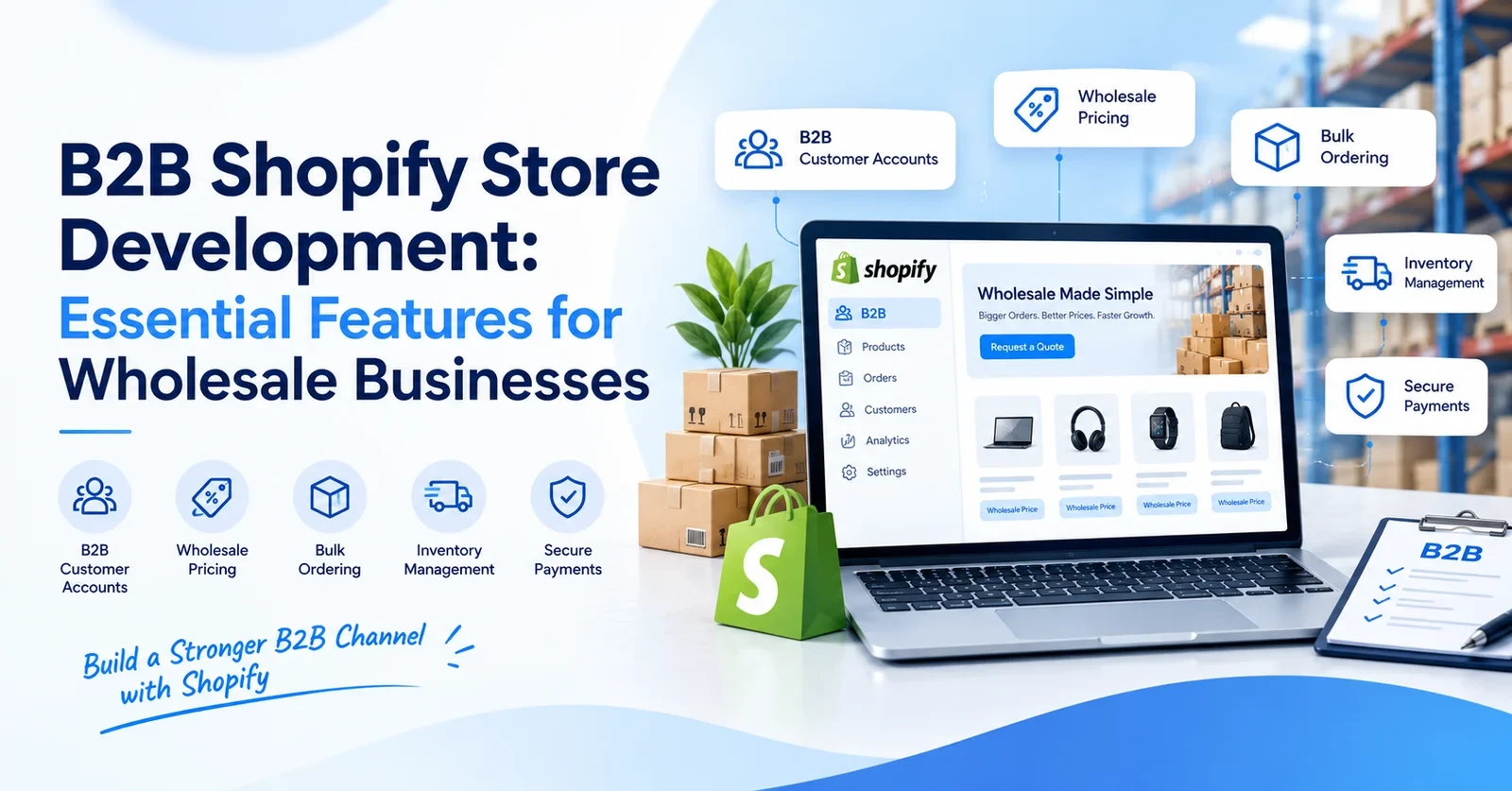
These features separate a proper Shopify wholesale store development project from a D2C setup with a bulk-order app added on top. Each one addresses a real gap in how standard platforms handle wholesale buying. This is what Shopify development for wholesale businesses looks like in practice.
Wholesale pricing is never the same for everyone, for example. Because a long-term distributor taking 500 pieces will ask for different rates. Compared to a new account placing their first order. And Shopify B2B development manages this through customer tags and access rules. So basically, each buyer only sees their agreed price. And their approved product list. That is all they see.
B2B buyers already know what they want. They need to add 10 to 20 SKUs in different quantities in one go, actually. Because opening every product page one by one is not how they work. So, in short, order forms let buyers search by SKU directly. Enter amounts for many items together. And just submit the whole order at once. It saves real time on every repeat purchase.
MOQs always protect your margins. Without them, a wholesale Shopify store is just a retail store selling at lower prices. And volume discounts are the other side of this. Order 100 units, you get one rate. Order 500 units, you get a much better rate. So, a proper B2B build applies these rules on its own, without checking every order manually.
See, every wholesale buyer needs their own separate account. Not just a shared login. Because a proper buyer portal shows their approved payment terms and saved addresses. Order history is also there. And role-based access really matters here. Because some buyers have two contacts. One person approves the order, and the other person places it.
Wholesale buyers never pay at checkout by card. Net 30 and Net 60 days are standard in the market. And some accounts run on advance deposit terms. So, a custom Shopify B2B store supports PO number capture easily. And invoice-based payment flows too. With part-payment options if needed. The exact setup just depends on your plan. And whether custom code is used.
Wholesale buyers order the exact same products again and again. If every reorder starts from zero. Your platform is adding friction that your competitor will take advantage of. So, saved order templates and one-click reordering from history fix this problem. And your buyers keep coming back on their own.
A standalone Shopify store is fine for small firms. But growing wholesale firms have stock in one system and buyer data in another. B2B Shopify store development covers API links with your ERP like SAP, Tally, or Zoho. And your CRM also. So one data flow replaces all the manual matching work. But remember, ERP integration is where things get expensive. So scope it out before the work starts.
Wholesale firms deal with things that retail stores do not see. Tax exemption papers and state tax rules are the biggest hurdles. And for global customers, you need multi-currency support and cross-border rules. In short, these are decisions you make early in the build. Because you cannot just add them cleanly after the website is completely done.
Buyers always check their orders on phones now. And a catalog that loads slowly or breaks on a small screen will cost you real orders. So, Shopify speed optimization handles your images. And controls the load speed across all devices. This means your store keeps running fast. Even when your catalog grows big.
Wholesale buyers always check vendors before making contact. And a well-indexed store with proper Shopify SEO services is a must. Because it means your business shows up when buyers search for wholesale vendors. And analytics close the loop completely. You track which buyer groups are active. And which products are moving the fastest. Even drop-off patterns are worth watching here.
A B2B vs B2C eCommerce website comparison is all about: who is buying and how they expect to buy. Many wholesale firms still run on phone orders or old ordering systems with no self-service option. Both put the full load on your internal team. That does not scale.
| Comparison point | Traditional system | Shopify B2B store |
| Ordering | Manual, phone or email | Online self-service, 24/7 |
| Pricing | Set manually per account | Automated, account-level rules |
| Operations | Separate tools, manual data matching | Integration-ready, one platform |
| Scalability | Requires rebuilding as volume grows | Platform scales with the business |
| Maintenance | Internal IT or vendor lock-in | Platform plus apps plus dev support |
For growing wholesale firms, a Shopify B2B store returns value fast. The right option depends on your workflow and how much your buyers prefer self-service.
Standard Shopify is enough for most stores out there. You can do plenty of things. But the final decision depends on your order volume and your daily workflow.
Firms with simple pricing and a smaller buyer base can easily manage on Standard Shopify Plans. A few apps and some custom code can cover the rest of your needs. The native feature set is narrower here. But for many wholesale operations, it is more than enough to run the business.
Shopify Plus includes native B2B features. So company accounts and buyer portals come built right in. Along with more detailed pricing tools that completely cut down on your app reliance. And for firms managing many wholesale accounts or complex tier pricing, Shopify Plus development is definitely worth your time. The monthly cost is higher. But the native options you get are much greater.
ERP and CRM links will always require custom API work on any Shopify plan. Because the plan only sets your native feature floor. And the actual development builds everything above it. So, you must know which parts of your wholesale workflow need native features. And which parts need custom code before you commit to any plan. That is exactly why your development partner should map this out for you before the build even begins.
The B2B eCommerce website development cost always varies by your exact scope. Because there is no standard rate card in the market. And if any agency gives you a price without checking your setup, you need to be very careful.
So, store design is just your starting point here. Custom pricing logic and buyer portal work come right on top of that. But the ERP or CRM link is exactly where the costs jump, actually. Because some firms need a deep custom integration. While others just need a simple middleware connector. And data migration plus post-launch support also add to your final bill.
A basic B2B setup using regular apps starts at the lower end. But a fully custom Shopify B2B store development with deep ERP links and complex tier pricing is a completely different scale of project. So, you should always ask for a properly scoped quote. Before you commit your money to anything.
The agency you hire shapes the outcome more than the platform you choose. A team with real B2B experience approaches the build differently from one adapting a consumer store template.
Questions to ask:
If you are planning to outsource Shopify development to an expert agency in India, check that their portfolio includes B2B or wholesale projects. D2C consumer work does not tell you what B2B development needs. If you want Appco Software Shopify experts handling the development part, check the portfolio for B2B and wholesale projects first.
Appco Software is one of the best Shopify development companies in India. We have been in this exact business for over 13+ years. Appco Software services cover the complete process, right from the initial architecture to the post-launch support. So, wholesale and B2B development is a very regular part of our work.
In practice, this means building buyer portals that your accounts can navigate easily, without ever calling your team. And setting up pricing logic that exactly matches your agreed terms. Plus ERP and stock links that keep your data perfectly consistent. So, you get a store built for speed and search from day one.
Let us build a wholesale buying experience that is tailored exactly to your pricing model and your ordering workflow. Just discuss your project with us. And if your ordering process needs a phone call or a price email, we will just find a vendor whose process does not. So, a properly built B2B Shopify store is the exact difference. Between a buyer coming back on their own and you chasing every single order. Just get the features right from the start.
It is a Shopify store built strictly for business buyers rather than retail customers. Because approved accounts and per-account pricing are exactly what set it apart. And buyer portals plus bulk ordering just come with that setup.
Yes, absolutely. Many wholesale businesses already run on Shopify. It easily supports wholesale features through native tools and third-party apps. And you even get custom development paths for those complex setups.
It needs much more than people expect. Per-account pricing and buyer portals are the main core features. But MOQ rules, ERP links, and your store speed matter just as much.
Customer tags and tiered pricing rules easily handle this on standard Shopify. And Shopify Plus gives you native B2B pricing with much finer tier control, actually. But for highly complex structures, custom development is exactly the answer you need.
It totally depends on your build. Standard apps handle basic MOQ rules without any issue. But for complex amounts of rules across a very large product catalog. So, custom development is always the cleaner path here.
Shopify’s API connects directly with SAP, Zoho, and other platforms. Through custom code or simple middleware. And the depth of this link just depends on how closely your systems need to share data.
Not always. Standard Shopify with the right apps handles all the core Shopify wholesale functionality. And Shopify Plus just adds the native B2B tools right on top of that.
It completely varies. Because a basic setup always costs less. But a full custom build with deep ERP integration can easily go much higher. So, you should always ask your development team for a properly scoped quote.
Error: Contact form not found.

Appco Software has been around for a very long time, helping startups and established brands build iconic websites and apps. For your unique idea to be presented in a beautiful way, contact us now!