
When you sit down to plan your website in 2026, one big question comes in front of you: custom website vs template website. Many of you think one option must be clearly better. But that’s not the right way to choose. Because website development is different for each project. The right choice depends on your budget, your timeline, and features.
You also have to see what your website is supposed to do. Like:
In today’s digital space, your website is not just a design project. It is the base of your online business. If this base is weak, everything else becomes difficult.
A custom website is built from scratch specifically for your business – every single line of code, every design element, every feature is created uniquely for you. In the custom development, pre-made templates are not used in any form. But custom website development services start with understanding your brand, your customers, and your business goals. And then building a digital solution according to your business needs.
For example, platforms like Netflix, Airbnb, or Amazon are totally custom-built. Because these are custom-coded platforms built to handle specific, complex requirements that no template could support. For Indian businesses, companies like Zomato, Swiggy, and Flipkart all run on custom-built platforms. Because they needed functionality that is not possible to achieve in prebuilt themes.
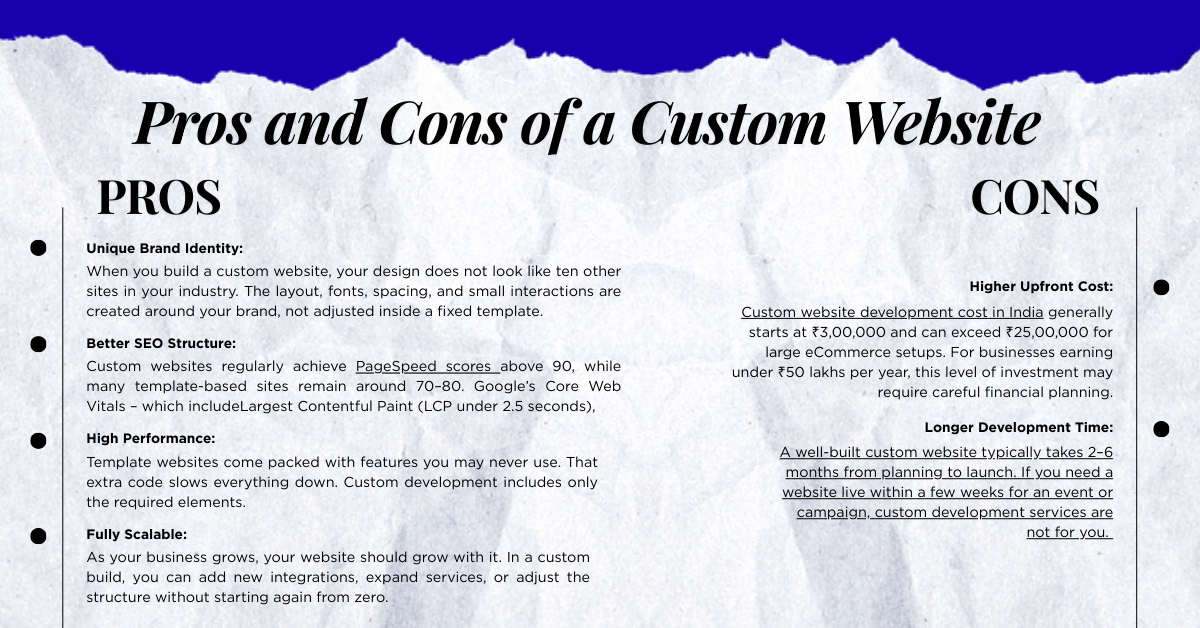
On custom websites, you can make so many changes according to your business needs. Because you have so much flexibility and scalability.
For example, if you:
All of that is possible with custom eCommerce website development. Because you’re not limited by what a template designer thought people might need.
Also Read – Top eCommerce Business Ideas to Start in 2026
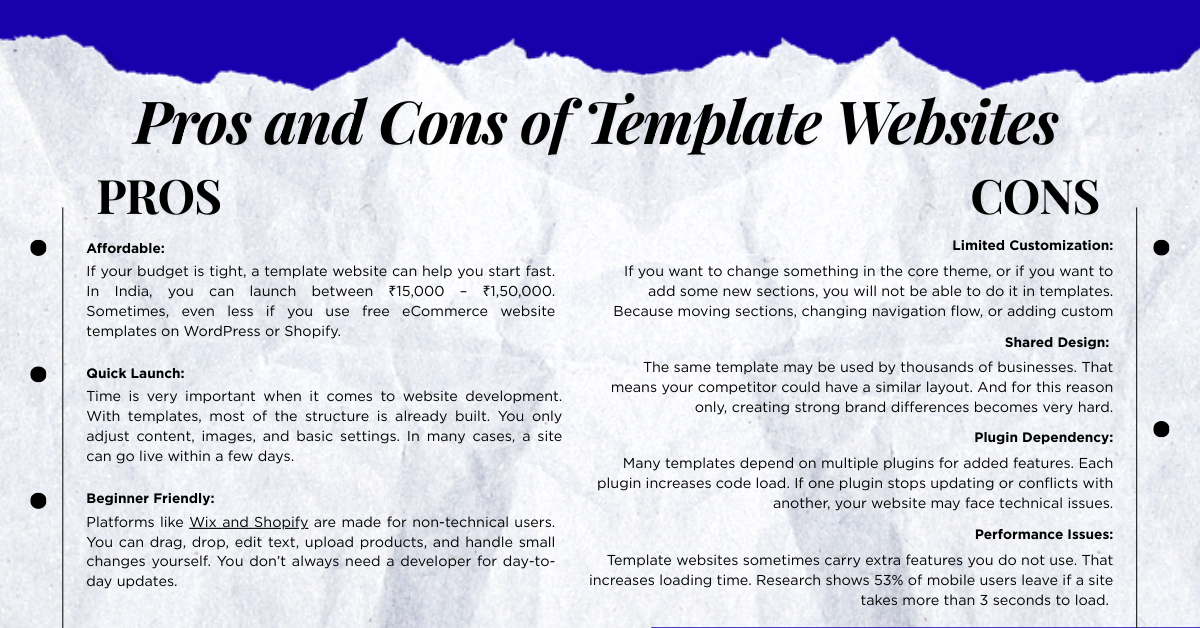
When you use a template website, you just edit some sections, text, logo, colors, and images. Platforms like WordPress, Shopify, and Wix already provide free website templates and eCommerce website design templates, so you don’t have to build everything from scratch.
These templates are created for common business needs. That is why you already get sections like contact forms, blogs, product pages, and galleries. You are using an existing layout and placing your brand inside it.
For small businesses or startups, this option saves time and upfront cost. You can go live faster. But you should understand that design changes depend on what the template allows. If you want deeper customization, options can become restricted.
Also Read – Cost of Website Development in Mumbai
So let us look at how custom and template websites stand against each other in different areas. Take a quick look:
| Feature | Custom Website | Template Website |
| Design | Completely unique, built for your brand | Pre-designed, shared with thousands of other sites |
| Cost | ₹3,00,000 – ₹25,00,000+ (India) | ₹15,000 – ₹1,50,000 (India) |
| Development Time | 2–6 months | Days to 2 weeks |
| SEO Flexibility | Full control over code, structure, and optimization | Limited by template structure and bloated code |
| Scalability | Unlimited – grows with your business | Limited by the template framework |
| Performance | Optimized for speed (90+ PageSpeed scores) | Variable (typically 70–80 PageSpeed scores) |
| Maintenance | Requires a developer for updates | Easy DIY updates via CMS |
| Ownership | Full code ownership | Limited – dependent on platform |
Read more: Why Every Store Owner Needs a Professional Website
Also Read – Cost of Custom Shopify Development and Design in Bangalore
You should understand this clearly: custom websites win in SEO performance. Not just because of optimized code, but because you get full control over Core Web Vitals, site structure, and technical optimization.
Google’s 2026 Core Web Vitals benchmarks are strict:
When a custom website design company builds a custom site from scratch, every section is optimized with these limits in mind. Template websites come with extra CSS, JavaScript files, and plugin layers you may never use. That extra weight slows everything down.
You should also remember this: a one-second delay can reduce conversions by 16%. When your website loads in under 2 seconds, your target audience will stay longer and interact more. Many template websites take 8–10 seconds on mobile. That directly affects trust and sales.
And on top of that, in the custom sites, you can do strategic internal linking, proper schema markup, URL structures, and mobile-first responsive design without compromises. Templates can support these, but adjustments are not always smooth and sometimes depend on plugin support.
If you’re a local service business like a dental clinic, law firm, consultancy, or retail shop, and if your website primarily serves as a digital brochure, a well-chosen template on WordPress or Wix is perfectly fine. You can take a budget of ₹50,000 – ₹1,50,000 and focus on great content and local SEO.
If you are just starting and testing products, Shopify templates, including free ecommerce website templates and ecommerce clothing website templates, help you launch fast. You can check what sells and what does not. But if you are crossing ₹1 crore yearly or planning subscriptions, multi-vendor systems, or complex integrations, you will need custom eCommerce website development services.
If you are building a startup, speed is one of the most important things in the first few months. Templates help you test your idea without spending too much. Once your product clicks in the market and funding improves, you should choose custom development services to get more control and flexibility.
If you’re an enterprise with complex workflows, multiple clients’ requirements, compliance needs, or proprietary systems to integrate, custom development is a must. Because, at that level, using templates would not be a good idea at all.
Also Read – Start an Ecommerce Business in India
Here’s the real comparison. If your business earns ₹3 crore yearly, investing ₹12 lakhs in a custom website equals 4% of annual revenue. That website may support your marketing and sales for 3–5 years. Spread that amount across 60 months, and the cost per month becomes easier to understand.
Several 2026 case studies show that businesses moving from template to custom websites improve conversions by 20–40% within months. One Indian B2C brand moved from 2% to 4.2% conversion rate after switching.
You should choose a custom website design if:
You should choose a template website in certain situations. It is not always a bad option. It depends on where your business stands right now.
Choosing the templates would be a great idea if:
You should not look at this like one option is perfect and the other is wrong. The right decision depends on where your business stands today.
Now it is your choice to go with custom website development services in Jaipur or choose a prebuilt theme. In both cases, Appco Software can help you. Because we have been in this business for over 13 years now, creating custom websites for different clients and industries. Having said that, if you are planning to make some changes to your existing website or want to develop a new website, you can check our professional website redesign services. For more information, you can contact our team or share your complete requirements with us.
A custom website is built from scratch based on your business needs. A template website uses an existing theme where you adjust content and design.
In India, a basic custom website starts around ₹3,00,000. And complex platforms can cross ₹25,00,000. Custom eCommerce website development generally ranges between ₹12,00,000 – ₹25,00,000 depending on integrations, features, and overall scale.
There is nothing like that. A template website is not bad for SEO in any case. But if you develop your website from scratch, there will be unique code and a proper SEO structure. This means you won’t use any random plugin, which increases the website size.
Yes, many businesses start with templates and later move to custom development. For the migration, you can hire the best website development company.
Yes. Template websites can manage high traffic if you are using a good hosting. But, at a larger scale, performance may slow down. But if your website is built with an optimized structure, you won’t face any issues.

Appco Software has been around for a very long time, helping startups and established brands build iconic websites and apps. For your unique idea to be presented in a beautiful way, contact us now!