If you are running an online store in India, you have already heard these two words many times: RTO and COD in eCommerce. And if you have not faced them yet, you will. RTO means Return to Origin. And COD means Cash on Delivery. Both sound normal on the surface, but for Indian e-commerce businesses, they create serious problems.
COD is popular in India because many customers still prefer paying after delivery. But COD also brings risks. For example, fake orders, wrong addresses, and customers refusing delivery are common issues. This leads to RTO, where the product is returned to the seller without being sold. In simple words, you pay for shipping twice and earn nothing. This is why the RTO has become a big loss factor. For many brands, especially small and mid-sized stores, high RTO ecommerce India is not just an operations issue; it’s a profit killer. Packaging cost, delivery charges, time, and inventory all get stuck.
In 2026, the challenge is even bigger, for example. Without proper RTO management for e-commerce, controlling losses and scaling the business becomes very difficult. Let’s understand how we can reduce these two things.
Many COD orders are placed with no real buying intent. These eCommerce fake orders in India increase delivery attempts, waste shipping costs, and finally return without any sale.
Customers often enter partial or incorrect addresses. Couriers fail to locate them, calls go unanswered, and the order comes back, adding directly to High RTO eCommerce India.
Some buyers change their minds after ordering. When the courier reaches, they simply refuse delivery, even though the product was shipped correctly.
Late deliveries frustrate customers. By the time the order arrives, interest is gone. Many customers refuse the parcel just because it did not arrive on time.
If courier partners delay attempts, skip calls, or mishandle parcels, customers lose trust and refuse orders, increasing RTO without the seller’s fault.
Also Read – Guide to Migrating Your eCommerce Store to Shopify
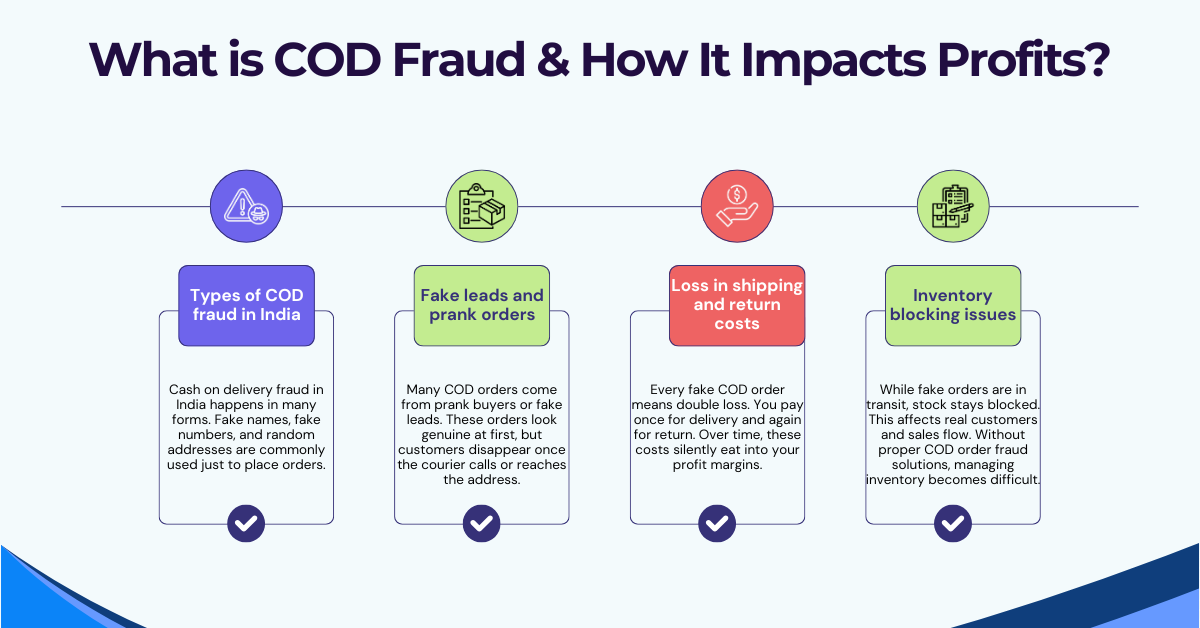
Cash on delivery fraud in India happens in many forms. Fake names, fake numbers, and random addresses are commonly used just to place orders with no intention of receiving them.
Many COD orders come from prank buyers or fake leads. These orders look genuine at first, but customers disappear once the courier calls or reaches the address.
Every fake COD order means double loss. You pay once for delivery and again for return. Over time, these costs silently eat into your profit margins.
While fake orders are in transit, stock stays blocked. This affects real customers and sales flow. Without proper COD order fraud solutions, managing inventory becomes difficult.
Also Read – Top 10 eCommerce Platforms to Build Your Online Store
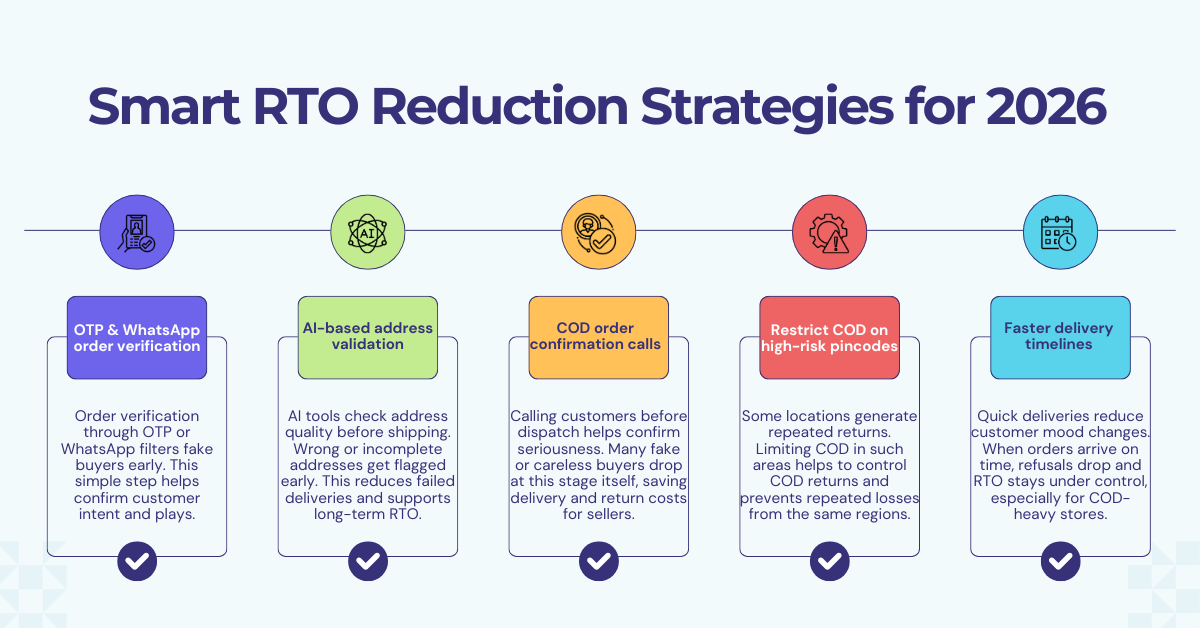
Order verification through OTP or WhatsApp filters fake buyers early. This simple step helps confirm customer intent and plays a big role in reducing RTO in eCommerce India.
AI tools check address quality before shipping. Wrong or incomplete addresses get flagged early. This reduces failed deliveries and supports long-term RTO reduction strategies in 2026.
Calling customers before dispatch helps confirm seriousness. Many fake or careless buyers drop at this stage itself, saving delivery and return costs for sellers.
Some locations generate repeated returns. Limiting COD in such areas helps to control COD returns and prevents repeated losses from the same regions.
Quick deliveries reduce customer mood changes. When orders arrive on time, refusals drop, and RTO stays under control, especially for COD-heavy stores.
Also Read – How to Start an E-commerce Business in India
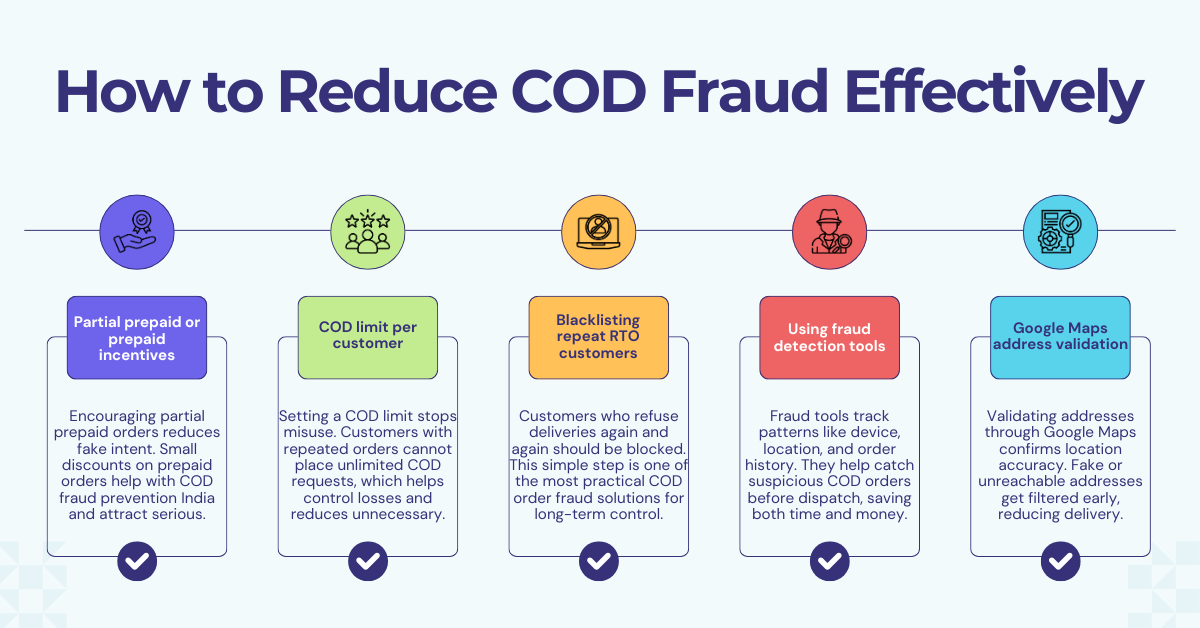
Encouraging partial prepaid orders reduces fake intent. Small discounts on prepaid orders help with COD fraud prevention in India and attract serious buyers instead of casual COD users.
Setting a COD limit stops misuse. Customers with repeated orders cannot place unlimited COD requests, which helps control losses and reduces unnecessary shipping risks.
Customers who refuse deliveries again and again should be blocked. This simple step is one of the most practical COD order fraud solutions for long-term control.
Fraud tools track patterns like device, location, and order history. They help catch suspicious COD orders before dispatch, saving both time and money.
Validating addresses through Google Maps confirms location accuracy. Fake or unreachable addresses get filtered early, reducing delivery failure and unnecessary return shipments.
Also Read – Make Money Online With an eCommerce Business
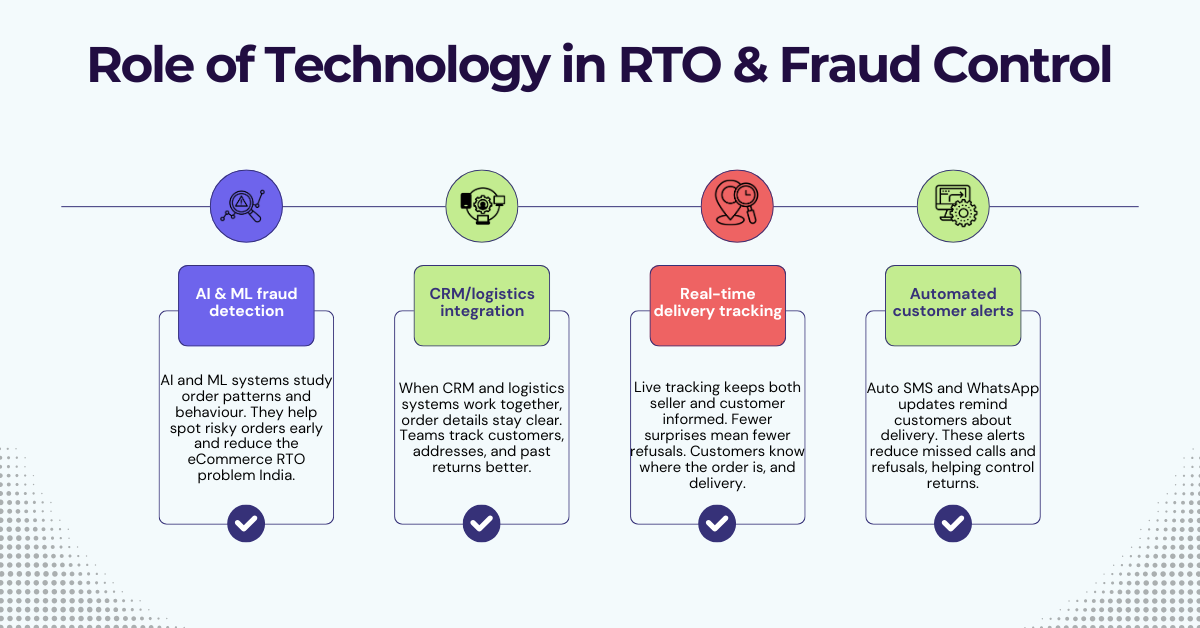
AI and ML systems study order patterns and behaviour. They help spot risky orders early and reduce the eCommerce RTO problem India faces due to fake or careless COD buyers.
When CRM and logistics systems work together, order details stay clear. Teams track customers, addresses, and past returns better, improving overall RTO management for eCommerce.
Live tracking keeps both seller and customer informed. Fewer surprises mean fewer refusals. Customers know where the order is, and delivery attempts become more successful.
Auto SMS and WhatsApp updates remind customers about delivery. These alerts reduce missed calls and refusals, helping control returns without manual follow-ups.
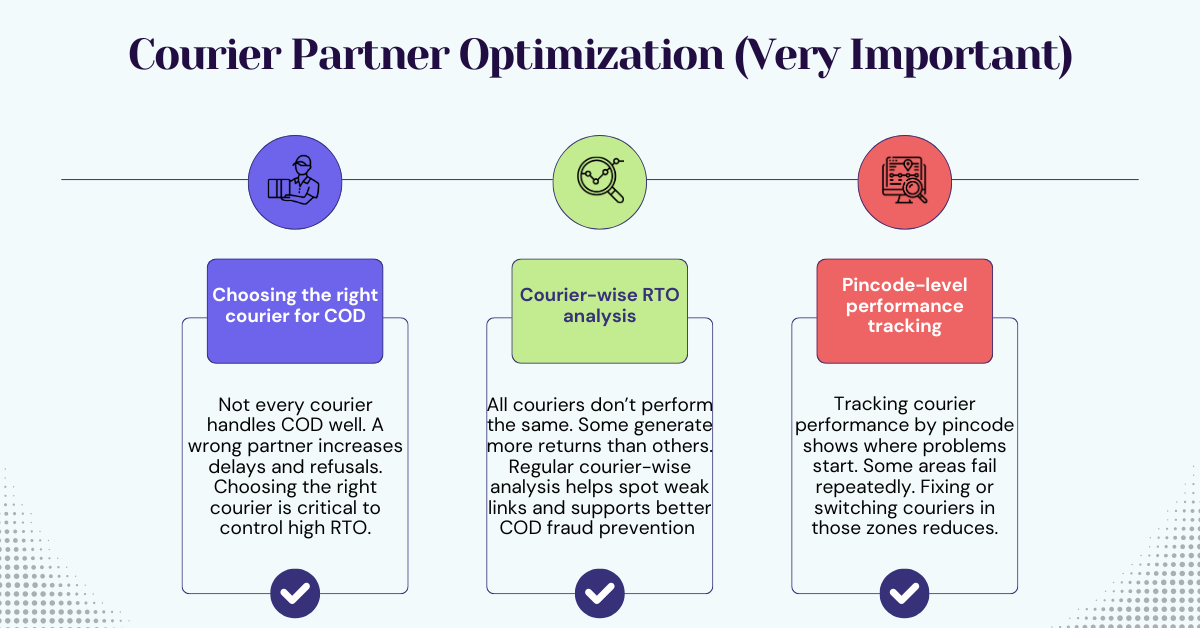
Not every courier handles COD well. A wrong partner increases delays and refusals. Choosing the right courier is critical to control high RTO in eCommerce India and protect daily margins.
All couriers don’t perform the same. Some generate more returns than others. Regular courier-wise analysis helps spot weak links and supports better COD fraud prevention in India decisions.
Tracking courier performance by pincode shows where problems start. Some areas fail repeatedly. Fixing or switching couriers in those zones reduces returns before they grow bigger.
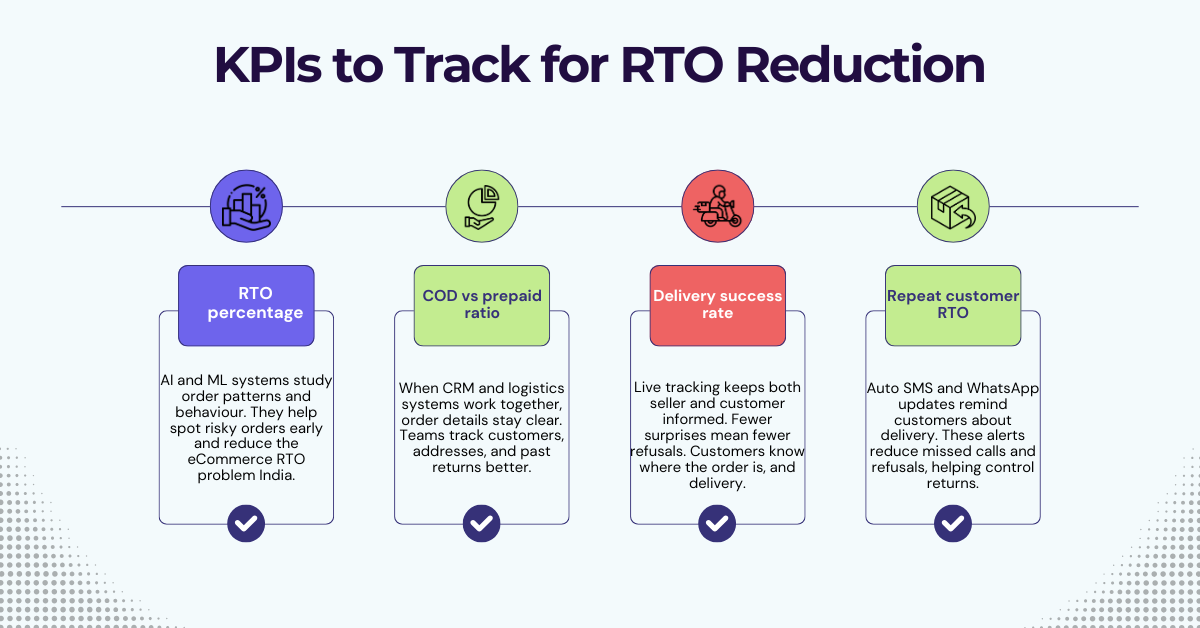
This number shows how many orders are coming back. A rising percentage clearly points to delivery issues, fake orders, or customer refusal. Tracking this helps control high RTO in eCommerce India.
This ratio tells you how risky your orders are. A heavy COD share usually increases returns. Balancing this helps with how to control COD returns.
This KPI shows how many orders actually reach customers. A low success rate often means courier issues, address problems, or delays that need quick fixing.
If the same customers cause returns again and again, that’s a red flag. Tracking this helps block risky buyers early and reduce unnecessary shipping losses.
Also Read –10 Reasons to Choose Shopify for Your eCommerce Store
In 2026, the way brands handle RTO and COD will change a lot. Not suddenly, but slowly, based on what sellers are already facing today. Losses are increasing, margins are tight, and sellers cannot afford repeated return issues anymore. That’s why most future changes are focused on prevention, not fixing problems after they happen.
One major shift is AI-based risk scoring. Instead of treating every order the same, systems will judge orders before shipping. Orders with strange patterns, repeated refusals, or risky locations will be flagged early. This helps sellers avoid shipping to buyers who are likely to refuse. Over time, this reduces losses caused by fake or careless buyers.
Another trend is the move towards prepaid-first ecommerce models. The COD feature is not going to end very soon. But slowly, brands will start to close this feature, depending on the situation or customer. Many brands are already encouraging prepaid orders by offering faster delivery or small discounts. In 2026, this approach will become more common. When prepaid orders increase, return rates naturally drop because customers are already committed.
Delivery models are also changing. Hyperlocal and same-day delivery is growing, especially in cities and nearby areas. Faster delivery, for example, reduces cancellations and refusals. When customers get their order within a day or two, they are less likely to change their mind. This alone helps reduce return issues without extra verification steps.
Another change is better customer tracking. Sellers will rely more on customer history. Buyers with repeated refusals will face limits automatically. Honest customers will not be affected, but risky behaviour will be controlled early. In simple words, the future of RTO and COD management is about smart filtering, faster delivery, and pushing serious buyers forward. Brands that adjust early will save money, time, and daily operational stress.
Also Read – Shopify is the Best Choice for Your eCommerce Website in 2026
At Appco Software, we work closely with Indian eCommerce brands that are already feeling the pressure of RTO and COD losses. We don’t treat this as a small logistics issue. We treat it as a business problem that needs structure, systems, and clarity. Our role is to help sellers reduce daily losses without adding more manual work or stress. We start by understanding where the problem actually comes from. Is it fake orders, wrong addresses, courier delays, or repeated refusal of customers? Once this is clear, we help set up proper verification flows, COD controls, and tracking systems. This includes practical solutions aligned with COD fraud prevention in India, not generic advice that looks good only on paper.
Our team also helps with tech-level improvements. From integrating fraud detection tools to setting rules for COD limits, pincode restrictions, and customer-level checks, everything is planned carefully. As a Shopify development company in India, our team focuses on building long-term systems, not short-term solutions. This is where our approach fits well with real RTO reduction strategies 2026, where prevention matters more than damage control.
Managing RTO and COD in eCommerce is pretty much important in order to run a successful business. Fake orders, refusals, delays, and courier issues quietly eat profits every day. The brands that survive are the ones that take control early. Simple steps like order verification, courier analysis, prepaid push, and customer tracking already make a big difference.
What matters now is timing. Sellers who start fixing these problems in 2025 will be far ahead in 2026. By the time competition increases further, their systems will already be stable. This is how you reduce RTO in eCommerce India without burning margins or daily energy. If handling all this is hard for you, you should hire experts in this case.
You reduce RTO by verifying COD orders, fixing address issues early, choosing better courier partners, pushing prepaid orders, and tracking repeat return customers regularly.
RTO can be minimized by confirming orders through calls or WhatsApp, restricting COD in risky areas, delivering faster, and avoiding repeat fake buyers.
There is no single solution to solve this problem. Solving RTO needs a mix of order verification, courier performance checks, prepaid push, and proper RTO management for e-commerce.
RTO reduction means lowering the number of orders that come back undelivered. It helps save shipping costs, time, and inventory, and improves overall e-commerce profit.
RTO stands for Return to Origin. It means the shipped order is returned to the seller without delivery, usually due to refusal or address issues.
COD in eCommerce means Cash on Delivery, where customers pay after receiving the product. The COD method is very popular in India, but it increases the risk of returns and fraud.
In India, the RTO rate varies by category and region. High RTO ecommerce India usually ranges between 15% to 40%, especially for COD-heavy stores.

Appco Software has been around for a very long time, helping startups and established brands build iconic websites and apps. For your unique idea to be presented in a beautiful way, contact us now!