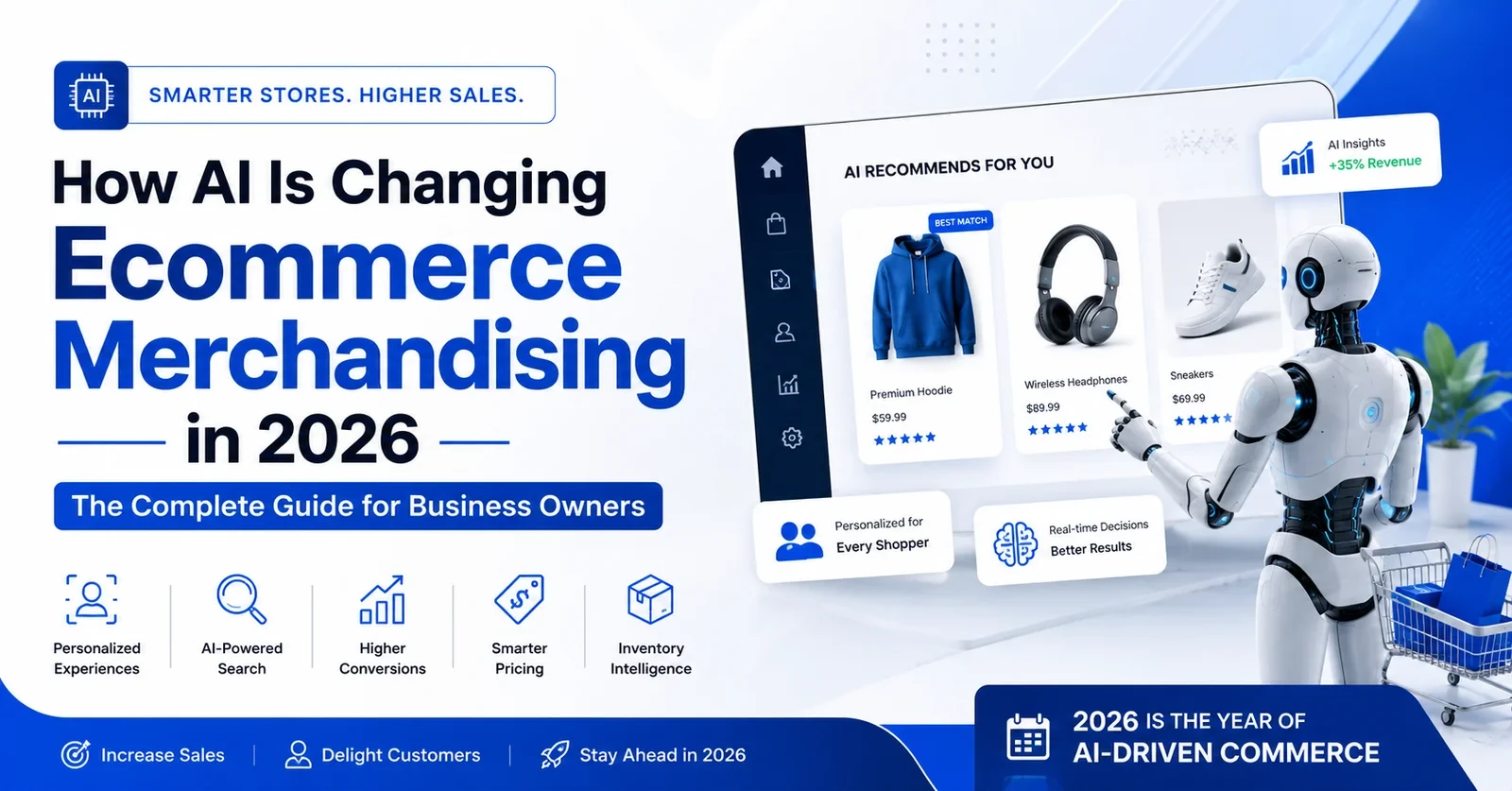
If you are still thinking ecommerce merchandising means arranging your collection pages and picking which product goes on top, you are already working with an outdated picture.
AI is changing ecommerce merchandising faster than most store owners are realizing. And we are seeing this with actual stores, actual traffic, actual numbers. Shopify’s own Q1 2026 data shows visitors arriving from AI platforms convert at nearly 50% higher rates than organic search visitors. Their average order values are 14% higher, also. Traffic to retail sites from generative AI sources increased 4,700% year-over-year in 2025. These are verified numbers from real commerce data; we are not making assumptions here.
So what is happening and what should you do about it? Let us go through this properly.
In a physical store, everything is kept properly. The owner thinks about everything. Like:
Nothing about that placement is accidental. That is merchandising. Online, it means which products show first in your collection, what gets featured on the homepage, what appears when someone searches your store, how your upsells and cross-sells are set up.
Most stores decide these things once, someone writes a rule, a developer sets it up, and then it stays the same for the next six months until someone remembers to change it. That is how traditional merchandising works.
AI ecommerce merchandising works on a completely different logic. Instead of fixed rules, it looks at what each visitor is doing right now. What they searched for. What they clicked. What similar customers ended up purchasing. And it adjusts what that specific person sees, automatically, in real time. That change, from static rules to dynamic real-time decisions, is what AI in ecommerce means for a store owner day to day.
Also Read – What is Google AI mode
So most businesses are somewhere in the middle right now. They have started experimenting but are still figuring out what moves the numbers.
The businesses that have figured it out are seeing real outcomes. AI product recommendations drive 25 to 35% of total ecommerce revenue when set up properly. Amazon’s recommendation engine drives roughly 35% of its annual sales. That is one feature accounting for a third of revenue.
AI-powered ecommerce is also becoming a discovery channel in its own right. AI-referred shoppers convert 31% higher and spend 45% more time on retailer sites. These are buyers who asked ChatGPT or Gemini a question, got a product recommendation, and arrived at your store already knowing what they wanted. That traffic converts completely differently from someone who clicked a generic keyword search result.
For any Shopify store, the right Shopify development services foundation matters here because AI integrations only work properly on a technically sound base. A slow, plugin-heavy store will struggle to support these tools.
Also Read – What is Google AI Mode
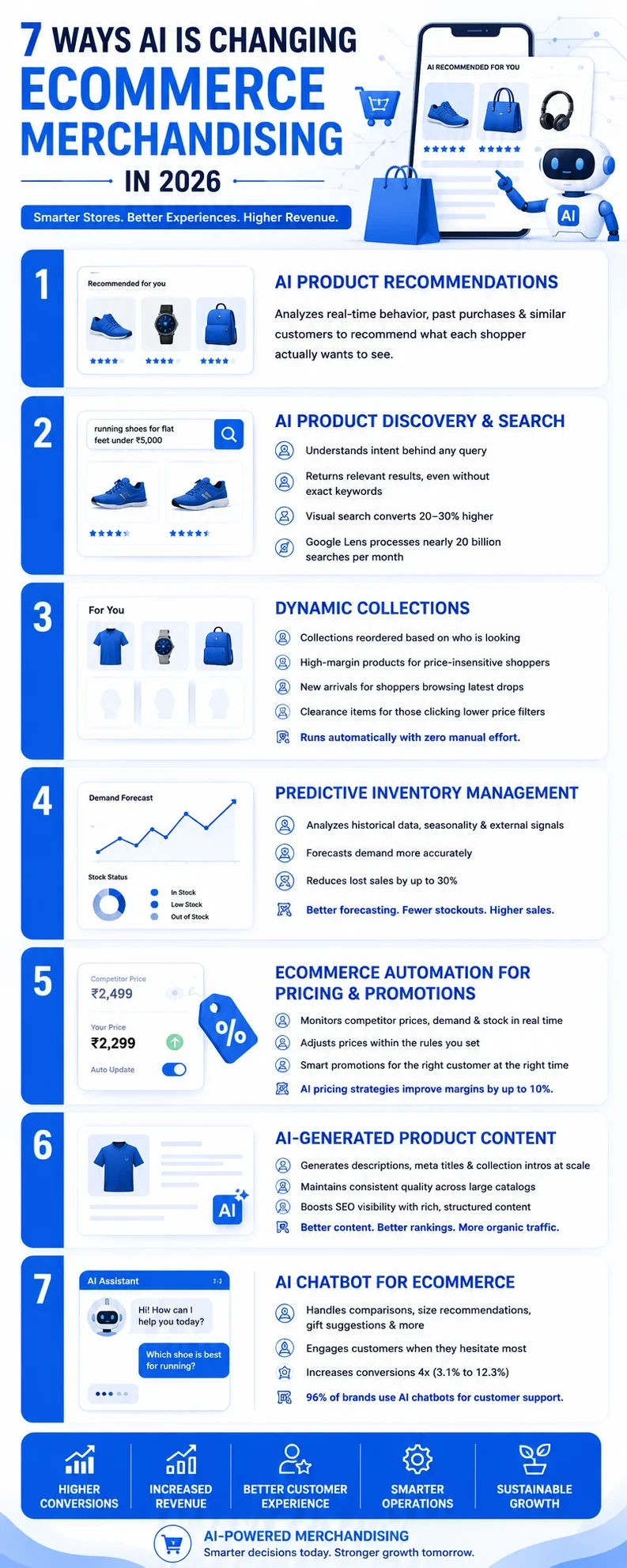
Old recommendation blocks used to show customers also bought based on whatever rules someone set up a year ago. AI product recommendations work differently. They look at the current session in real time, what this specific visitor browsed, clicked, and skipped, and combine that with past purchase history and what similar customers ended up choosing. The recommendation that comes out of this is usually something the person wants to see.
When someone comes to your store and types running shoes for flat feet under ₹5,000, keyword-based search gives them results that match those exact words. AI product discovery tools understand the intent behind that query. They figure out what the customer means and return relevant results even when the product title does not use those exact words.
Visual search is growing alongside text search. Google Lens is processing nearly 20 billion searches per month, and visual search users convert 20 to 30% higher. For all of this to work properly, your store needs to load fast. Our Shopify speed optimization services directly affect how quickly search results and product pages appear for visitors.
Here is something most store owners have never thought about. Your collection page looks the same to a first-time visitor as it does to someone who has bought from you three times. Same product order. Same featured items. AI personalization in ecommerce fixes this.
– Collections are reordered based on who is looking at them.
– High-margin products surface for people who are showing price-insensitive behaviour.
– New arrivals show up for shoppers browsing the latest drops.
– Clearance items appear for people who keep clicking lower price filters.
All of this runs automatically, with zero manual adjustment from your team.
Overstocking ties up cash. Stockouts lose sales and sometimes lose customers permanently. Both problems come from the same root: estimating demand instead of forecasting it properly.
AI tools analyse historical data, seasonal patterns, current marketing activity, and external signals to forecast demand more accurately than any manual method. Businesses using AI for inventory optimisation reduce lost sales by up to 30%. For Shopify stores with seasonal products or large catalogues, Inventory Planner handles this forecasting directly inside the Shopify ecosystem.
Manually checking competitor prices every morning and updating your own across hundreds of SKUs is just impractical. AI pricing tools do this continuously. They watch competitor activity, track demand signals, monitor your stock levels, and adjust prices within the rules you set.
Promotions also get smarter. Instead of a blanket sale on a fixed date, a discount triggers for a visitor who has viewed a product four times in three days. A different offer goes to someone visiting for the first time. Retailers using AI pricing strategies report margin improvements of up to 10%.
Writing descriptions for 500 products is slow work. And when you do it all at once, the quality becomes inconsistent across the catalogue. AI content tools handle first drafts at scale, product descriptions, meta titles, collection page introductions, all of it.
This matters for SEO as much as for efficiency. Collection pages with no introductory text and products with thin descriptions lose search visibility over time. Our Shopify SEO services include structured content work on collection and product pages, which works well alongside AI content tools when a store has a large catalogue to cover.
An AI chatbot for ecommerce is very smart now. Customers can now do product comparisons, size recommendations, gift suggestions, and use-case questions. It engages customers at the exact moment they are hesitating, which is usually the moment they are about to leave.
AI chat increases conversions four times, moving the rate from 3.1% for unaided shoppers to 12.3% for those who get AI-assisted guidance during their session. 96% of brands using conversational AI deploy it for customer support. Our Shopify app development services cover custom integrations for stores that want something connected to their actual product catalogue and order data rather than a generic off-the-shelf chatbot.
Also Read – How AI Benefits SEO
This part is where most business owners are behind right now, and they are losing visibility because of it.
When someone asks ChatGPT for the best lab-grown diamond ring under ₹1,00,000, they get one answer back. One recommendation. If your store is not in that answer, that customer never knows you exist. They go to whoever ChatGPT recommends.
This is what Generative Engine Optimisation, or GEO, means. It is about making sure AI search engines understand your store well enough to recommend it. That means product pages that answer real buyer questions, proper schema markup, and content that AI engines can cite and reference.
Nine in ten retail executives expect AI to be used more than traditional search engines going forward. Half expect the multi-step shopping journey to collapse by 2027 into a single AI-driven interaction. These are the ecommerce merchandising trends 2026 research is pointing to clearly. Preparing for this now means building product pages and content that AI can read, understand, and reference.
Also Read – Google’s AI Overviews: Really Mean for Your Organic Traffic
Here is the table of the best AI merchandising tools for ecommerce.
| Tool | Category | Best For | Shopify Compatible |
| Algolia | Search and Discovery | Large catalogues, developer flexibility | Yes |
| Constructor | Search and Discovery | High-SKU stores needing AI merchandising software | Yes |
| Searchspring | Search and Discovery | Visual merchandising without heavy coding | Yes |
| Nosto | AI Personalization Ecommerce | Mid-size D2C brands | Yes |
| Dynamic Yield | AI Personalization Ecommerce | Enterprise-level personalisation | Yes |
| Bloomreach | Search and Personalization | Combined discovery and personalisation | Yes |
| Inventory Planner | Forecasting | Shopify-native demand forecasting | Yes |
| Triple Whale | Analytics | Shopify attribution and ecommerce AI tools reporting | Yes |
| ChatGPT / Jasper | Content Generation | Product descriptions at scale | Via integration |
Also Read – AI In Performance Marketing
Appco Software is one of the leading ecommerce website development companies in Mumbai and Jaipur, with more than 13 years of experience and over 5,000 projects delivered across India and international markets.
Installing a few apps does not make a store AI-ready. The foundation has to be right first. For example, you must add fast loading, clean third-party integrations, proper structure for both Google and AI search.
We build and optimize Shopify stores for D2C brands, fashion businesses, jewellery brands, and B2B sellers around the globe. Everything from Shopify store redesign to performance marketing, SEO, and custom app integration is handled by our own in-house team.
If your store is live but none of the tools covered in this article are set up yet, get in touch for a free Shopify consultation, and we will tell you where to start.
Yes, a lot. AI is changing ecommerce merchandising in many ways. Like recommendations, search results, and product ordering. All of it adjusts per visitor automatically now instead of following rules someone set up months ago.
Yes, and the numbers back it up. Stores using them properly see around 26% higher conversions, and AI drives 25 to 35% of total revenue for those businesses.
For search, Algolia and Constructor are solid. For personalisation, Nosto and Dynamic Yield. For inventory, Inventory Planner. Pick whichever one solves your biggest problem right now and start there.
GEO is about getting your store cited in ChatGPT and Gemini answers. More people are using AI to find products now and if your store is not showing up there, you are missing that traffic completely.
It is a search that understands what someone means. Not just what they typed. AI product discovery apps understand the intention and show the list of items.
Error: Contact form not found.

Appco Software has been around for a very long time, helping startups and established brands build iconic websites and apps. For your unique idea to be presented in a beautiful way, contact us now!