Google AI Overviews crossed 2 billion monthly users, as per Google’s Q2 2025 report. And by 2026, 68% of Google searches are ending without a single click. But most businesses that do not have an expert SEO team and workflow are still running audits built for 2019.
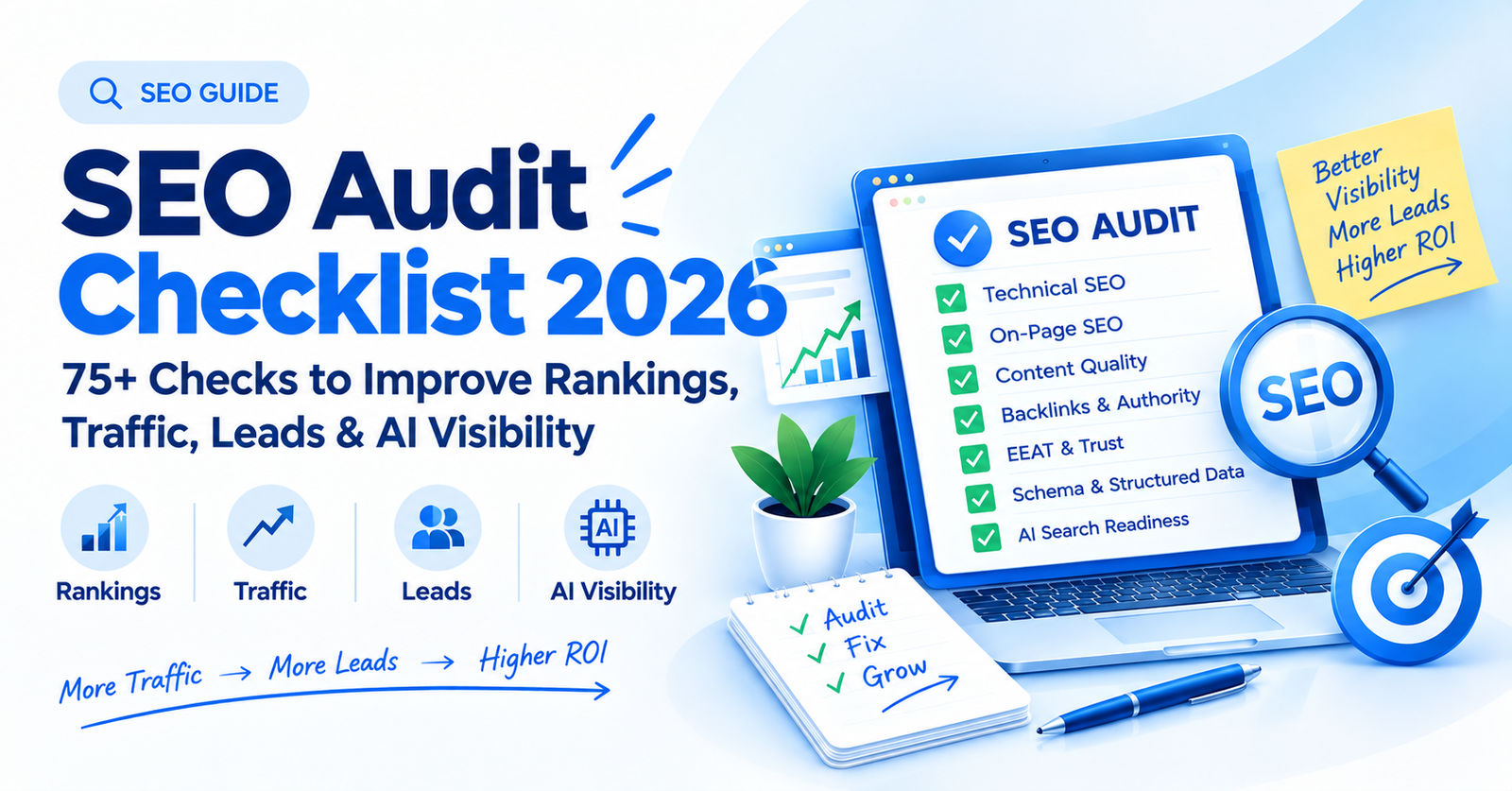
Use this website SEO audit checklist as your complete SEO audit guide for 2026. It covers technical health, on-page signals, content quality, backlinks, and AI search readiness. Do it right, and you will know exactly what is blocking your rankings and what to fix first.
This checklist covers 75+ checks on every SEO layer that matters.
Before you deep dive into this post, take it as a full SEO health check of your website. Not a report card. A diagnostic scan.
A good audit tells you what Google can access, what it is choosing to index, what it is rewarding, and where you are quietly losing ground. The goals are straightforward:
Five goals: improve rankings, increase organic traffic, generate more leads, improve user experience, and improve AI search visibility. A technical fix without a content plan stalls. A content plan without a technical foundation fails.
The critical checks are available for free. Start with Google Search Console. It tells you the most about how Google sees your site. Everything else builds on top.
| Tool | Purpose | Free? |
| Google Search Console | Indexing, performance, crawl errors | Yes |
| PageSpeed Insights | Core Web Vitals by page | Yes |
| Rich Results Test | Schema validation | Yes |
| Google Lighthouse | Full technical audit | Yes |
| Screaming Frog | Full crawl audit | Free up to 500 URLs |
| Ahrefs Webmaster Tools | Backlink profile | Free |
Search engines and AI crawlers need to access your content before anything else matters.
| # | Check | Tool | Fix |
| 1 | HTTPS Enabled | Browser | Force HTTPS redirects, fix mixed content |
| 2 | XML Sitemap | GSC | Submit domain.com/sitemap.xml |
| 3 | Robots.txt | Browser | Remove accidental blocks on key pages |
| 4 | Pages Indexed | GSC URL Inspection | Request indexing for missing pages |
| 5 | Crawl Errors | GSC Pages | Resolve 404s, set up 301 redirects |
| 6 | Redirect Chains | Screaming Frog | Direct 301 only. One hop, not three. |
| 7 | Canonical Tags | View Source/Free Extensions | Self-referencing canonical on every page |
| 8 | Duplicate Pages | Screaming Frog | Canonicalize or merge |
| 9 | Mobile Friendly | Lighthouse | Responsive design required |
| 10 | URL Structure | Browser | Descriptive slugs, no ?id=123 parameters |
| 11 | Orphan Pages | Screaming Frog | Add internal links from related pages |
| 12 | Broken Links | Screaming Frog | Update URLs or redirect |
| 13 | Site Architecture | Screaming Frog | Every page within 3 clicks from homepage |
| 14 | Breadcrumbs | Rich Results Test | Implement Breadcrumb schema |
| 15-20 | Hreflang, WWW/non-WWW, Trailing Slash, Pagination, JS Rendering, Crawl Budget | Screaming Frog / GSC | Fix per crawl report findings |
Fix indexing and robots.txt first. If Google cannot access your pages, nothing else moves rankings. Deep technical issues often need a proper Shopify store development rebuild rather than months of patching.
Core Web Vitals are a direct ranking signal. We can say this confidently: slow pages do not wait for visitors. They leave before anything loads.
| # | Metric | Target | Fix |
| 1 | LCP (Largest Contentful Paint) | Under 2.5s | Compress images, use a CDN, remove render-blocking resources |
| 2 | INP (Interaction to Next Paint) | Under 200ms | Reduce JS, lazy load non-critical scripts |
| 3 | CLS (Cumulative Layout Shift) | Under 0.1 | Define image dimensions, prevent layout shifts |
| 4-7 | TTFB, Mobile Speed, FCP, TBT | Per Google thresholds | Run full Lighthouse audit for recommendations |
A 1-second delay in page load reduces conversions by 7%. Shopify speed optimization directly addresses LCP and TTFB, the two metrics Shopify stores fail on most.
Get this wrong and even a technically perfect site will not rank.
| # | Check | Tool | Pass Condition |
| 1 | Title Tags | Screaming Frog | Unique, 50-60 characters, primary keyword included |
| 2 | Meta Descriptions | Screaming Frog | Unique, 150-160 characters, CTA included |
| 3 | H1 Tag | View Source | One per page, primary keyword included |
| 4 | H2/H3 Structure | View Source | Logical hierarchy, no skipped levels |
| 5 | Image ALT Tags & Format | Screaming Frog / Lighthouse | Descriptive ALT on every image, WebP format |
| 6 | Internal Linking | Screaming Frog | No page should be there without at least one internal link pointing to it |
| 7 | Search Intent Match | Manual review | Format matches what Google is rewarding |
| 8 | Keyword Placement | Manual review | Primary keyword in H1, opening paragraph, and at least one H2 |
| 9 | FAQ Section | Manual review | 5-7 questions with direct answers |
| 10 | Conversion Elements | Manual check | Contact form working, CTA above fold, WhatsApp visible on mobile |
| 11-15 | Semantic keywords, duplicate titles, structured data, schema, anchor text | Screaming Frog | Zero duplicates, all elements present and functional |
We see technically solid sites where the contact form is broken, or the WhatsApp button is buried two scrolls down. That is an SEO audit failure as much as a missing meta description. CRO services solve the conversion gap.
Google and AI systems both favor content with real first-hand experience. This section is about proving it.
| # | Check | What to Do |
| 1 | Author Bio | Name, role, and one-line credential on every article |
| 2 | Experience Signals | Screenshots, case study results, real client data |
| 3 | Stats with Sources | Every stat names the source inline |
| 4 | Content Freshness | Update articles older than 18 months |
| 5 | Thin Content | Pages under 500 words, expand or merge |
| 6 | Keyword Cannibalization | Multiple pages on the same keyword; merge or differentiate |
| 7 | Topical Authority | Build content clusters, not isolated articles |
| 8 | FAQ Sections | On every article and service page, structured for AI extraction |
| 9 | Business Information | About Us, team, contact details, address, visible sitewide |
| 10 | Updated Publish Dates | Show last reviewed date on all articles |
One pattern on every eCommerce SEO audit checklist: great product pages, zero brand credibility. Google cannot assess EEAT for a brand with no face.
Schema markup gives search engines and AI systems the context they need to understand what your content is about. Validate all schema using the Google Rich Results Test.
| Schema Type | Who Needs It | What It Enables |
| Organization | Every website | Knowledge panel, brand recognition |
| LocalBusiness | Service businesses | Maps, local knowledge panel |
| Article / BlogPosting | Blog pages | Rich snippets, AI citation signals |
| FAQ | Any page with FAQs | Featured snippet, voice search, AI extraction |
| Product | Ecommerce pages | Price, availability, rating in results |
| Breadcrumb, Review, HowTo, Video, Service | As applicable | Rich results, AI extraction, structured display |
Missing schema is not just a ranking issue. If content is not marked up, AI systems cannot extract or cite it. That is a GEO failure. Complex schema for product catalogues or service structures needs Shopify custom app development at the code level.
An AI SEO audit checklist, or GEO audit checklist, checks whether your content is built for AI search optimization. ChatGPT SEO optimization is about content structure. It’s not about code.
37% of users now start searches directly in an AI tool. The question is whether your content is inside the AI answer.
| # | Check | Fix |
| 1 | Direct question answers in content | Answer in first 2-3 sentences |
| 2 | FAQ Schema present and valid | Add and validate via Rich Results Test |
| 3 | Entity-based SEO: brand, services, location named consistently | Full brand name at first mention everywhere |
| 4 | Author credibility signals | Author bio with credentials on every article |
| 5 | Stats cited with named sources | Source name and year inline |
| 6 | Semantic HTML structure | H1 → H2 → H3 hierarchy enforced sitewide |
| 7 | Topic clusters in place | Pillar pages linking to supporting articles |
| 8 | Knowledge Graph signals | Brand presence on Wikipedia, Wikidata, major directories |
| 9 | Brand mention consistency | Identical name on website, GMB, social, directories |
| 10 | AI visibility monitored | Test monthly in ChatGPT, Perplexity, Gemini |
You can rank #1 on Google and still be absent from AI-generated answers. With 51% of B2B decision-makers starting product research in an AI chatbot, that gap costs leads. The solution is content structure: direct answers, named sources, author credentials, FAQ schema. For paid visibility alongside organic, performance marketing compounds this well.
A local SEO audit checklist goes beyond Google Business Profile. For Indian B2B businesses, citations on JustDial and IndiaMART are authority signals for regional search.
| # | Check | Tool |
| 1 | Toxic and lost links | Ahrefs, Google Search Console |
| 2 | Competitor link gap | Ahrefs Link Intersect |
| 3 | Unlinked brand mentions | Ahrefs Brand Alerts |
| 4 | Google Business Profile. Fully completed, photos, categories correct | Google Business Profile Manager |
| 5 | NAP Consistency: Name, Address, Phone identical everywhere | Manual check & Moz Local |
| 6 | Reviews: 10+ reviews, recent, responded to | Google Business Profile |
| 7 | Local Citations: JustDial, IndiaMART, Sulekha, industry directories | Manual audit |
| 8-10 | Location pages, link diversity, domain authority | Ahrefs / Manual |
Not all issues are the same. Every issue is different. Here you can find the solutions. Fix them in order.
| Priority | What to Fix |
| #1 Critical | Indexing blocks, robots.txt errors, canonical conflicts, Core Web Vitals |
| #2 High | Content gaps, thin pages, keyword cannibalization, internal linking, schema |
| #3 Medium | EEAT signals, GEO optimization, backlink building, local citations |
Use this free template to log issues as you audit:
| Issue Found | Page or Area | Business Impact | Tool Used | Fix Required | Priority |
| Example: Missing alt tags | /products | Lower image search visibility | Screaming Frog | Add descriptive ALT to all product images | High |
Copy this SEO audit template into a spreadsheet, sort by priority, and hand it to your developer with fixes written out. That is what converts this SEO audit report into actual results.
Appco Software is a certified Shopify Partner agency based in Jaipur and Mumbai, with 13+ years of experience and over 5,000 projects delivered for D2C brands, ecommerce stores, and growing businesses.
We run full-stack SEO audits covering every layer in this checklist. Our team includes Shopify development specialists and digital marketing professionals who work together on the same audit, so technical fixes and content improvements happen in parallel.
If you want an audit done for your site, reach out to Appco Software, and we will tell you exactly what is holding your rankings back.
The websites winning in organic and AI search in 2026 are not doing anything magical. They have clean technical foundations, content written with real expertise, schema that machines can read, and enough brand authority for AI systems to trust and cite them. Run this checklist. Fix what comes up. And if the list feels long, start with Priority 1 and work down.
SEO audit checklist is a point-by-point framework to find out why your site is not ranking or converting. It covers technical health, on-page signals, content quality, backlinks, and AI search visibility. Each check either passes or reveals a problem. That gives you a prioritized fix list instead of guessing.
Every six months for a full website SEO audit. But Core Web Vitals and crawl errors you want monthly. And if you just migrated, relaunched, or saw traffic drop, run it right away.
Yes. Google Search Console, PageSpeed Insights, Lighthouse, and Screaming Frog (free up to 500 URLs) cover what paid tools find. Agencies add value in reading that data and knowing what to fix first. The tools find the issues. Expertise decides the priority.
A technical SEO audit checklist is the infrastructure check. Like, can search engines crawl your pages? Is HTTPS set up? Are there redirect chains, canonical errors, or orphan pages? What do Core Web Vitals look like? If the technical foundation is broken, no amount of content fixes the rankings.
An AI SEO audit, or GEO audit, checks whether your content is structured for ChatGPT, Google AI Overviews, and Perplexity to extract and cite. FAQ schema, author credibility, direct answers, and entity consistency are what AI systems need. Standard SEO audits skip this. In 2026, you cannot.
Error: Contact form not found.
Appco Software has been around for a very long time, helping startups and established brands build iconic websites and apps. For your unique idea to be presented in a beautiful way, contact us now!