
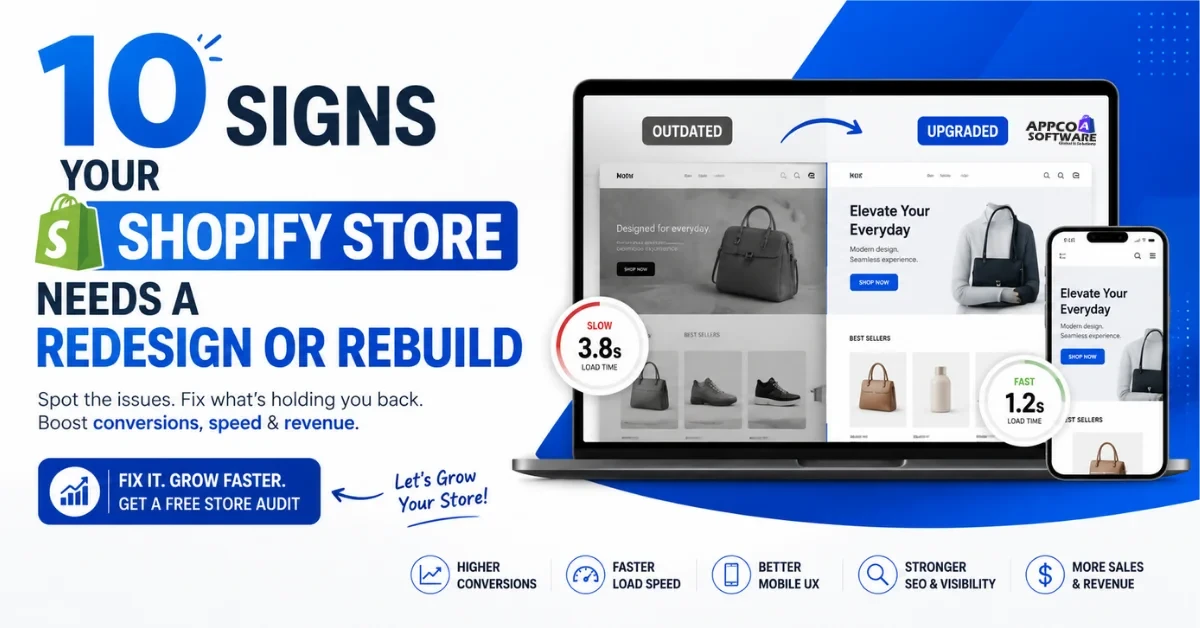
Baymard Institute puts the average cart abandonment rate at 70.22% in 2026, which means seven out of every ten shoppers who add a product to their cart walk away before paying. Mobile makes it worse. Mobile carts get abandoned at close to 80%, against roughly 66% on desktop, and mobile now carries about 62% of all ecommerce traffic. Most stores are losing the majority of their visitors on the exact device most of them are using.
A one-second delay in page load can cost a store 7% in conversions, and Google’s own case studies show stores passing all three Core Web Vitals see conversion gains of 15% to 30%. Put these numbers together, and the pattern is hard to miss. Rising sessions with flat revenue rarely mean the marketing is broken. It generally means the store itself needs work.
With all of these things in mind, let’s understand that the Shopify store needs a redesign. We’ll walk through checkout, mobile UX, AI shopping readiness, and what an eCommerce website redesign should cost in 2026.
Shopify website redesign is far more serious than most people think. It is not making some changes here and there and giving it a new look.
People find stores through AI chat answers now just as much as through Google. Around 60% of ecommerce traffic comes from mobile. And after Google’s March 2026 core update, stores that ignored speed or Shopify mobile optimization are already ranking lower before a single customer lands on a product page.
So a redesign today has to work for three very different things at once.
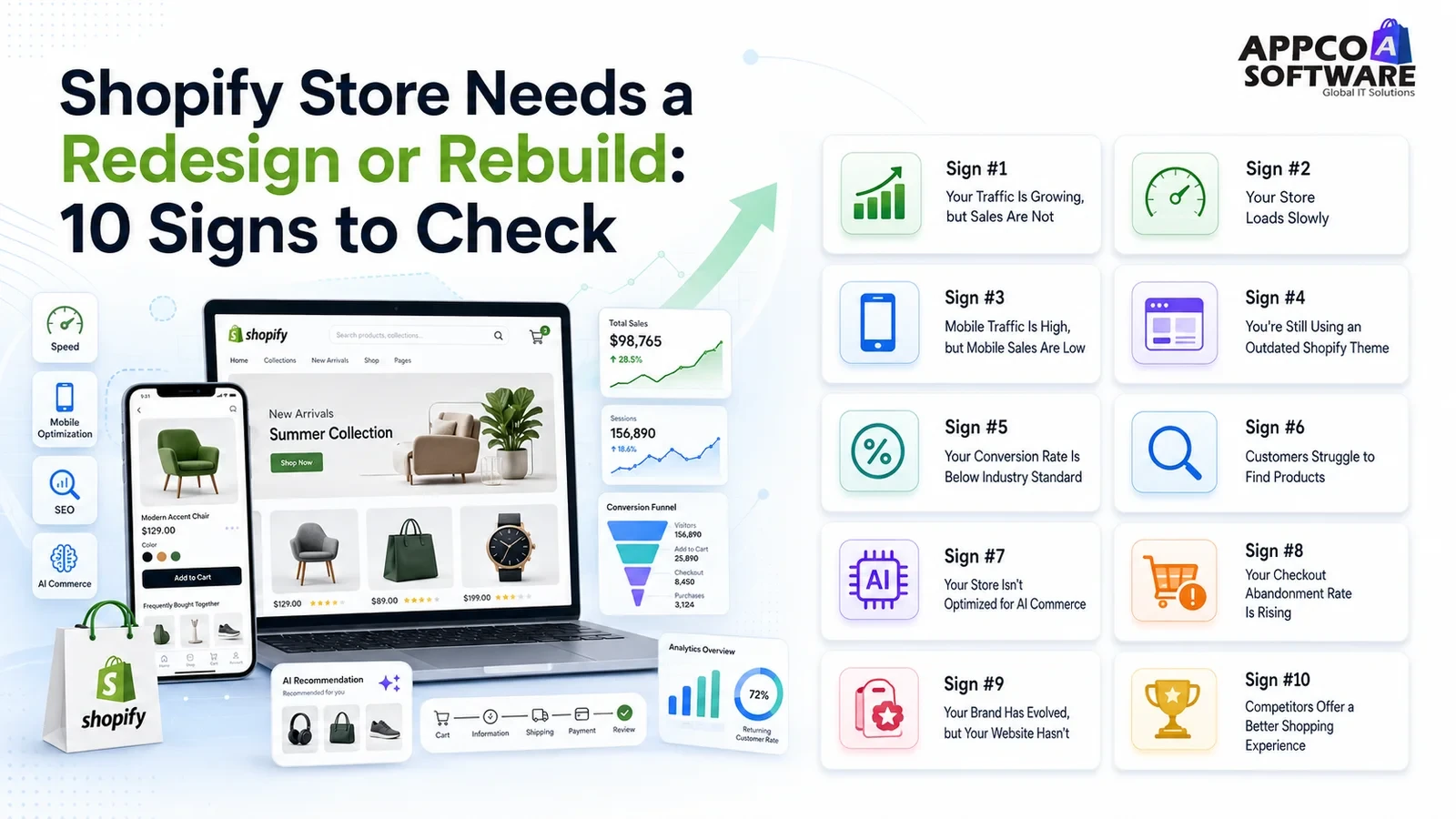
This is the one that gets business owners calling us first. Sessions climb month after month, ad spend goes up, and revenue barely moves. Nine times out of ten, this means Shopify conversion optimization was never done properly on the store. Visitors arrive, look around, and leave without a reason to stay. A Shopify store not converting visitors despite healthy traffic is not a traffic problem. It’s a trust and layout problem, and our CRO services are usually where we start fixing it.
A one-second delay in page load can cost roughly 7% in conversions, and Google’s own case studies show ecommerce stores that pass all three Core Web Vitals see conversion gains between 15% and 30%. That is not a small number for a store doing lakhs in monthly revenue. Heavy themes, unused apps, and uncompressed images are the normal suspects. Shopify speed optimization means auditing every app installed on the store, not just resizing a few banner images and calling it done.
A rough benchmark to work against:
Most Shopify stores we open get more than 60% of their sessions from a phone. If mobile sales don’t match that share, something in the phone experience is broken. Cramped filters, tiny buttons, product images that take forever to load, and multi-step checkouts are common culprits.
So, what is a good mobile conversion rate for Shopify stores?
Anywhere between 1.5% and 3% is considered healthy, though fashion and accessory brands can go higher with the right Shopify mobile optimization and a checkout that doesn’t ask for ten fields before payment.
Older themes built before Shopify’s OS 2.0 architecture limit what a store can do with sections, metafields, and app blocks. If your developer keeps saying the theme doesn’t support that every time you ask for a small change, a Shopify theme upgrade is overdue. Store modernization on OS 2.0 also loads faster by default, which loops right back into the speed problem from Sign #2. A capable Shopify development company can judge within one call whether your current theme can be upgraded or needs a rebuild from scratch.
Below is a simple way to check where a store stands before calling in a Shopify conversion rate optimization agency.
| Metric | Weak | Average | Strong |
| Add-to-cart rate | Under 5% | 5–10% | Above 10% |
| Cart-to-checkout rate | Under 40% | 40–60% | Above 60% |
| Checkout completion | Under 30% | 30–65% | Above 65% |
If two out of three of these sit in the weak column, the issue normally runs deeper than copy or images. A Shopify UX redesign, focused on the path from product page to payment, tends to move all three numbers together.
Ask five people outside your team to find a specific product in your store without help. If two of them get stuck, your navigation has a problem most regular visitors won’t tell you about; they’ll just leave. Weak filters, cluttered menus, and search bars that return nothing for common terms all point to a site architecture issue rather than a design one. This is exactly what a Shopify store audit is meant to catch, and our Shopify UX design services are built around fixing this specific gap.
People are asking ChatGPT to recommend products now. Not just Google. And when an AI tool gets that question, it pulls from whatever structured data it can find on your store. If your product pages are missing schema markup, proper attributes, or clean descriptions, the AI has nothing useful to work with. So it recommends someone else.
Shopify AI commerce optimization is not a plugin you install and forget. It is about how well your product data is structured underneath everything the customer sees. Good data gets picked up. Incomplete data gets skipped. Most store owners have not thought about this yet. Which means fixing it before your competitors do is still an option.
As we said above, according to Baymard Institute’s meta-analysis of checkout studies, the average cart abandonment rate sits at 70.22% in 2026, and mobile abandonment runs close to 80% against roughly 66% on desktop. Nearly half of customers who abandon a cart cite unexpected costs like shipping or tax showing up too late in the flow. A quick checkout audit checklist:
Shopify checkout optimization built around these four points alone can recover a meaningful share of abandoned revenue without touching the rest of the store.
If your store was built three years ago, it was fine that time. But when you add more products and more categories, the design also needs to be changed. That is when you need to think about redesigning your Shopify store. Because the problem is not how the store looks anymore. The problem is how it is built. An ecommerce website redesign at this stage only works if it starts from the brand as it exists right now.
Open three competitor stores on your phone right now. See how fast they load. See how well the product pages answer questions. Count how many taps it takes to check out. In 2026, the gap shows up in load speed, mobile view, trust signals like reviews and return policies, and how well the store uses personalisation. These are not small details anymore. They are the reasons someone buys from a competitor without ever explaining why they left your store.
A good Shopify redesign agency in India will show you this gap in actual data. Traffic numbers, bounce rates, conversion comparisons. And a Shopify website redesign agency that tracks how buying behaviour is shifting will close that gap faster than you can by making changes one at a time on your own.
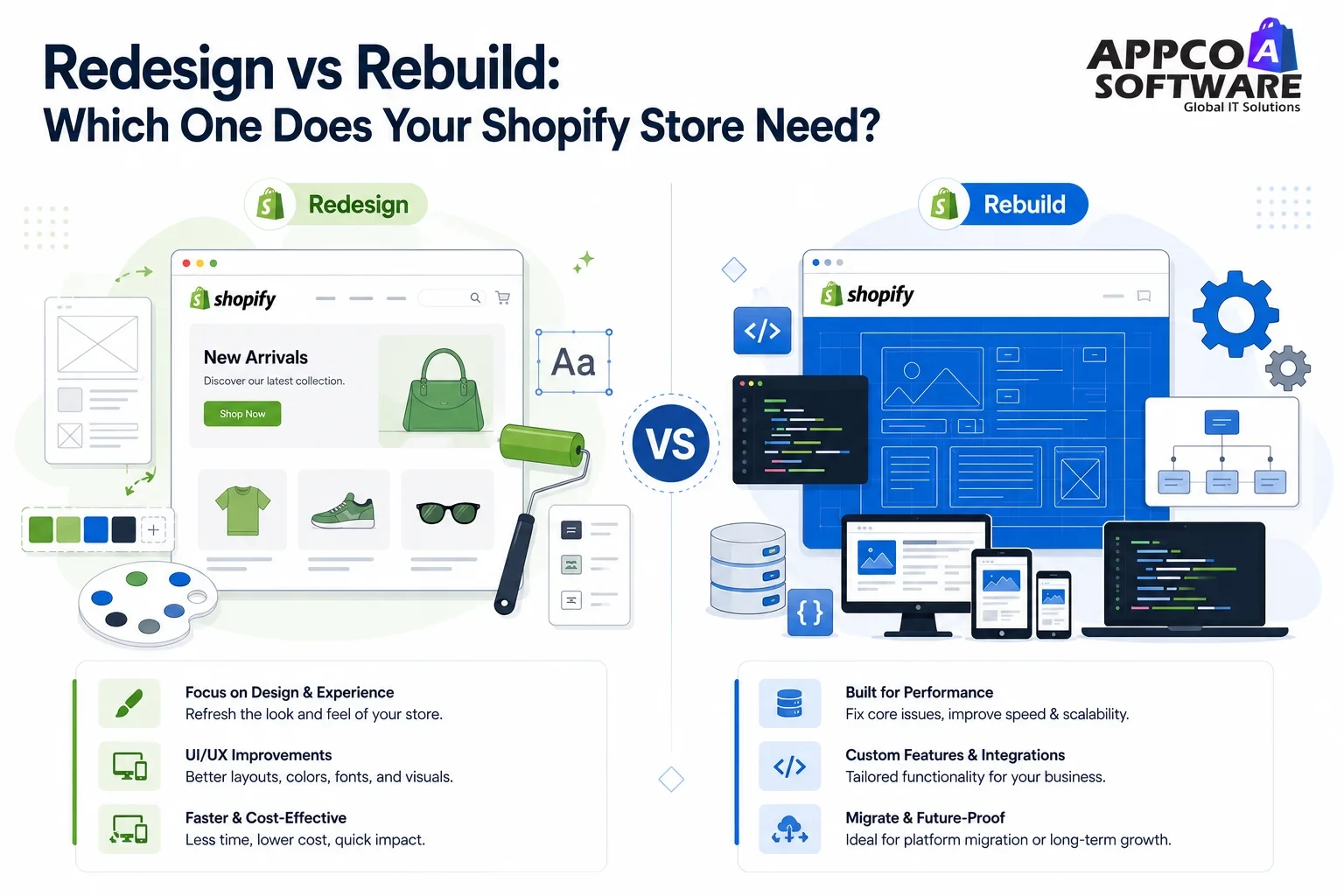
This is the most common question we get once a store owner has read this far, so here’s the Shopify redesign vs rebuild breakdown we use internally.
| Issue | Redesign | Rebuild |
| Visual updates only | Yes | No |
| Theme upgrade to OS 2.0 | Yes | No |
| Poor site structure | No | Yes |
| Major speed problems from the core architecture | No | Yes |
| Custom features required | No | Yes |
| Migration from another platform | No | Yes |
If you think that the design is quite dated and you’re facing some UX-level or theme-related issues, a redesign is needed. Signs your Shopify store needs a redesign
show up when the structure itself is the block, not the surface.
A store that checks most of these boxes ranks better for Shopify store redesign for SEO searches and converts better at the same time, since the two goals overlap more than most owners expect.
We are a Shopify development company based in Jaipur, and redesign work makes up a large share of what our team handles every month. Our Shopify redesign services cover UX audits, theme upgrades, speed fixes, and full visual overhauls, depending on what the store actually needs after an audit, not before one. For stores that have outgrown their current setup, our Shopify development services extend into full rebuilds on OS 2.0, along with Shopify migration services for brands moving over from WooCommerce, Magento, or a custom-built site.
Shopify store redesign cost on our end normally depends on the scope. A theme-level redesign runs lower than a full rebuild with custom app integrations, and we quote each project after the audit, not before it. Our Shopify store optimization services also include ongoing CRO work post-launch, since a redesign is a starting point.
A Shopify store redesign isn’t something to schedule around a calendar date. It’s something to schedule around what the data on your own store is already telling you. If two or three signs from this list sound familiar, that conversation is worth having sooner rather than later.
18 to 24 months is a rough guide. But if your sales are almost zero and mobile traffic is also low, you should consider redesigning your store.
When it comes to making some changes here and there, it’s called redesign. On the other hand, when you want to restructure the entire store, it is called a rebuild.
The store redesign cost depends on your store. Because every store is different. We look at it first, then give a number that actually means something.
Yes. If done properly. Generally, Google measures speed, mobile UX, and structured data to rank a store. If you redesign, your rankings will automatically increase.
It can. If your current store has checkout friction, confusing navigation, or a poor mobile section, then these things are eating up your sales.
Yes. Without it, you are spending money on the wrong thing. The audit tells you what the actual problem is before anyone writes a single line of code.
Error: Contact form not found.

Appco Software has been around for a very long time, helping startups and established brands build iconic websites and apps. For your unique idea to be presented in a beautiful way, contact us now!