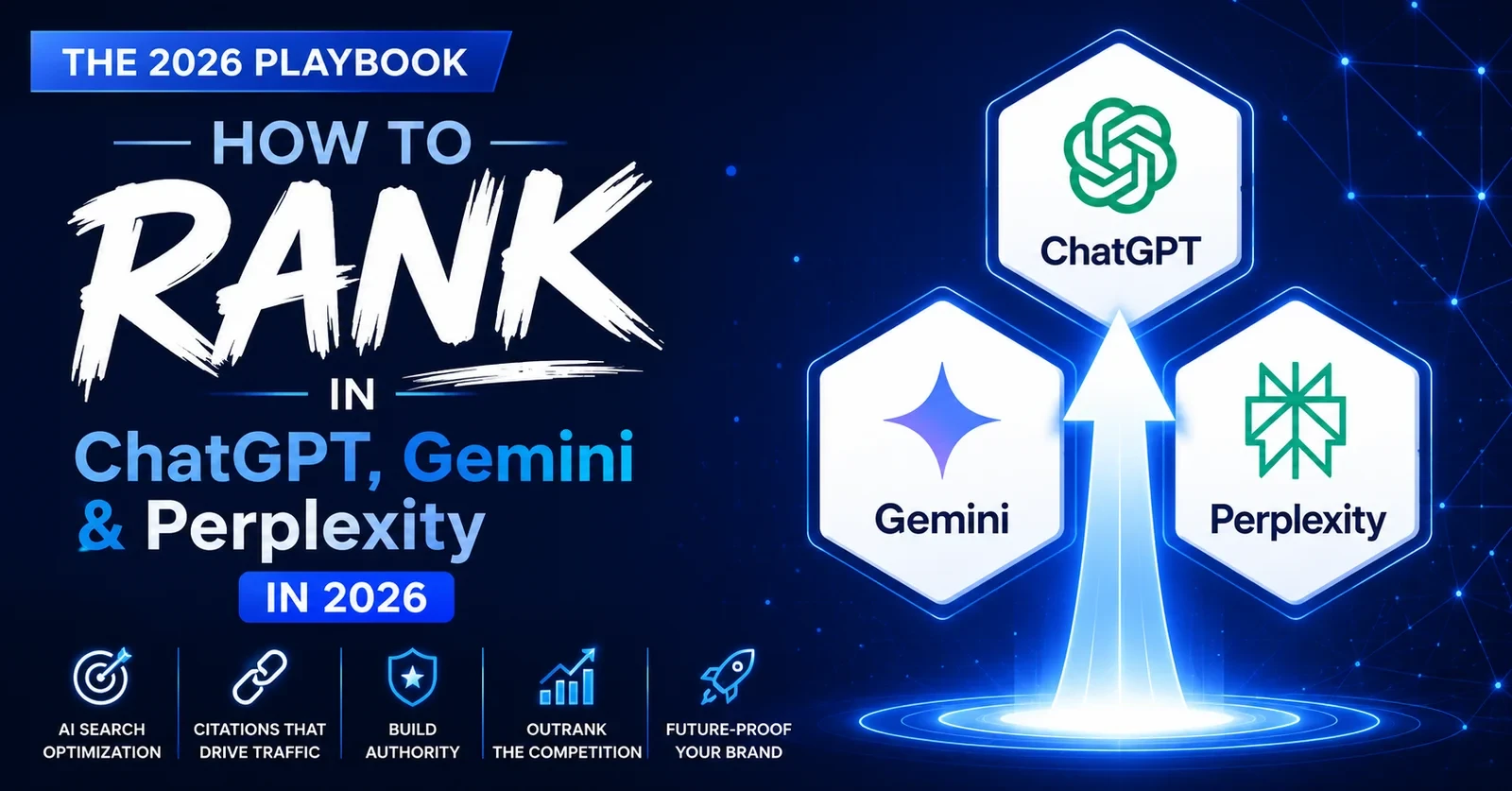
This is the change that changes everything about how to rank in ChatGPT, how to rank in Gemini, and how to appear in Perplexity answers. Traditional SEO got you a position in a list of ten blue links. AI search gives the user one generated answer with two or three cited sources. If your business is one of those sources, you get the traffic and the credibility. If you are not cited, you are essentially invisible to that buyer, regardless of where you rank on Google.
This guide covers how ChatGPT, Gemini, and Perplexity choose their sources, and the 10 things you need to do to start appearing in their answers. This is what Generative Engine Optimization (GEO) looks like in practice.
| Traditional SEO | AI Search |
| Rankings | Citations |
| Clicks | Mentions |
| Keywords | Entities |
| Backlinks | Authority and Evidence |
| Aim for Position 1 | Aim to be the cited source |
The gap between Google rankings and AI citations is quite interesting:
Being number one on Google does not guarantee you appear in ChatGPT or Perplexity. These platforms run their own selection process and regularly choose completely different sources. So you need to optimise for both. AI search visibility is its own channel now, and it rewards different things than traditional SEO does.
Also Read – How AI Benefits SEO
ChatGPT Search uses a Retrieval-Augmented Generation pipeline. It retrieves multiple candidate pages, evaluates them, and selects which sources to cite in a synthesised answer. ChatGPT ranking factors in 2026, in order of observed impact from Wellows analysis of 485,000 citations, are: answer-first extractable structure, Bing indexation and crawler access, original research, being the recognised primary source, schema markup, content freshness, and cross-platform consistency.
One practical thing most people miss about ChatGPT SEO: ChatGPT Search runs on Bing, not Google. Most SEO teams obsess over Google and ignore Bing entirely, then wonder why they are invisible in ChatGPT. Submit your sitemap to Bing Webmaster Tools. It takes five minutes and makes a real difference.
Also Read – ChatGPT Prompts for SEO
Perplexity is built differently from ChatGPT and Gemini. It runs a live web search for every single query. It surpassed 230 million monthly active users in Q1 2026 and processes over 780 million monthly queries. It retrieves candidate pages, reranks them through a multi-layer pipeline, then cites the top 3 to 8 sources inline.
Perplexity decides which sources to cite through a six-stage pipeline: query intent parsing, hybrid web retrieval, three reranking layers testing relevance, recency, entity clarity, and authority, and a final synthesis stage that only cites what it can quote without distortion. Of 5 to 10 retrieved pages per query, 3 to 4 survive.
Perplexity citation optimization specifically rewards freshness more than any other platform. An article published this week has more chances of being cited than the same content published a few days ago. For Perplexity SEO, keeping content updated and properly dated is not optional.
Gemini powers Google AI Overviews, which now appear in 25 to 48% of all US searches according to Conductor and BrightEdge research. Gemini 3 became the default model for AI Overviews on January 27, 2026, and increased average sources cited per answer by 31.8%.
For the Gemini SEO strategy, the most important thing to know is that brands are 6.5x more likely to be cited through third-party sources than through their own domains. Entity authority and off-site mentions carry enormous weight here. Also, 96% of AI Overview content comes from verified authoritative sources. Named authors with credentials, original research with methodology notes, and citations from other credible sources all feed into how to rank in Gemini.
AI Overviews optimization benefits directly from strong traditional SEO, but ranking well in organic search is not enough on its own. Only 19% of AI Overview sources overlap with Google’s top 10 organic results.
Also Read – Future of AI in e-commerce
One article on a topic is almost never enough for AI search visibility. AI engines are looking for the source that knows the subject thoroughly. If you are a Shopify agency, you need connected content around Shopify development, Shopify SEO, speed optimization, ecommerce growth, conversion optimization, and related topics. Our Shopify SEO services start with building exactly this kind of cluster structure before creating individual pages. Publishing 15 to 20 connected articles on a topic signals topical depth in a way that a single article cannot.
AI engines extract answers from pages. If your answer is buried in paragraph six after a long introduction, it gets skipped. Put the direct answer in the first 50 to 100 words of every section. This is the most consistent signal across ChatGPT ranking factors, Perplexity citation optimization, and Gemini SEO alike. Wellows analysis confirms that content with a clear structure gets extracted word-for-word in AI responses, while dense, unformatted content rarely gets cited even when the domain is authoritative.
FAQ sections are heavily weighted by all three platforms.
AI systems pull from questions and answers because they map directly to how users phrase queries.
Add specific, answerable questions to every major page on your website.
Schema-marked FAQ content gets cited 3x more often in ChatGPT answers.
This is one of the clearest wins available in AI citation optimization right now.
AI engines cite sources that bring something new. If your article says exactly what the top 10 ranking articles say, you offer zero information gain, and AI has no reason to pick you over those other sources. Client results, case studies, traffic benchmarks, and conversion data are things only you have. Publish them. Reference them with clear dates and methodology. They are your biggest competitive advantage for LLM SEO.
Experience, Expertise, Authoritativeness, and Trustworthiness. These signals matter for Google, and they matter even more for AI search engines. Named authors with real credentials, team pages that show who actually works at the company, certifications, and published case studies with real numbers all contribute. Anonymous pages with no author information rarely get cited across any of the three major AI platforms.
Brands are 6.5x more likely to be cited through third-party sources than through their own domains. Industry blogs, PR coverage, review platforms like Clutch and GoodFirms, podcast appearances, and YouTube mentions, these build the entity authority that AI engines use to evaluate your brand. AI search marketing in 2026 is as much about off-site presence as it is about on-site content quality.
Comparison content appears in AI-generated recommendations very often.
Shopify vs WooCommerce
SEO vs Google Ads
Shopify agency vs freelancer
These match exactly how people phrase questions when asking AI assistants for help making a decision. Our eCommerce SEO services include building these comparison pages specifically to capture AI citation slots alongside organic rankings.
Schema markup helps AI systems understand what your page is about and what relationships exist between entities. For example:
Organisation schema,
FAQ schema,
Article schema,
Product schema,
Review schema.
For Shopify stores, Product schema and Review schema directly affect visibility in Gemini AI Overviews and Perplexity shopping responses. Our Shopify speed optimization and technical SEO services cover schema as part of the full technical setup because a fast, well-structured store performs better in both traditional and AI search.
AI engines increasingly rely on entity recognition. They check whether your brand exists consistently across multiple trusted sources. Your website, Google Business Profile, LinkedIn, Crunchbase, Clutch, and GoodFirms should all carry consistent information about who you are and what you do. For LLM SEO, the brand that is recognisable across many platforms gets cited. The brand that only exists as a website largely does not. Our Shopify development services clients often bring this up as part of their broader GEO Optimization strategy after the store launch.
Create content like lists, tables, statistics, step-by-step guides, and direct definitions. Structured pages get extracted more easily than dense, unformatted prose. Answer Engine Optimization is really about making your content extractable. If the AI system has to work hard to identify what your answer actually is, it will use a different source that makes it easier.
Also Read – SEO vs AEO vs GEO
Also Read – AI in Performance Marketing
Get a Free AI Search Visibility Audit
Most businesses starting with a GEO Optimization strategy make the same mistakes. And they are not complicated mistakes; they are just easy to miss.
Also Read – 30 SEO Mistakes to Avoid
Use answer-first structure, add FAQ schema, submit your sitemap to Bing Webmaster Tools, and publish original data. Pages with FAQ schema get cited 40% more often.
Keep content fresh and clearly dated. Perplexity runs live web searches for every query and cites only 3 to 4 pages out of every 10 it retrieves.
Strong traditional SEO helps since Gemini draws from Google’s index. Add FAQ schema, build third-party mentions, and keep your Google Business Profile active.
Publish original research, use answer-first structure, add schema markup, submit to Bing Webmaster Tools, and build brand presence on Clutch and GoodFirms.
All three look at content structure, domain authority, freshness, schema markup, and off-site brand mentions. Each platform weighs these signals differently.
Yes. Traditional SEO targets a ranking position. GEO Optimization targets citation selection inside a generated answer. Extractability and entity clarity matter far more here.
Well, it depends on so many things. But Perplexity responds fastest, sometimes within hours. ChatGPT and Gemini take longer. Most businesses see early improvements within 4 to 8 weeks of proper GEO implementation.
Error: Contact form not found.
Appco Software has been around for a very long time, helping startups and established brands build iconic websites and apps. For your unique idea to be presented in a beautiful way, contact us now!