
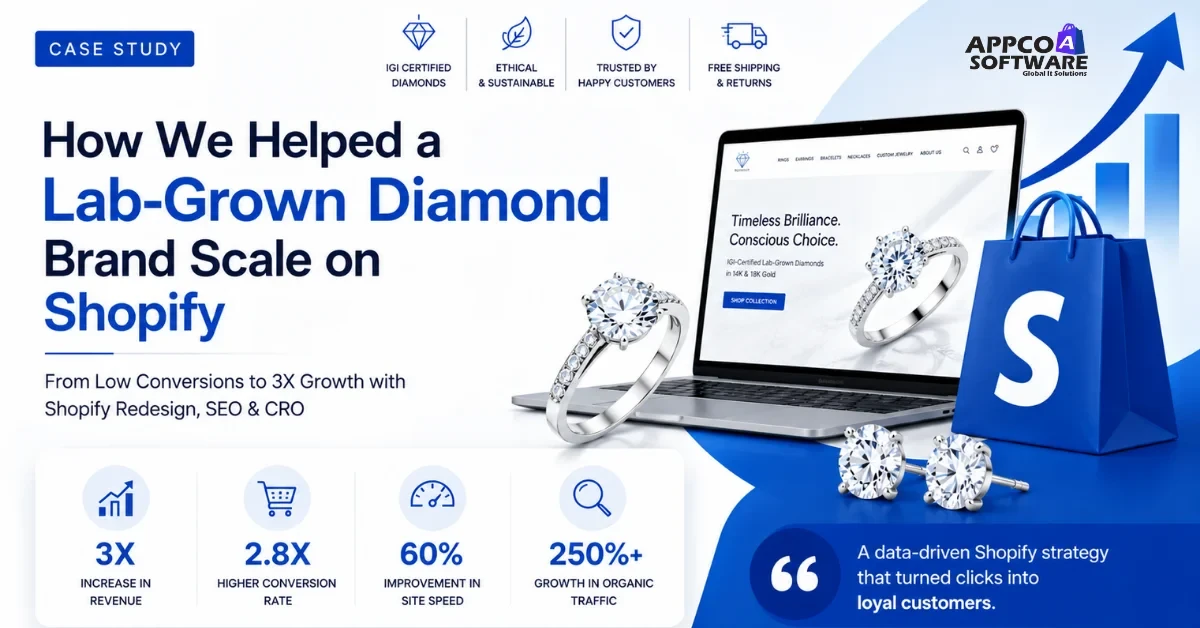
This Shopify case study for a jewelry brand covers what we found, what we fixed, and what changed. We audited the store, rebuilt it from the ground up, and fixed everything that was holding it back. This is a lab-grown diamond eCommerce case study with real numbers and challenges.
The brand specializes in lab-grown diamond jewelry, offering IGI-certified pieces crafted in 14K and 18K gold, including solitaire rings, tennis bracelets, stud earrings, and custom jewelry designs. These are not inexpensive substitutes but genuine diamonds grown in a controlled environment, certified for quality and authenticity, and typically priced 40–60% lower than mined diamonds.
Metro professionals, mostly.
NRIs sending something meaningful back home.
Couples who want a certified diamond for an engagement ring but do not want to spend six lakhs on something that came out of the ground.
17% of the global diamond market is now lab-grown, compared to less than 3% just five years ago. Customer demand is growing rapidly, search volumes continue to increase, and buyers are willing to invest in high-quality lab-grown diamonds. However, despite operating in a growing market, the brand’s website was not effectively engaging visitors or guiding them toward a purchase.
Continue reading this case study to know more about the challenges that the brand was dealing with every single day.
The store was getting visitors. The conversion rate was not reflecting that at all. Visitors were landing on product pages and leaving without adding to the cart. The product pages had single images in many cases, no size guides, no trust signals, and no social proof. For a high-consideration category like lab-grown diamonds, where a customer might research for weeks before purchasing, that kind of product page does not close a sale.
Mobile performance was a real problem. The store was loading slowly on mobile, which is where most of their buyers were browsing. Heavy image files, unoptimised apps running in the background, and a theme with too much unnecessary code were all pulling down the PageSpeed scores. According to Google, 53% of mobile users abandon a page that takes more than three seconds to load. This jewelry brand was nowhere near that threshold.
Navigation was not set up for how people buy. Someone looking for a round solitaire ring in 18K gold for under ₹1,50,000 had no easy way to filter to that. Collections were too broad. There was no wishlist feature. Product discovery required too many clicks. That kind of friction in a high-intent category means lost sales at every step.
The store had almost no organic visibility. Collection pages had no meta descriptions. Product titles were not optimized for how people search. The blog content was absent. Technical SEO basics, canonical tags, sitemap submission, and structured data were either missing or incorrectly set up. The brand was entirely dependent on paid ads for traffic, which is an expensive way to run a jewelry ecommerce business long-term.
The first thing we did was rebuild the store’s visual and structural foundation. We worked on a mobile-first Shopify store redesign that addressed how people browse. The homepage was rebuilt to communicate brand trust immediately, with IGI certification badges, ethical sourcing statements, and real customer reviews visible above the fold.
Collection pages were restructured to match purchase intent. Instead of broad categories, we built collections around the way people think: by metal type, stone shape, occasion, and price range. Navigation was simplified to three clicks maximum to reach any product.
This Shopify store redesign case study starts here, because the redesign was not cosmetic. Every UI decision was tied to a conversion or SEO outcome.
We ran a full audit of the store’s technical performance as part of this Shopify performance optimization case study. Heavy image files were compressed and converted to WebP format. Unused apps that were loading scripts on every page were removed or replaced. The theme code was cleaned to remove render-blocking elements.
The result was a significantly faster store on both desktop and mobile. Our Shopify speed optimization work brought Core Web Vitals scores into the green across LCP, FID, and CLS metrics. A faster store means lower bounce rates, better Google rankings, and a checkout experience that does not frustrate the customer mid-purchase.
Product pages were rebuilt from scratch for this Shopify CRO case study. Multiple images, 4Cs breakdown, IGI certification details, size guide, all on one page. No reason for a customer to go looking elsewhere. We also worked on trust signals. For example: return policy badge, free shipping threshold, secure checkout indicators, and review widgets.
Checkout dropped from four steps to two. Added a persistent cart and one-page checkout for returning customers. That one change alone moved the numbers in this Shopify conversion rate optimization project more than anything else.
Organic visibility was close to zero when we started. Our Shopify SEO services work covered three things.
The standard theme could not do what this store needed. Through our Shopify development services, we built everything from scratch.
Here is what changed after the project was complete:
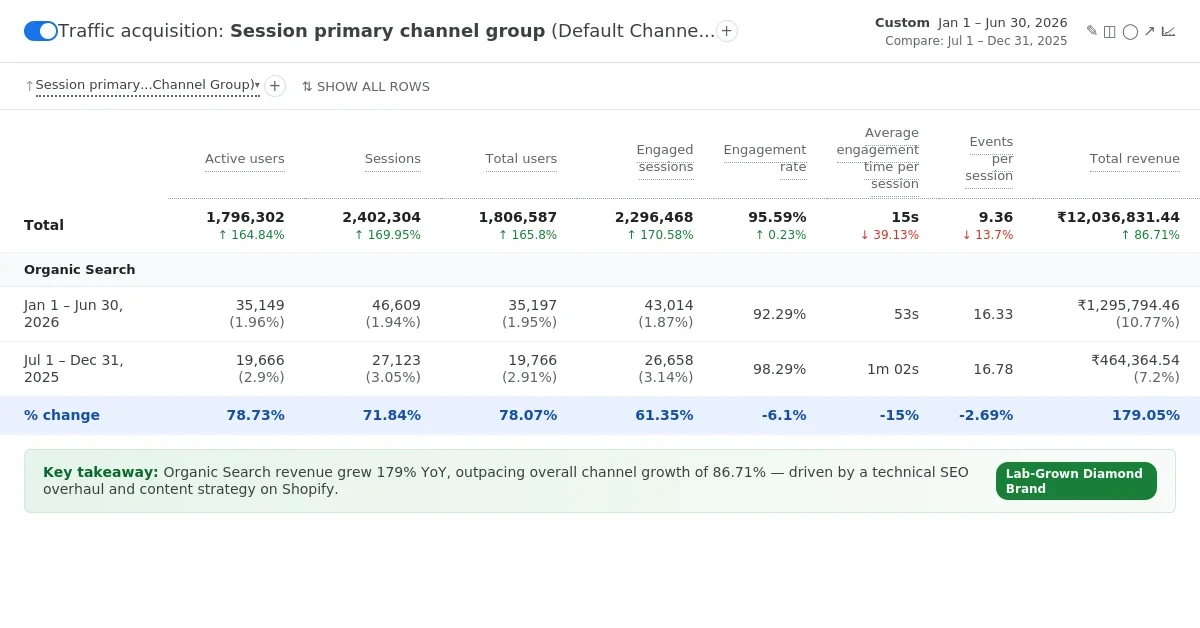
These numbers are what a proper Shopify growth case study looks like in practice. The conversion rate improvement came from the product page rebuild and checkout simplification. The organic traffic growth came from the technical SEO fixes and the collection page content. The mobile speed improvement came from image optimisation and code cleanup.
None of these results came from a single change. It was the combination of redesign, performance work, CRO, and SEO applied together that made this a complete eCommerce growth case study.
If we had to pick the four things that moved the numbers most in this Shopify conversion optimization case study, it would be these.
If you run a jewelry brand on Shopify and your store is not performing, this ecommerce scaling case study has a few things worth paying attention to.
Appco Software is a Jaipur and Mumbai-based Shopify development company with 13+ years of experience building and optimising ecommerce stores across fashion, jewelry, home decor, and B2B categories. This Shopify case study for a jewelry brand is one of many similar projects the team has delivered for D2C brands across India and international markets.
Our services for jewelry brands on Shopify cover the full project lifecycle: store audit, redesign, performance optimisation, conversion rate optimisation, SEO, custom feature development, and post-launch support.
If your jewelry store is live on Shopify but not performing the way it should, get in touch with us for a free Shopify audit. We will tell you exactly what is holding the store back and what it would take to fix it.
The brand is now in a fundamentally different position than when it first came to us. The store converts. It loads fast. It ranks for the terms their buyers search. And the foundation is there for the next phase of growth. That is what a complete Shopify success story looks like.
It varies a lot. A simple mid-size store takes around 1 week. And for custom features or a messy product catalogue, it can take up to 4 to 6 weeks.
Yes, and we have done it. The key is setting up metafield-based filtering properly so a customer can find the right product.
Shopify SEO helps a jewelry brand a lot. Jewelry is a visual and emotional category; people research a lot before buying. So when your store shows up for the right search, it converts better than most other product types.
Klaviyo for cart recovery, a review app that outputs schema so stars show on Google, a wishlist for customers who need time before deciding, and a filtering app for bigger catalogues.
We measure around six things, before and after. Conversion rate, organic traffic, revenue, mobile speed score, session time, bounce rate. If those go in the right direction, the project did its job.
We have set this up for brands going into the UAE and the US. Shopify Markets takes care of currency, local payments, and shipping. No extra development is needed every time you want to reach a new market.
Error: Contact form not found.

Appco Software has been around for a very long time, helping startups and established brands build iconic websites and apps. For your unique idea to be presented in a beautiful way, contact us now!