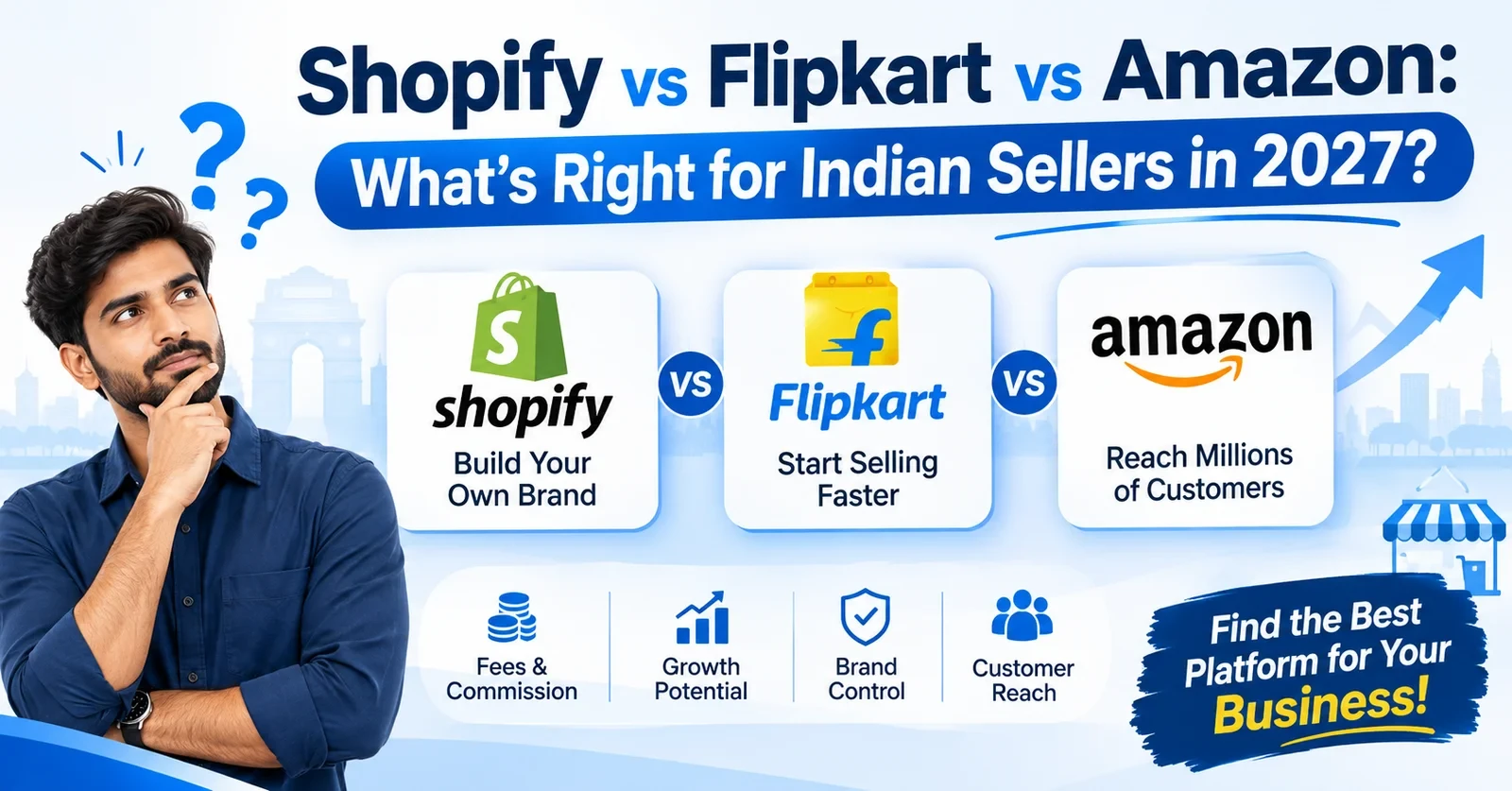
Shopify vs Flipkart vs Amazon is more a question of ownership than of apps. Flipkart and Amazon give you shelf space on rent inside their app. On Shopify, for example, you build your own shop.
If you want sales from the first day with less setup, then start from a marketplace. If you want your own brand and the list of your own customers, then make a Shopify store. When orders start coming in regularly, run both.
We have been making Shopify stores for Indian brands for years through our Shopify store development services. The founders who grow the fastest take this as a plan with two parts. Below, we have compared the fees and growth of all three, and all the figures are checked from official pages in November 2026.
Here is the full comparison at one glance before we go deeper.
| Factor | Amazon India | Flipkart | Shopify |
| Monthly fee | None for standard sellers | None to register | ₹1,994 a month on Basic, ₹1,499 a month billed yearly |
| Commission | 0% referral fee on eligible products under ₹1,000 in 1,800+ categories, category rates above ₹1,000 | 0% on eligible products under ₹1,000, 0% on all fashion at any price | No Shopify commission, 2% fee on third-party payment gateways on Basic |
| Other selling costs | Shipping, fulfilment, closing and other fees may apply | Fixed fee, shipping, COD or collection fee, returns and GST on fees may apply | Domain, apps, gateway processing, shipping and marketing costs |
| Brand control | Low | Low | Full |
| Customer data | Marketplace controls the buyer relationship and data | Marketplace controls the buyer relationship and data | You own first-party customer data |
| Speed to start | Fast | Fast | Slower at first; you build and run the store |
| Best for | Testing products and marketplace volume | Value products and fashion volume | D2C brands, premium brands and owned customer relationships |
No, they are two different kinds of business. Flipkart is a marketplace, so visitors come to Flipkart and your product shows up next to other sellers. Shopify is software you pay for to build your own website on your own domain.
This is the good choice in Shopify vs marketplace in India. On a marketplace, the visitor belongs to the platform. On Shopify, the visitor belongs to you, but you have to bring that visitor to your site yourself.
All three platforms sell your products online, but the way you join and get paid is different on each one. Let us see them one by one.
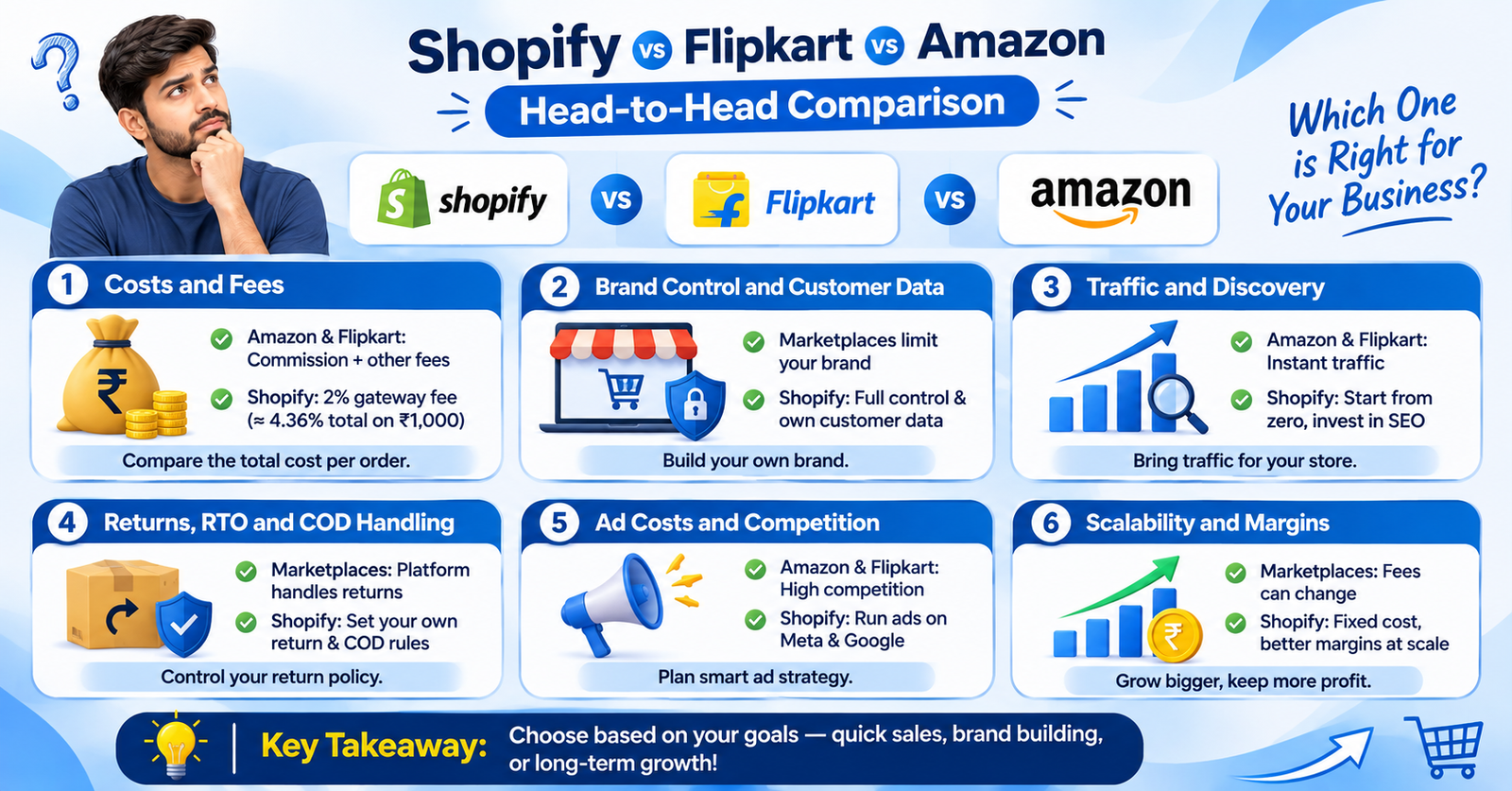
Now let us compare all three on six points, from fees to margins. Each point below shows where one platform is strong, and where it can cost you more money.
The meaning of zero commission is not zero fees. Amazon India removed the referral fee on eligible products under ₹1,000 in 1,800+ categories from March 16, 2026. But on September 7, 2026, the closing fee went up: ₹1 on items up to ₹500 and ₹3 on items above that. Flipkart removed the commission on every fashion product in July 2026, but its fixed fee and collection fee still get charged on every order.
Shopify also has one hidden layer of its own. Shopify Payments is not available in India, so every Indian store runs on a third-party gateway like Razorpay or PayU. Over the gateway charge, Shopify takes 2% on every order in Basic, 1% in Grow, and 0.6% in Advanced. As per Razorpay, after adding its own 2% and GST, the total cost on Basic comes to about 4.36% on a ₹1,000 prepaid order. Shopify’s fee does not get charged on cash on delivery orders, because no gateway handles them.
So compare the platforms on the cost of one full order, and never only on the commission you see on top.
The marketplace decides how your listing will show, right beside other sellers. On Shopify, your theme and product pages are in your hands, and that is why brands spend on Shopify website design services from the start. The big thing is data. On Shopify, you keep the email and phone number of every customer with you, and you can reach that person again for free.
Marketplaces bring visitors who already want to buy. A new Shopify store starts from zero visitors, so you have to bring traffic from Google and social media. Search takes months to build, and good ecommerce SEO services in India start with product page titles and site speed.
Marketplaces run returns by their own policy, and when the parcel comes back, the seller pays the fee. On Shopify, you decide your return rules yourself and choose which PIN codes cash on delivery will be given. RTO pinches more on your own store, because you pay for the shipping on both sides. That is why many brands push prepaid with a small discount, and our guide on COD vs prepaid orders tells you how to reduce RTO.
On Amazon and Flipkart, you bid against other sellers for the same search term inside the app. On Shopify, you give money to Meta or Google for clicks. None of the two is cheap, but a Shopify ad can bring back that customer who is already yours.
The margin on a marketplace depends on those fee changes, which you cannot control, and both platforms changed seller fees in 2026. The cost of Shopify is fixed as per the plan, so the margin gets better as orders grow. Higher plans reduce the Shopify fee on every order, and this saving matters more at high volume.
Every platform gives you something and takes something in return. So before choosing one, read the good and weak points of each below, and match them with your business stage.
| Platform | Pros | Cons |
| Amazon India | Huge ready traffic, Prime badge through fulfilment | Fee changes, price wars, no customer data |
| Flipkart | Zero commission on fashion, strong in value shopping | Strict penalties for fulfilment lapses, no customer data |
| Shopify | Full brand control, own data, repeat sales | Monthly fee, you build traffic yourself |
The best ecommerce platform in India 2027 depends on your stage. New people who are testing products should start from a marketplace. Listing costs no money there, and before spending on a website, you get to know what sells. Our list of ecommerce business ideas for 2027 can help you in choosing a category.
D2C and premium brands of jewellery, apparel, or home decor should build on Shopify. These products sell on photos and trust, and a results page full of cheaper sellers makes both of them weak.
For many growing brands, the ecommerce website vs marketplace debate ends in a mix of thoughts.
To get a store like Amazon, you do not need a custom build. Shopify already manages search, cart, and checkout, and with the right theme, a few apps do the work of filters and reviews.
In a custom build, the cost is more and the time taken is also more, and then you also pay the money for maintaining the code.
With good ecommerce website development services, a Shopify store can give a shopping flow like a big marketplace, and only your products show in it.
If you want to read the full method step by step, then read our guide on how to build a website like Amazon.
Appco Software is one of the best Shopify ecommerce development agencies in India. We have been in this business for over 13 years, and we have delivered more than 5,000 projects in these years. If you have been thinking about these platforms or are confused between the two, we are here to help. Our team has top Shopify engineers you can talk to directly.
Our Shopify store development services include:
If you are not sure what to go with, talk to our Shopify experts or share your complete requirements with the team. We will take it from there.
Shopify is better than Amazon for those sellers who are building a brand and repeat customers. Amazon is better for fast sales without any setup, so many sellers start there and add Shopify later.
You can sell on Flipkart and Shopify together, and many brands are doing it already. Just use an inventory sync app so that the stock gets updated on both channels.
Owning customer data is not possible on Amazon or Flipkart. Like, the marketplace controls the buyer relationship, and you only see the order details that are needed for shipping.
For jewellery and apparel brands, Shopify is better for building a brand, because these products sell on photos and trust. But Flipkart’s zero fashion commission does help in getting volume, so a mix of both makes sense.
Your Shopify store development cost in India depends on the theme and on the custom work you need. The Basic plan is ₹1,800 a month before GST, and the build cost changes, so first take a written quote.
No, Shopify Payments is not available in India yet. So you connect a gateway like Razorpay or PayU, and Shopify adds its own fee on every order on top, except for cash on delivery orders.
Error: Contact form not found.