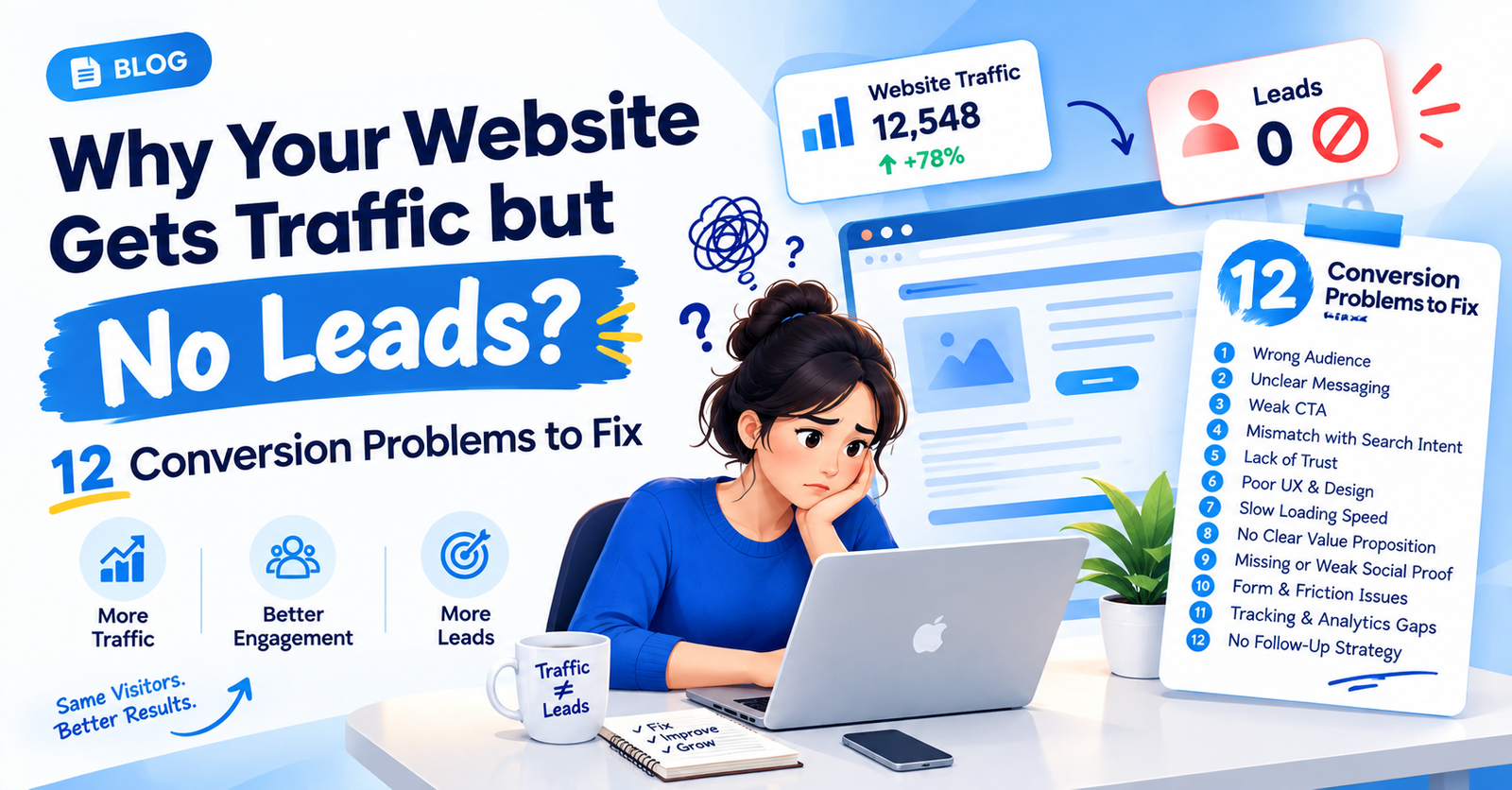
Getting website traffic but no conversions is something we see all the time. Visitors are coming in, the numbers look fine, but the enquiry box is empty. And somewhere along the way, every business in this situation starts asking the same thing: why is my website not converting?
We have audited dozens of websites like this. Almost every time, traffic is not the problem. Something in the conversion path is. Website lead generation does not stop working because traffic dries up. It stops because something breaks between the visitor arriving and the moment they should be filling out your enquiry form.
If you run a service business, an eCommerce store, or a D2C brand and your enquiry volume does not match your traffic, this guide is for you.
Websites get traffic but no leads when the audience is wrong, messaging is weak, trust is missing, or tracking is broken. You do not need more visitors. You need the ones already coming to actually enquire. Our website CRO services are built for this exact situation, and this guide helps you find what is breaking your funnel before you spend another rupee on ads or SEO.
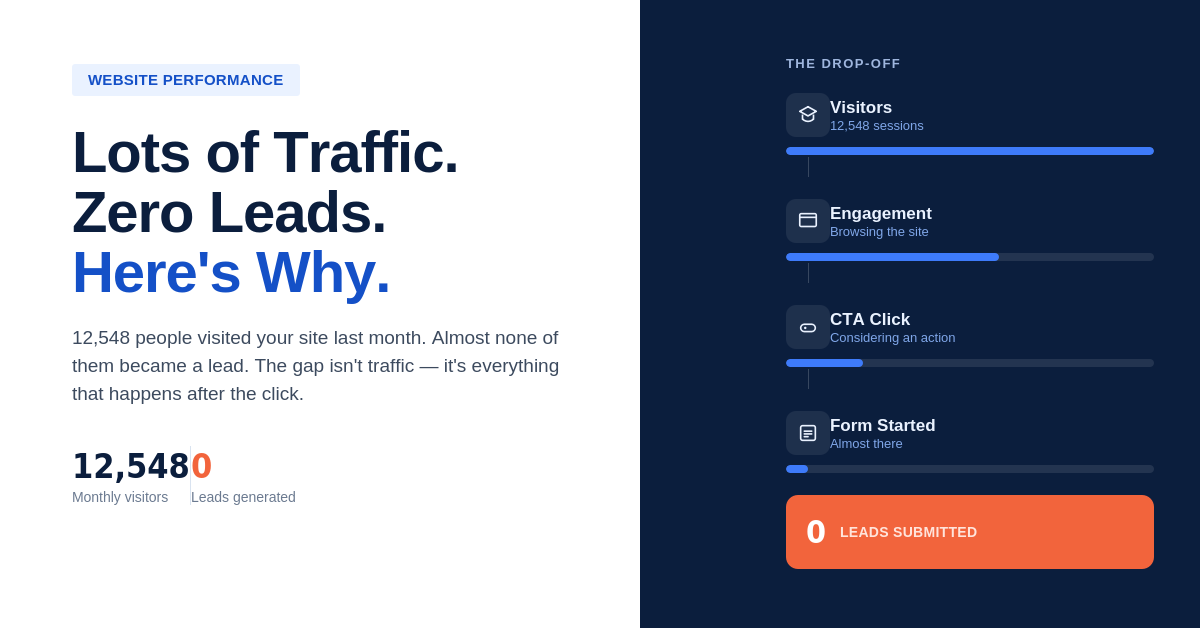
Let us be clear on something first. Traffic and leads are not the same metric, and treating them the same leads to the wrong fix.
A Simple Website Conversion Formula
Conversion Rate = Leads / Website Visitors x 100
For a B2B service website, 2 to 5 percent conversion is healthy. Below 1 percent with consistent traffic means something between the visitor arriving and the enquiry form is broken. That is a website conversion problem.
This is the most common website conversion problem we have seen over the years. And it is hard to spot because the numbers in Analytics look fine on the surface. If your Search engine optimization (SEO) is pulling informational traffic- people who are researching a topic rather than people ready to buy- your enquiry rate will stay low no matter how well the website is built.
For example:
You have about five seconds before a visitor decides whether to stay or leave. In that time window, they need to understand what you do, who you serve, and what they should do next. Most websites fail this. A headline like We Build Better Businesses says nothing specific. A visitor should be able to answer five questions just from your homepage.
If your page cannot answer all five above the fold, you are losing people who could have become clients. This is one of the biggest reasons a website gets visitors but no leads, even when the traffic numbers look perfectly fine in Analytics.
A button that says Submit tells a visitor nothing about what they are going to get. The CTA copy should be very specific about the outcome.
For example: Get a Free Website Audit. Request a Project Estimate. Talk to an Expert.
The visitor needs to know exactly what happens after they click. Placement, on the other hand, matters just as much as the wording. CTA in the hero section, after the main service sections, near your testimonials, and again at the bottom of the page. A visitor who scrolls all the way down was clearly interested. If there is no CTA there, that interest goes nowhere.
Most businesses trying to increase website conversion rate start with traffic and ads. But fixing the CTA alone, wording and placement together, is one of the fastest ways to improve website conversions without spending anything extra.
Someone searches for a Shopify development company in India and clicks your ad. They expect a Shopify development page. If they land on your homepage instead, the page does not match what brought them. They leave within seconds.
We see this constantly with paid campaigns. The ad is specific. The landing page is generic. That disconnect is where conversions die, and ad budgets go to waste.
Every campaign needs to send visitors to a page built for the exact search they came from. When the ad, the page, and the CTA all match the same intent, website conversion optimization starts working in your favour.
In general, most service websites describe what they do but never show actual evidence they have done it well for other businesses. If your target audience does not trust you, they will not contact you.
What builds trust is not a list of services. It is called client testimonials with real company names, case studies with before-and-after numbers, recognisable client logos, a team page with actual photos, a working phone number, and a physical address. A website without any of this looks like it might not be around six months from now.
We have come across contact forms with fourteen mandatory fields. Name, designation, company, phone, email, website, budget, timeline, source, project description, file upload, terms checkbox. Nobody fills that out on a first visit.
The first form should ask for as little as possible. Name and phone number. One line about the requirement. Get the lead first, and everything else comes out in the follow-up conversation. Also test your form on a phone right now. A broken submit button on mobile does not show up in your analytics, but it costs you enquiries every day.
Core Web Vitals are not just an SEO metric. They directly affect whether someone stays long enough to see what you offer.
Google’s own research shows that when page load time goes from one second to five seconds, the probability of someone leaving goes up 90 percent. Our Shopify speed optimization service is built around this because we see how directly it affects lead generation. Navigation problems cause the same kind of quiet drop-off. If a visitor cannot find your services page in two clicks, they leave.
In India, most of the traffic comes from mobile devices only. Most websites are still built desktop-first and adjusted for mobile as an afterthought. The result is a mobile experience that pushes people away before they even see your offer.
A visitor who is close to enquiring wants specific answers before they pick up the phone.
Your website should answer these questions. You can put these things in the FAQs section, for example. This also matters directly for how to generate more leads from website traffic through AI search. Google AI Overviews and Perplexity extract content that gives specific, direct answers.
Claims without evidence do not convert. If you claim big things but do not have something to show, it makes no sense.
A client who went from, let’s say, 800 visits a month to XXX in six months. A screenshot of ranking improvements. A quote from a named client saying exactly what changed after working with you. Without evidence behind the claims, you are asking strangers to take your word for everything.
Most visitors do not enquire on their first visit. They are still researching. For example, some people come back two or three times before they decide. If you have no system to stay visible between those visits, you lose them to whoever they find next time.
Remarketing through Google or Meta keeps you in front of people who already showed interest. An email capture with something genuinely useful, a free audit offer, or a practical guide gives you a way to keep the conversation going. Our performance marketing services include retargeting setup as part of the full funnel strategy because one visit is rarely enough in a service business.
12. You Are Not Measuring the Conversion Funnel Correctly
This is one of the most important things. Sometimes leads are coming in, but nobody knows it because tracking was never properly set up.
Common gaps we find in audits:
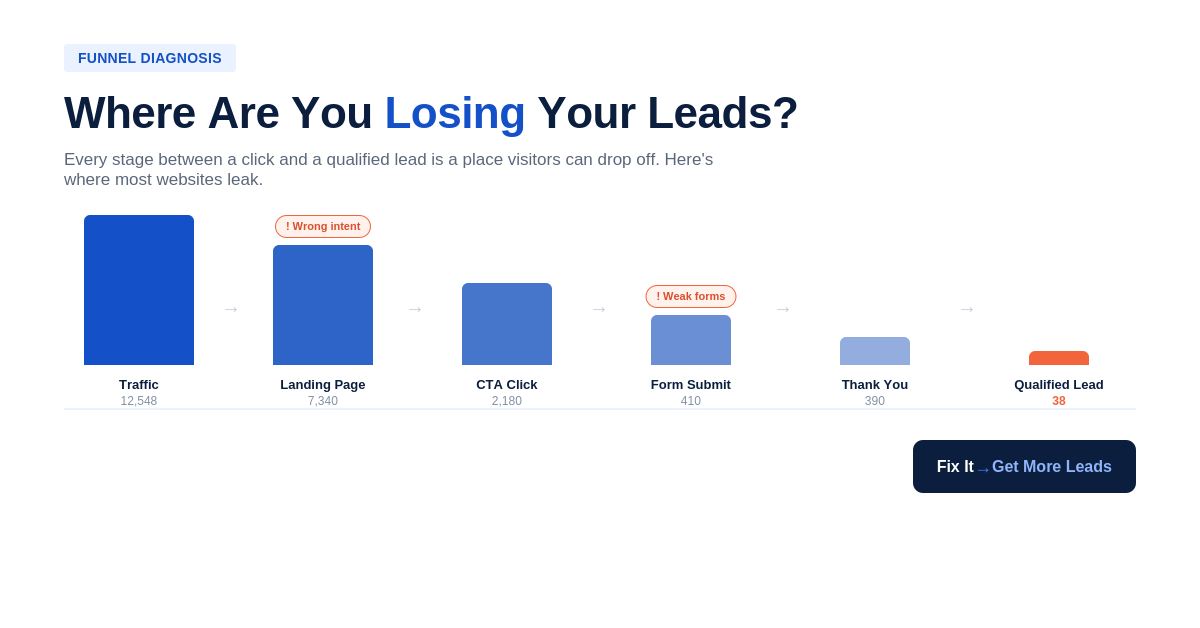
Traffic Source → Landing Page → CTA Click → Form Submit → Thank You Page → Qualified Lead
If any step here is missing from your tracking, you are assuming where people drop off. And assuming the fix is almost always more expensive than finding the actual problem.
Step 1: Check Traffic Quality: Open Google Search Console. Look at the search queries bringing visitors.
Step 2: Check Engagement: In GA4, look at scroll depth on your key service pages. Are visitors even reaching your CTAs?
Step 3: Check Conversion Points: Are people clicking your CTAs? Use heatmaps or GA4 event tracking. A CTA nobody clicks is either not visible, not compelling, or placed in the wrong spot.
Step 4: Check Technical Issues: Test your forms across three different devices. Run a Core Web Vitals check in the Search Console. Solve what is broken before doing anything else.
Step 5: Check Lead Quality: If some enquiries are coming in but not turning into clients, the problem may be audience intent at the top of the funnel. Look at where your best existing clients came from and work backwards.
Here is the conversion audit checklist for you to follow. Take a quick look:
| Area | What to Check |
| Traffic | Keyword and audience match |
| Messaging | Homepage value proposition clarity |
| CTA | Wording and placement across the page |
| Landing Pages | Intent match with the search query |
| Trust | Case studies, testimonials, team info |
| Forms | Field count and mobile usability |
| Mobile | Speed, tappable buttons, navigation |
| Speed | Core Web Vitals scores |
| Content | Buying questions answered clearly |
| Tracking | GA4, GTM, and conversion events configured |
As an eCommerce website development company in India, we work with D2C brands, eCommerce businesses, and service companies who are stuck exactly here.
If your website gets traffic but enquiries are not following, the gap is in one of these areas. We find it and solve it.
Get a Free Website and Conversion Audit from Appco Software.
Most of the time it is an intentional mismatch. Visitors from informational searches are researching, not buying, so website traffic but no conversions is the result.
Your website visitors are not converting because of weak CTAs, slow pages, or too much form friction.
For B2B service websites, 2 to 5 percent is healthy. Below 1 percent means your conversion funnel has a problem worth fixing now.
Check traffic intent first. Then solve CTAs, trust signals, and contact friction. That is how you improve website conversions without spending more on ads.
Yes, easily. Informational keywords bring readers. Website lead generation only works when you target commercial-intent searches alongside informational ones.
If your traffic is growing but enquiries are almost zero, it is the clearest signal. You should check CTA click rate, form completion rate, and whether GA4 is tracking website conversions correctly.
Error: Contact form not found.
Appco Software has been around for a very long time, helping startups and established brands build iconic websites and apps. For your unique idea to be presented in a beautiful way, contact us now!