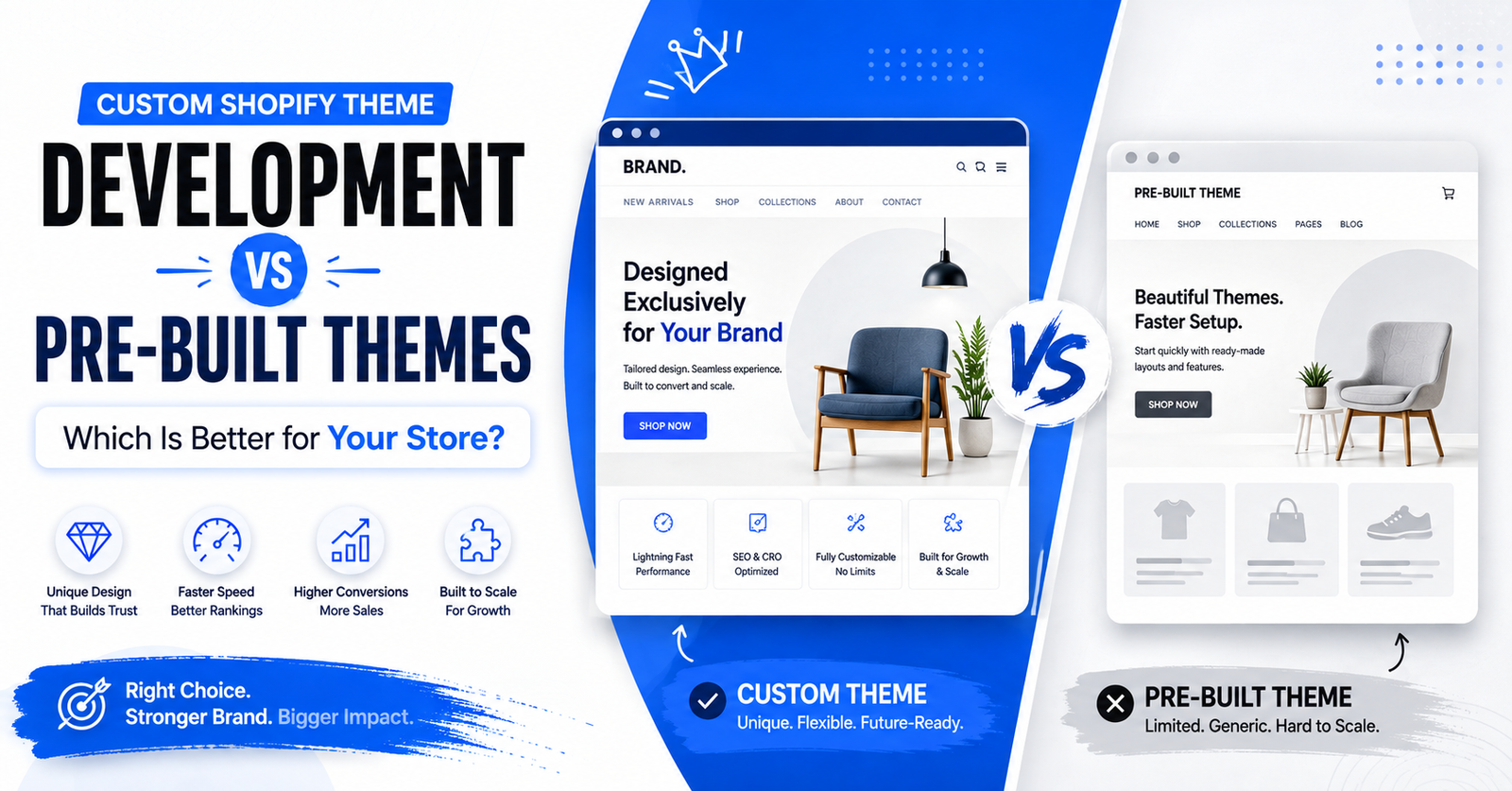
Your Shopify store design touches more than visuals. Page load speed, how Google reads your store, how a customer gets from product discovery to payment, whether your brand looks like yours or like fifty other stores on the same theme. All of that comes from this one decision.
Most people choose between custom Shopify theme development and a pre-built theme based on upfront cost alone. That comparison misses the point entirely.
That said, in this guide, we are going to cover the real cost data and performance numbers. Read it before you decide.
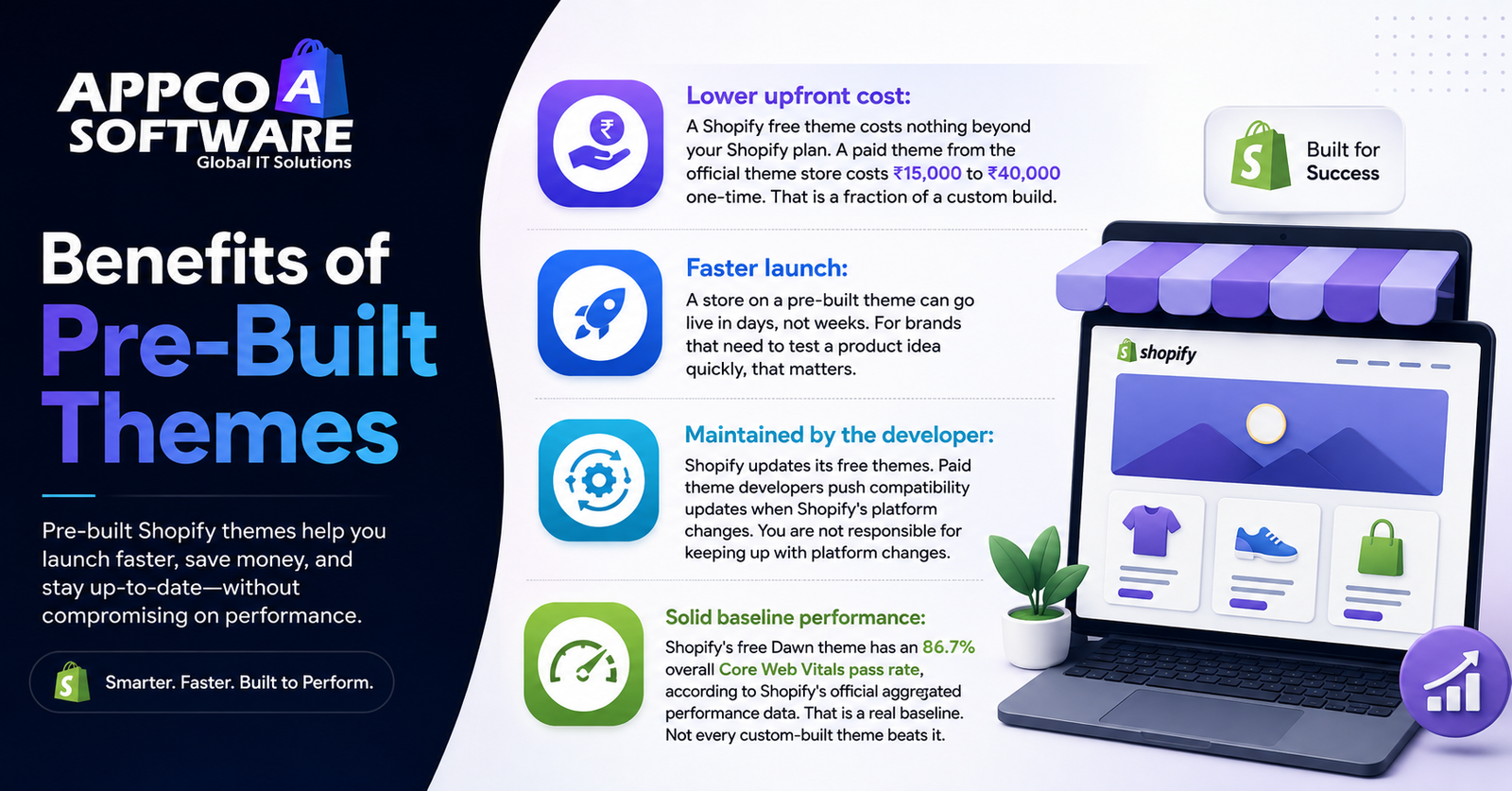
Shopify’s own theme store has both free and paid options.
Free themes: Dawn, Horizon, Sense, Craft, Studio. Shopify builds and maintains all of these themes directly.
Paid themes: Paid themes cost $180 to $500, one time payment. For example: Impact, Impulse, Prestige, and Symmetry. These are the names that come up most when Indian brands are shortlisting.
You install the theme, configure colors and fonts, upload your logo, and adjust sections through Shopify’s visual editor. No coding required. Most Shopify 2.0 themes support drag-and-drop sections across every page type.
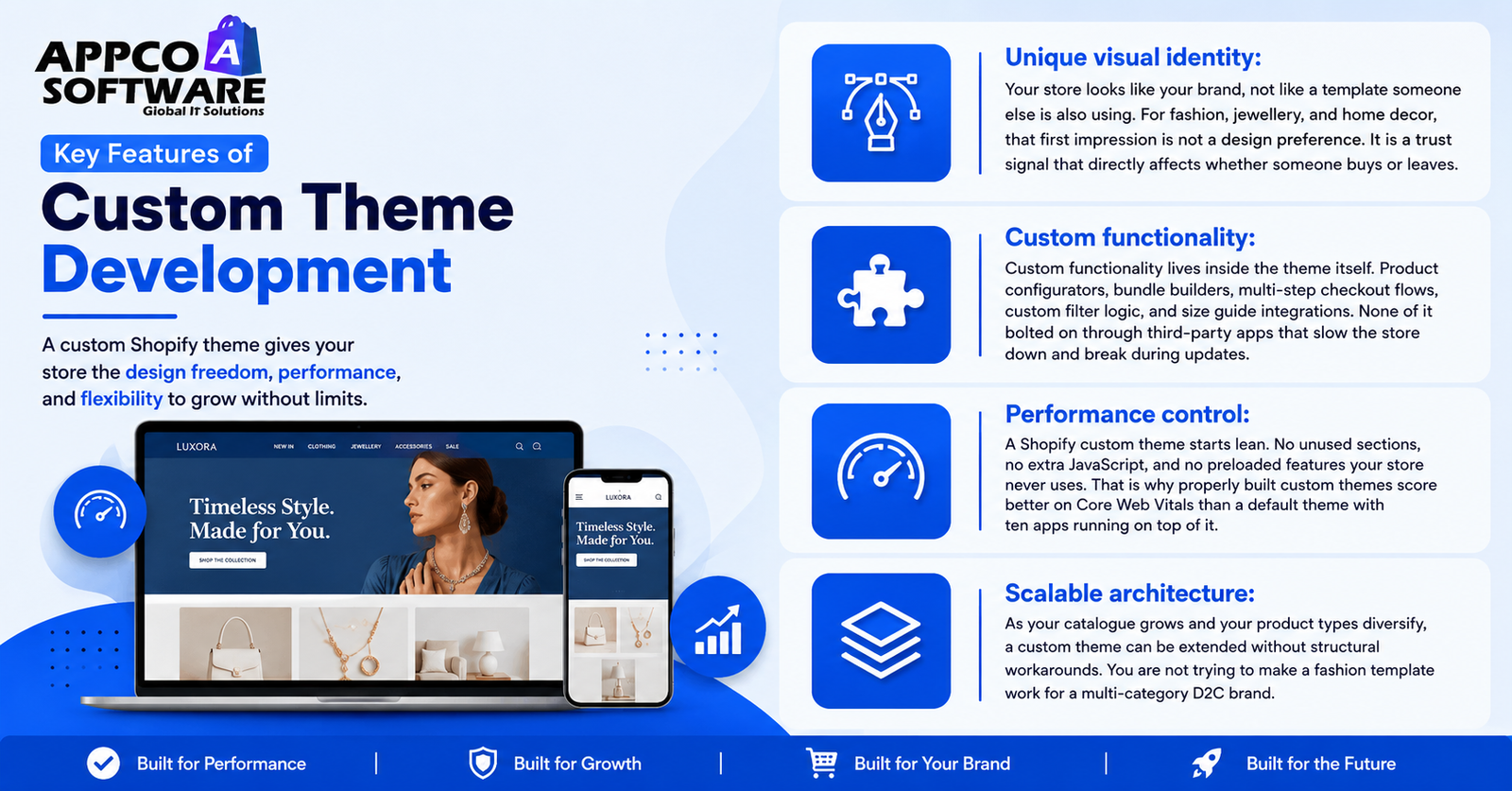
Custom Shopify theme development means building a storefront from scratch using Shopify’s Liquid templating language, combined with HTML, CSS, and JavaScript. A Shopify theme developer writes the code specific to your brand. Not adapting a template, but creating the structure, sections, and functionality from a design brief.
A custom Shopify theme is an entirely separate codebase built to a design specification. Every section type, every interactive element, and every product page layout is built deliberately for how your specific buyer shops.
Shopify 2.0 theme development gives developers full access to the Online Store 2.0 architecture without the constraints of a pre-existing template.
| Factor | Pre-Built Theme | Custom Shopify Theme |
| Upfront Cost | ₹0–40,000 | ₹50,000–3,00,000+ |
| Launch Time | Days | 4 to 8 weeks |
| Design Uniqueness | Generic | Brand-specific |
| Shopify Theme Customization Limits | High | None |
| Performance Baseline | Good (Dawn: 86.7% CWV pass) | Depends on build quality |
| App Dependency | High | Lower |
| Scalability | Limited | High |
| SEO Control | Standard | Full |
| Enterprise Theme Shopify Fit | Limited | Full |
| Long-Term Cost | Higher (apps & patches) | Lower |
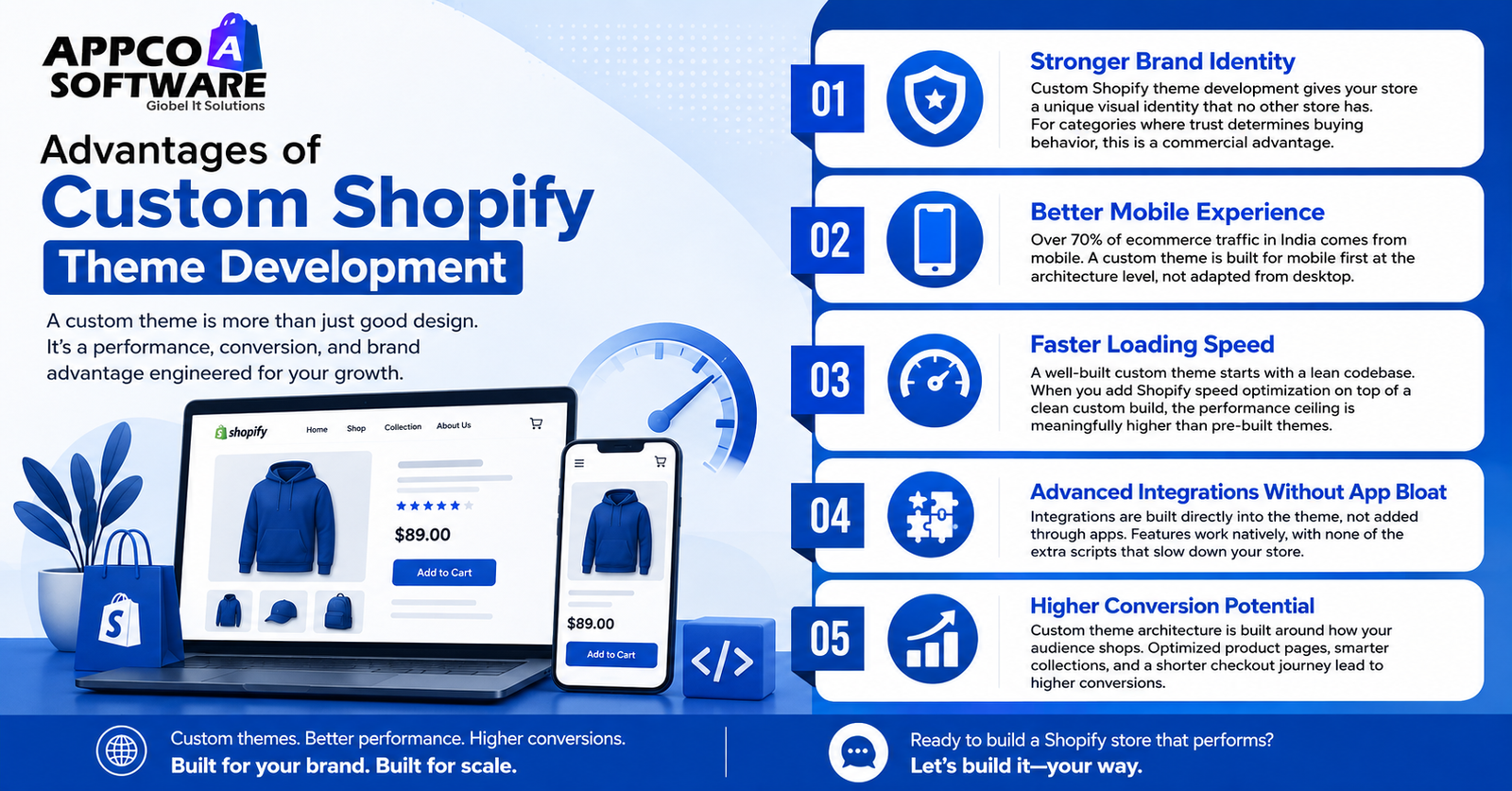
If your store looks like an Impact theme with different colors, that familiarity works against you. Custom Shopify theme development gives your store a visual identity that no other store has. For categories where trust determines buying behavior, this is a commercial advantage.
Over 70% of ecommerce traffic in India comes from mobile. A custom theme is built for mobile first at the architecture level, not adapted from desktop. Tap targets, sticky cart behavior, image loading order, and filter UX are designed for how a customer uses a phone.
A well-built custom theme starts with a lean codebase. No unused sections rendering in the background. No template JavaScript is running for features your store does not use. When you then add Shopify speed optimization work on top of a clean custom build, the performance ceiling is meaningfully higher than what is achievable on a bloated pre-built theme. We covered the most common speed problems in our blog on the Shopify store running slow: problems and fixes.
Custom Shopify theme development services allow integrations to be built directly into the theme rather than added through apps. A review system, a loyalty widget, a WhatsApp chat button, and a dynamic bundle builder can all be coded natively, with none of the external script loading that app-based equivalents add to every page.
A custom theme is built around how your target audience shops.
Our Shopify conversion rate optimization services consistently show that stores with custom theme architecture convert better than structurally identical stores running on stock templates.
We documented one example in our lab-grown diamond Shopify case study.
The mistake is staying on a pre-built theme after you have grown past what it can support.
The problem is not starting on a pre-built theme. The problem is staying on one after your store has grown past what it can do.
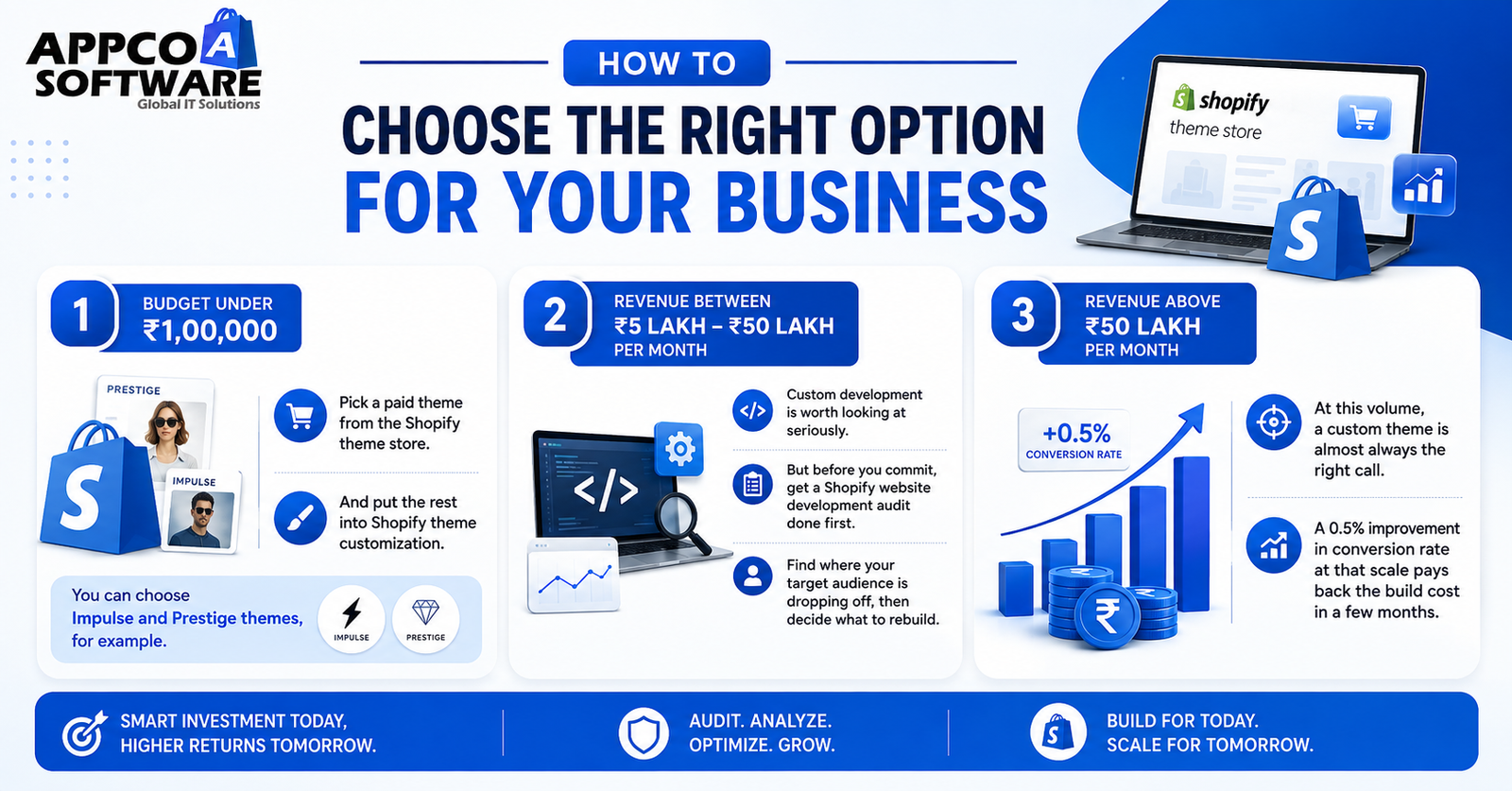
Invest in a custom Shopify theme when your store has consistent revenue, and you know what your customers respond to. Specifically:
If two or more of those apply, a custom development will pay for itself faster than continued patching.
All figures are verified 2026 India market data.
| Cost item | Pre-built theme | Custom theme |
| Theme purchase | ₹0 – 40,000 | — |
| Design and development | — | ₹50,000 – 3,00,000 |
| Developer customization | ₹25,000 – 75,000 | — |
| App subscriptions (per month) | ₹5,000 – 10,000 | Low dependency |
| Annual app spend | ₹60,000 – 1,20,000 | Minimal |
| Year 1 total | ₹1,00,000 – 2,50,000+ | ₹80,000 – 3,50,000 |
A store paying ₹8,000/month on apps spends ₹96,000 per year on features that a custom theme could have included once. The cost gap narrows within 12 to 18 months.
The Shopify theme development decision is not just a build cost decision. It is a total cost of ownership decision.
Appco Software is one of the leading Shopify expert agencies in Jaipur. In fact, we are a certified Shopify Partner with 13+ years of experience and 5,000+ projects delivered. As a Shopify development company working across fashion, jewellery, home decor, and D2C food brands, we do not recommend a custom development to every client. We audit the current store first and go from there.
Our Shopify theme development services cover both routes: customisation of an existing theme or a full custom build from scratch, with performance and SEO built in from day one. For brands moving platforms, our ecommerce migration service handles full data transfer.
Book a free consultation. We will audit your current theme and tell you exactly what it can and cannot support.
The theme decision comes down to where your store is and where you want it to go.
Not sure which applies? Talk to our team, and we will look at your store and tell you straight.
If your store already makes money, your theme is blocking new features, and conversions are low for your traffic, yes. Early-stage brands can start with a pre-built theme.
It totally depends on your requirements. But generally, custom development costs you more than working with a theme.
It also depends on where your store is. Pre-built themes are fine if you are starting out with limited products.
Yes. You can customize things like colors, fonts, section layout, etc. And for new section types, custom product page logic, and advanced filters, you will need a developer to write Liquid code.
Clean code, faster load, no extra app JavaScript. Shopify’s own March 2026 Core Web Vitals data shows theme choice directly affects CWV pass rates, which Google counts as a ranking signal.
Four to eight weeks from design approval to launch. Complex functionality, large catalogues, or Plus requirements push that to eight to twelve weeks.
Error: Contact form not found.
Appco Software has been around for a very long time, helping startups and established brands build iconic websites and apps. For your unique idea to be presented in a beautiful way, contact us now!