
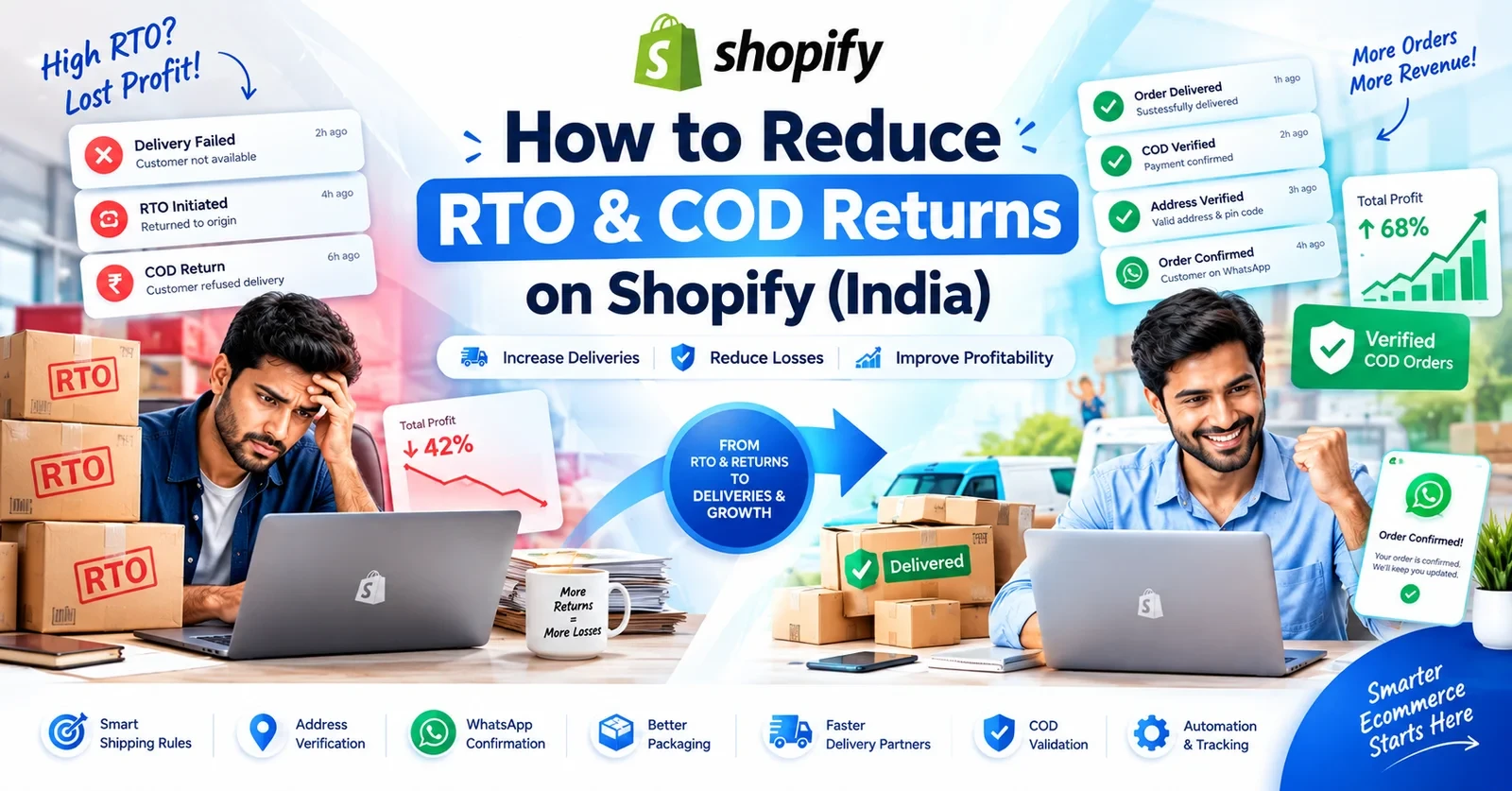
To reduce RTO on Shopify in India, you need to act before the order ships. Yes, you can reduce RTO on Shopify to under 15%, even with heavy COD. But it takes the right rules at checkout.
RTO (Return to Origin) is what happens when a courier fails delivery and ships the package back to you. You pay for both legs. Inventory gets blocked for days. And your ROAS looks fine until you net the returns out.
According to Razorpay, COD orders in India return at 25 to 30% while prepaid orders return at just 2-5%. And for a business, this number is very, very important.
A Shopify store audit reveals the exact checkout and COD configuration issues driving this. In our experience, we have noticed that most stores have 3-4 fixable problems hiding in plain sight.
COD still drives 45 to 65% of Indian D2C orders, especially in Tier 2 and Tier 3 cities. According to different studies, Tier 2 and 3 cities drove 66% of new orders in FY26, and 70% of those customers preferred COD. Any serious Shopify RTO reduction effort starts with understanding that this is structural.
The reasons for a high return-to-origin rate on Shopify are predictable. For example:
Forward shipping. Reverse logistics. Inventory tied up for 5 to 10 days. Lower ROAS when you net the returns out of your ad spend. One Shopify merchant on Indie Hackers ran the math on 300 COD orders at 28% RTO; the logistics leakage came to ₹35,000-₹40,000 every month.
For any brand serious about Shopify store optimization in India, RTO control is the thing that keeps margin from disappearing while GMV grows.
Also Read – What Is RTO and COD in eCommerce
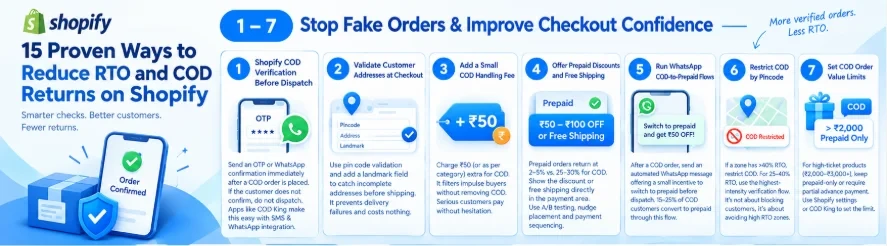
The first step in any Shopify COD verification setup is an OTP or WhatsApp confirmation sent immediately after a COD order is placed. If the customer does not confirm, do not dispatch. A fake or impulse order almost never makes it through a verification step. Apps like COD King run this natively with SMS and WhatsApp channels already integrated.
Pin code validation at checkout catches incomplete addresses before the order ships. Add a landmark field. Many delivery failures start at the address input stage, and adding validation there costs nothing.
Charge ₹50, or as per your product category, extra for COD. It filters out impulse purchases without removing COD entirely. Serious customers pay without hesitation. Casual ones generally switch to prepaid or drop off, which, for any Shopify RTO solutions plan, is exactly the right outcome.
Shopify prepaid conversion is the highest-ROI move on this list. Show a ₹50 to ₹100 discount or free shipping for prepaid orders directly in the payment selection area. Do not hide it behind a coupon code. Prepaid orders return at 2 to 5% vs. 25 to 30% for COD. That difference alone justifies the discount.
Shopify CRO services handle the A/B testing, nudge placement, and payment method sequencing that makes this conversion happen at scale.
After a COD order is placed, send an automated WhatsApp message offering a small incentive to switch to prepaid before dispatch. Data from BotSpace and AiSensy shows D2C brands consistently converting 15-25% of COD customers to prepaid through this flow. A converted COD order carries near-zero RTO risk.
Pull your historical RTO data by pincode.
This is not about blocking customers. It is about not shipping COD into zones where 4 in 10 orders come back.
High-ticket products above ₹2,000 to ₹3,000 should be prepaid-only or require partial advance payment. Set the threshold in Shopify’s payment settings or through COD King. These two rules together, pincode restriction and value limits, form the practical core of any Shopify RTO solutions framework.
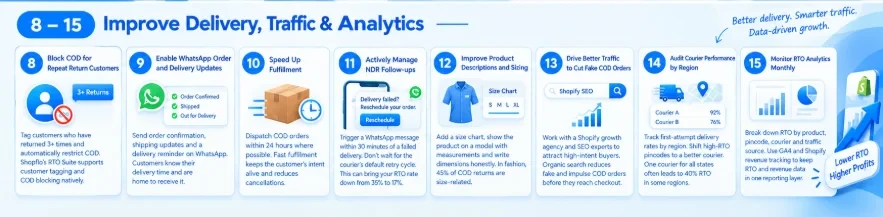
Tag customers in Shopify who have returned orders three or more times. Automatically restrict COD for those tags. Shopflo’s RTO Suite supports customer tagging and COD blocking natively. The customer still exists in your store. They just cannot abuse the COD option.
Unreachable customers during delivery is one of the top NDR causes. Send order confirmation, shipping updates, and a delivery day reminder on WhatsApp. Customers who know their delivery time are home to receive it.
Dispatch COD orders within 24 hours where possible. Long fulfillment windows cool the customer’s intent. By the time the courier shows up on day 5, they may have found the product cheaper elsewhere. Fast dispatch keeps intent alive.
According to different studies, proper NDR management is the difference between a 17% and a 35% overall RTO rate for COD-heavy brands. When a delivery fails, trigger a WhatsApp message within 30 minutes to reschedule. Do not wait for the courier’s default retry cycle.
Shopify development services cover the Shopify Flow automations that make this NDR workflow run without manual intervention.
A lot of COD returns have nothing to do with logistics. The customer got the product, took one look, and decided it was not what they expected.
In fashion, 45% of COD returns are size-related, according to the Internet. The customer did not return it because delivery was late. They returned it because the size chart was useless or the photos did not show the actual fit.
Bad traffic is a direct cause of high RTO. When someone lands on your store from a broad interest-based ad and places a COD order on impulse, there was never purchase intent there. That order was always going to come back. Working with a Shopify growth agency focused on organic search changes this. The people coming in from SEO searched for the product. They wanted it before they landed on your page.
Shopify SEO services in India target buyers at the search intent level, which cuts fake and impulse COD orders before they reach checkout. That is Shopify store optimization services working at the very top of the funnel. Before the ad spend, before the order, before the courier.
Your courier’s first-attempt delivery rate varies by region. Track it. Shift high-RTO pincodes to a courier with better reach in that zone. Using one courier for all of India is a common reason certain states show 40% RTO while others sit at 12%.
Break down RTO by product, pincode, courier, and traffic source. A specific product at 38% RTO points to a product page issue. A specific pincode at 45% points to a COD restriction decision. GA4 and Shopify revenue tracking makes this monthly review faster by keeping your RTO and revenue data in one reporting layer.
For brands looking at Shopify store optimization services, these tools are the starting point.
Shopify Flow lets you build rule-based automations without writing code.
This is where Shopify development experts make a real difference. Generic app configurations go only so far. Custom automation built for your category and order volume produces better results over time.
Appco Software is a Shopify development company in India, based in Jaipur. As a Shopify growth agency, we work with D2C founders and eCommerce brands who want to build, migrate, or scale on Shopify. The Appco Software Shopify experts team works on RTO reduction in four areas.
If your COD return rate is above 20%, the margin leak is there, and it compounds every month you leave it unaddressed.
We have helped Shopify brands in India bring their RTO down through store audits, COD rule setup, checkout work, and automation. Book a Free Shopify Store Audit with Appco Software, and we will tell you exactly where the returns are coming from.
Anything under 15% is good for a COD-heavy store. Prepaid-focused stores regularly hit under 5%. Fashion stores in Tier 2 markets running above 20% should treat that as a problem needing immediate attention.
You can reduce COD returns with OTP verification, pincode restrictions, and WhatsApp COD-to-prepaid flows. You keep the accessibility and filter the risk.
Yes. A minimum COD fee reduces impulse orders without turning off serious customers. And it also nudges people toward prepaid, which is where the real RTO reduction happens.
COD King for verification and COD control can help you reduce RTO on Shopify. AiSensy or LimeChat for WhatsApp prepaid conversion flows. Shiprocket or Shipway for courier and NDR management.
Yes, and like, this is where stores leave the savings on the table. Shopify Flow plus a WhatsApp automation tool handles customer tagging, COD-to-prepaid nudges, and NDR follow-ups automatically. Once set up, it runs without manual work.
Prepaid orders return at 2 to 5% in India. COD returns at 25– 30%. When a customer has already paid, they are committed to receiving the order. A COD order has zero financial commitment at placement. And that difference shows up entirely in your RTO numbers.
Error: Contact form not found.

Appco Software has been around for a very long time, helping startups and established brands build iconic websites and apps. For your unique idea to be presented in a beautiful way, contact us now!