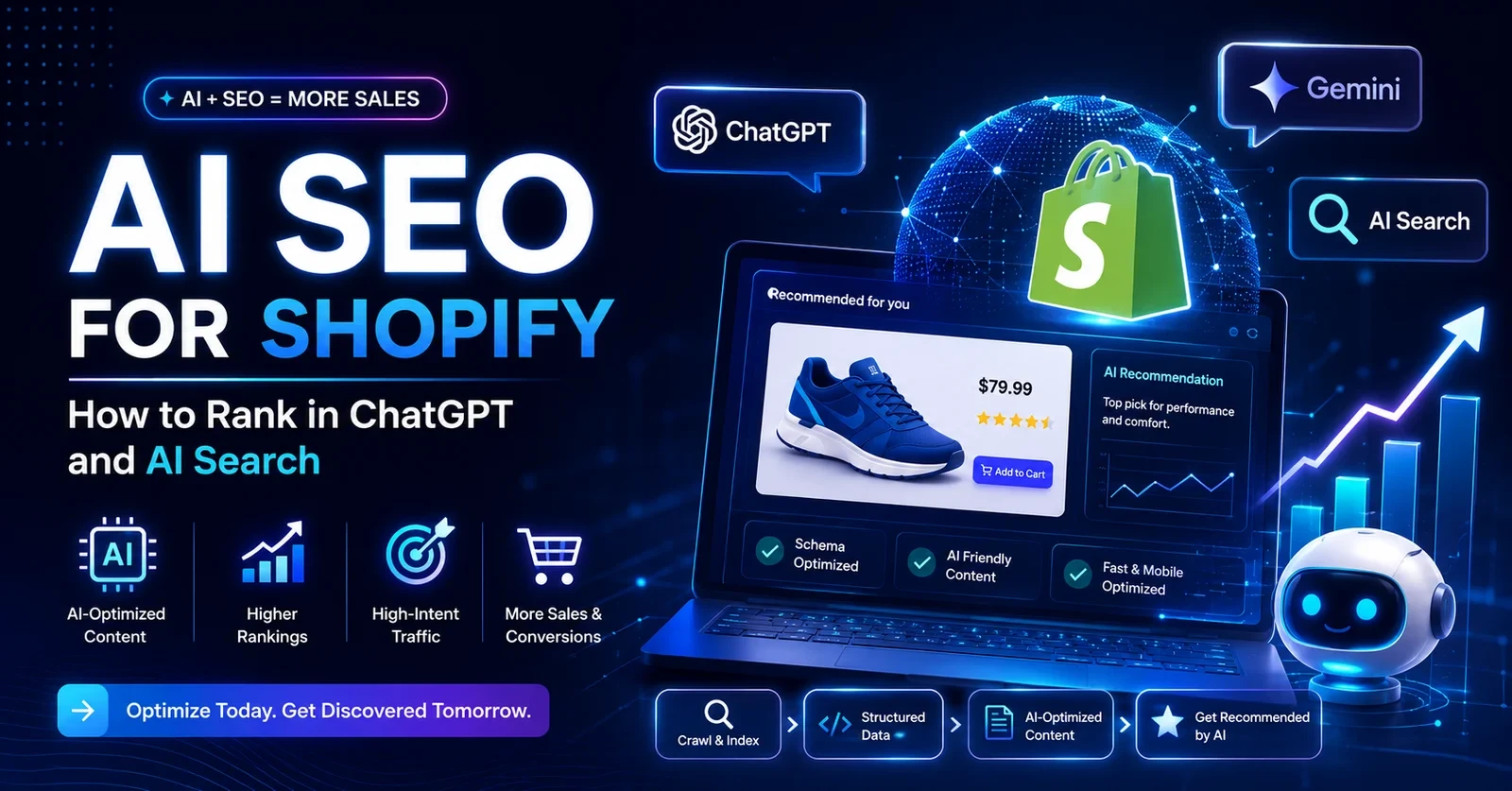
AI SEO for Shopify is basically optimizing your store so these new AI tools like ChatGPT, Gemini, and Perplexity can directly push your products.
Shopify’s Q1 2026 data clearly shows AI-referred traffic to Shopify stores growing a massive 8x year over year. And these visitors are converting nearly 50% better than your standard organic search. If your store is fully invisible in AI search today, you are already losing a high-intent audience to your smart competitors.
A few years ago, ecommerce AI SEO was mostly experimental. Not anymore.
What makes AI search optimization for ecommerce websites different is not just the volume. It is the buyer’s behaviour. Shopify’s own data shows that more than half of AI-referred sessions start directly on product pages, compared to 20% for organic search. These are not casual browsers. They arrive with specific intent, often already influenced by an AI recommendation before they click.
For D2C brands and Shopify stores in India, this matters even more. AI adoption rates in India are among the highest in the world at 70 to 80%. The audience is already using these tools. The question is whether your store shows up when ChatGPT or Gemini recommends products in your category.
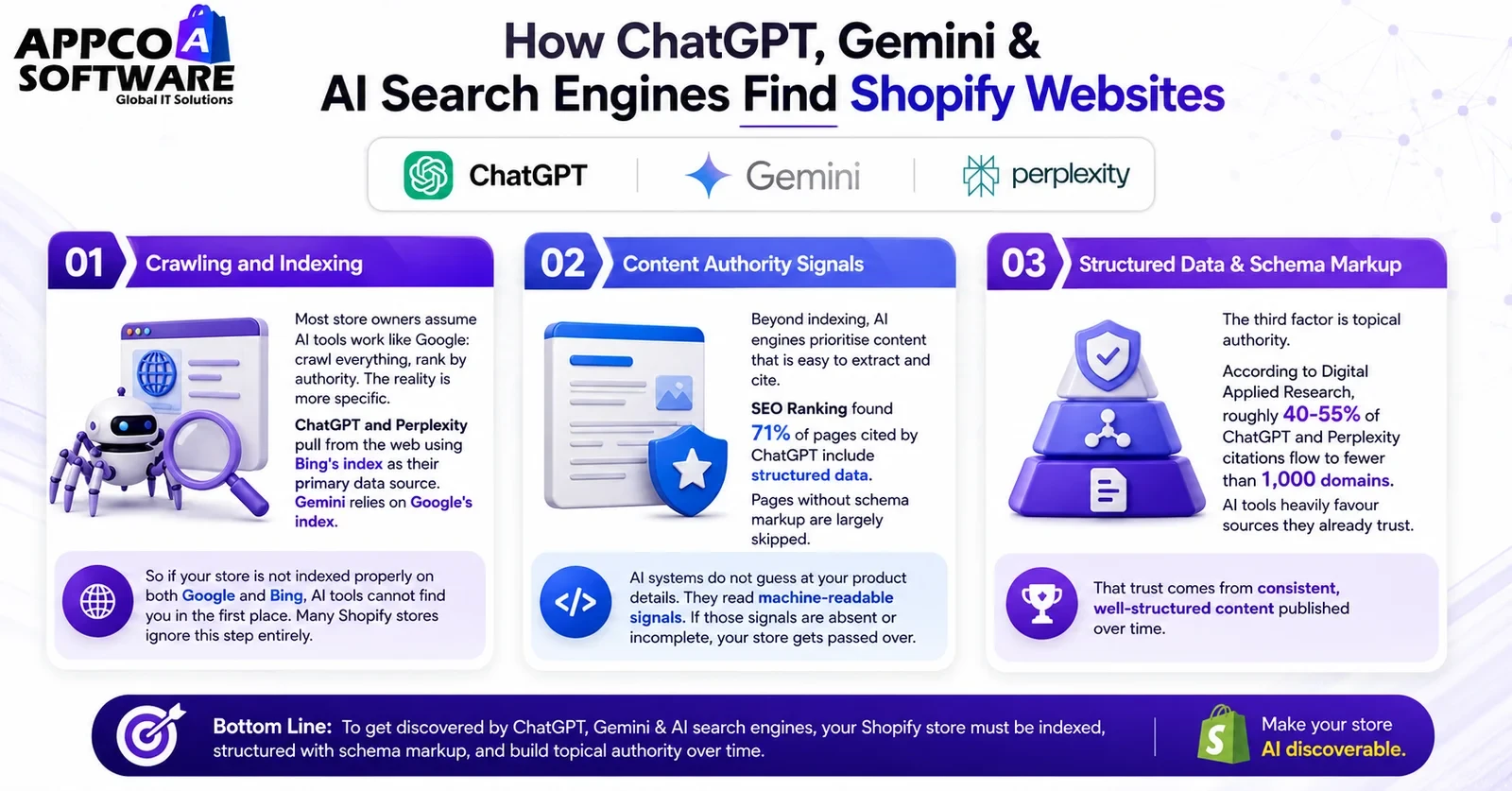
Most store owners assume AI tools work like Google: crawl everything, rank by authority. The reality is more specific. ChatGPT and Perplexity pull from the web using Bing’s index as their primary data source. Gemini relies on Google’s index. So if your store is not indexed properly on both Google and Bing, AI tools cannot find you in the first place. Many Shopify stores ignore this step entirely.
Beyond indexing, AI engines prioritise content that is easy to extract and cite. SEO Ranking found 71% of pages cited by ChatGPT include structured data. Pages without schema markup are largely skipped. AI systems do not guess at your product details. They read machine-readable signals. If those signals are absent or incomplete, your store gets passed over.
The third factor is topical authority. According to Digital Applied Research, roughly 40-55% of ChatGPT and Perplexity citations flow to fewer than 1,000 domains. AI tools heavily favour sources they already trust. That trust comes from consistent, well-structured content published over time.
Generative Engine Optimization for Shopify is the practice of structuring your store’s content so AI tools can extract, summarise, and cite it accurately. We have a full breakdown of how GEO differs from traditional SEO in our SEO vs AEO vs GEO guide.
The short version: traditional SEO is optimised for ranking positions. GEO optimises for AI citations and mentions. When someone asks ChatGPT:
The stores in those answers have built a deliberate Shopify GEO strategy for ecommerce stores.
GEO requires three things from your content.
If your collection pages are just a product grid with no text, GEO cannot work for you. That needs to change.
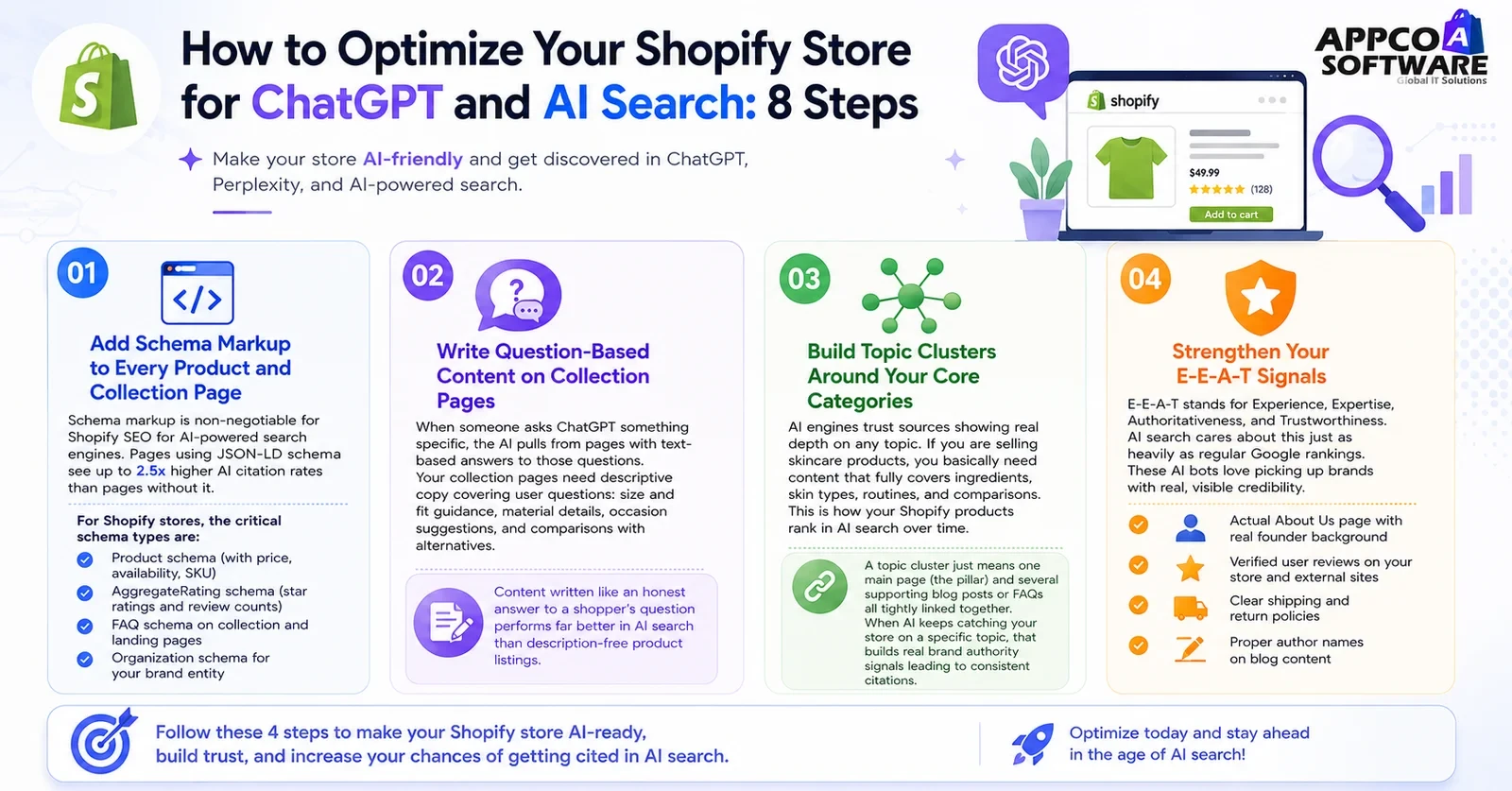
This section covers the eight most impactful changes for Shopify AI SEO. Not every tactic carries equal weight. Start with structured data and content, then move to authority signals.
Schema markup is non-negotiable for Shopify SEO for AI-powered search engines. SE Ranking’s data shows 65% of pages cited by Google AI Mode and 71% cited by ChatGPT include structured data. Pages using JSON-LD schema, the format preferred by Google, Bing, and all major AI engines, see up to 2.5x higher AI citation rates than pages without it.
For Shopify stores, the critical schema types are:
Shopify’s built-in schema covers the basics, but it is rarely complete. Custom implementation fills the gaps AI crawlers need.
When someone asks ChatGPT something specific, the AI pulls from pages with text-based answers to those questions. Your collection pages need descriptive copy covering user questions: size and fit guidance, material details, occasion suggestions, and comparisons with alternatives.
We covered this in detail in our Shopify product page optimization guide. The principle applies equally to collection pages. Content written like an honest answer to a shopper’s question performs far better in AI search than description-free product listings.
AI engines trust sources showing real depth on any topic. If you are selling skincare products, you basically need content that fully covers ingredients, skin types, routines, and comparisons. This is how your Shopify products rank in AI search over time.
A topic cluster just means one main page (the pillar) and several supporting blog posts or FAQs all tightly linked together. When ChatGPT or Perplexity keeps catching your store repeatedly on a specific topic, that exact pattern builds real brand authority signals, leading straight to consistent citations.
E-E-A-T stands for Experience, Expertise, Authoritativeness, and Trustworthiness. In fact, AI search cares about this just as heavily as regular Google rankings. These AI bots love picking up brands with real, visible credibility.
And on the ground, that means putting up an actual About Us page with real founder background, verified user reviews right on your store plus external sites, no-nonsense shipping policies, and proper author names on blogs.
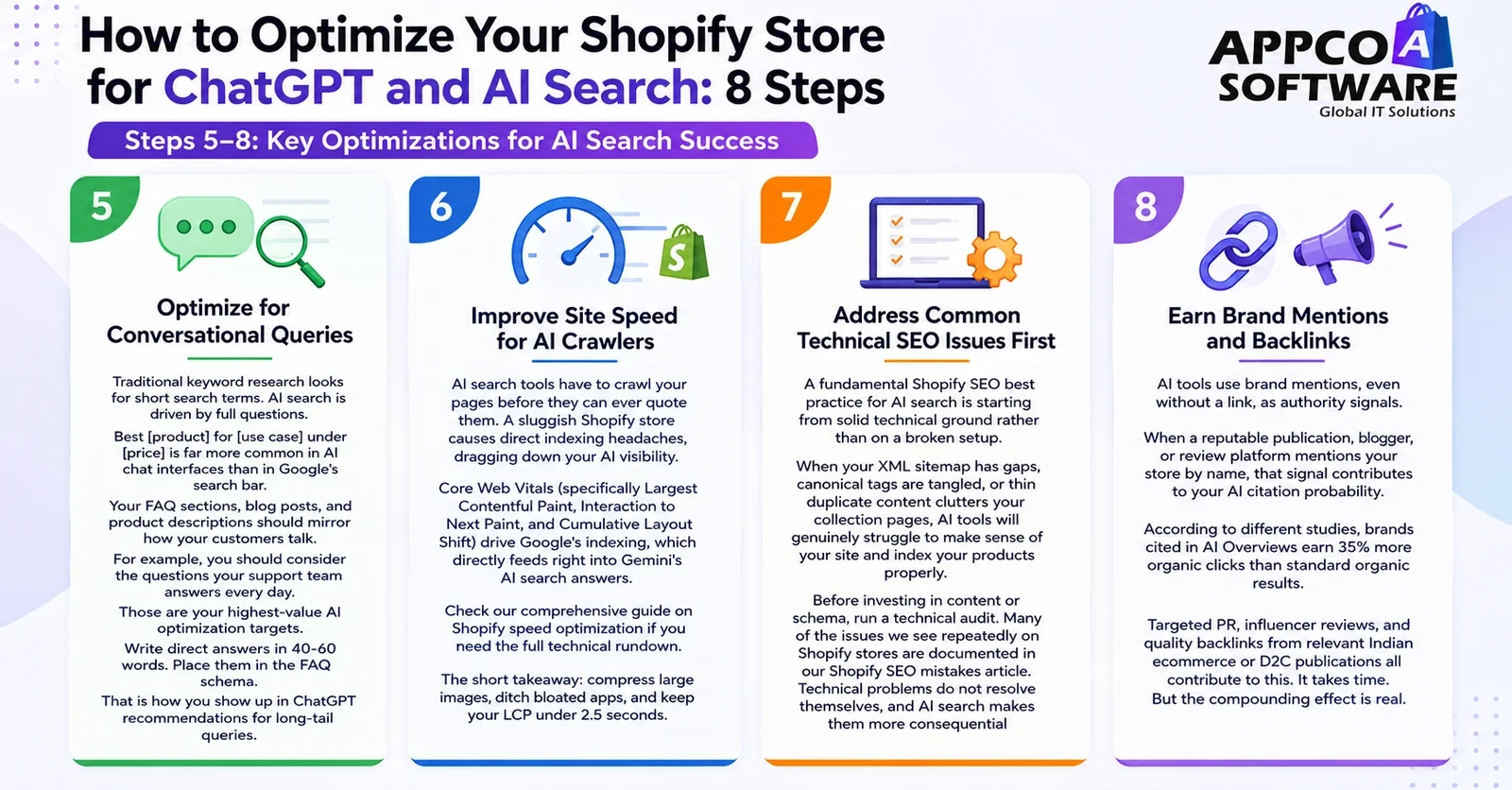
Traditional keyword research looks for short search terms. AI search is driven by full questions.
Best for [use case] under [price] is far more common in AI chat interfaces than in Google’s search bar.
Your FAQ sections, blog posts, and product descriptions should mirror how your customers talk. For example, you should consider the questions your support team answers every day.
Those are your highest-value AI optimization targets. Write direct answers in 40-60 words. Place them in the FAQ schema. That is how you show up in ChatGPT recommendations for long-tail queries.
AI search tools have to crawl your pages before they can ever quote them. A sluggish Shopify store causes direct indexing headaches, dragging down your AI visibility. Core Web Vitals (specifically Largest Contentful Paint, Interaction to Next Paint, and Cumulative Layout Shift) drive Google’s indexing, which directly feeds right into Gemini’s AI search answers.
Check our comprehensive guide on Shopify speed optimization if you need the full technical rundown. The short takeaway: compress large images, ditch bloated apps, and keep your LCP under 2.5 seconds.
A fundamental Shopify SEO best practice for AI search is starting from solid technical ground rather than on a broken setup. When your XML sitemap has gaps, canonical tags are tangled, or thin duplicate content clutters your collection pages, AI tools will genuinely struggle to make sense of your site and index your products properly.
Before investing in content or schema, run a technical audit. Many of the issues we see repeatedly on Shopify stores are documented in our Shopify SEO mistakes article. Technical problems do not resolve themselves, and AI search makes them more consequential
AI tools use brand mentions, even without a link, as authority signals. When a reputable publication, blogger, or review platform mentions your store by name, that signal contributes to your AI citation probability. According to different studies, brands cited in AI Overviews earn 35% more organic clicks than standard organic results.
Targeted PR, influencer reviews, and quality backlinks from relevant Indian ecommerce or D2C publications all contribute to this. It takes time. But the compounding effect is real.
We have been building and optimizing Shopify stores since 2013. Over 5,000 projects have been delivered, with offices in Jaipur and Mumbai. We are one of the best certified Shopify Partner teams, fully understanding both the technical and content sides of Shopify store optimization.
Most stores we audit have the same exact gaps. For example: incomplete schema markup, collection pages with zero text content, and site speed slowing crawling. These are totally solvable. And fixing them doesn’t just improve Shopify AI visibility optimization. It improves regular Google rankings and conversion rates simultaneously.
If you want to know exactly where your store stands, our Shopify SEO services include one proper technical audit covering schema, crawlability, content structure, and Core Web Vitals. For stores needing a rebuild from the ground up with AI search in mind, our exact Shopify store rebuild service starts with the right architecture.
Get in touch with the Appco team, and we will identify what is holding your store back from AI search visibility.
AI SEO for Shopify means tweaking site data, code, and copy so AI-powered search tools like ChatGPT, Gemini, and Perplexity can spot your store and pitch products to shoppers asking questions.
It pulls straight from Bing’s crawl, cherry-picking pages loaded with tight schema tags, crisp layouts, and genuine brand trust cues.
GEO for Shopify is just the practice of structuring your store’s content so AI tools can easily get and cite it directly.
The most important schema types for Shopify are Product schema, AggregateRating schema, FAQ schema, and Organization schema. All should be implemented in JSON-LD format only.
Just start with these four steps: submit your sitemap to both Google and Bing, add JSON-LD schema to product and collection pages, write question-based copy fully answering user queries, and publish consistent topic cluster content in your exact niche.
Traditional Google SEO remains the main foundation because most AI tools are pulling straight from Google and Bing’s indexes.
The best AI SEO tools for Shopify start with SEMrush, Ahrefs, and SE Ranking to easily identify keyword and schema gaps. For AI citation tracking, BrightEdge and OtterlyAI properly track how often your store is cited inside AI-generated answers on ChatGPT, Gemini, and Perplexity today.
Error: Contact form not found.
Appco Software has been around for a very long time, helping startups and established brands build iconic websites and apps. For your unique idea to be presented in a beautiful way, contact us now!