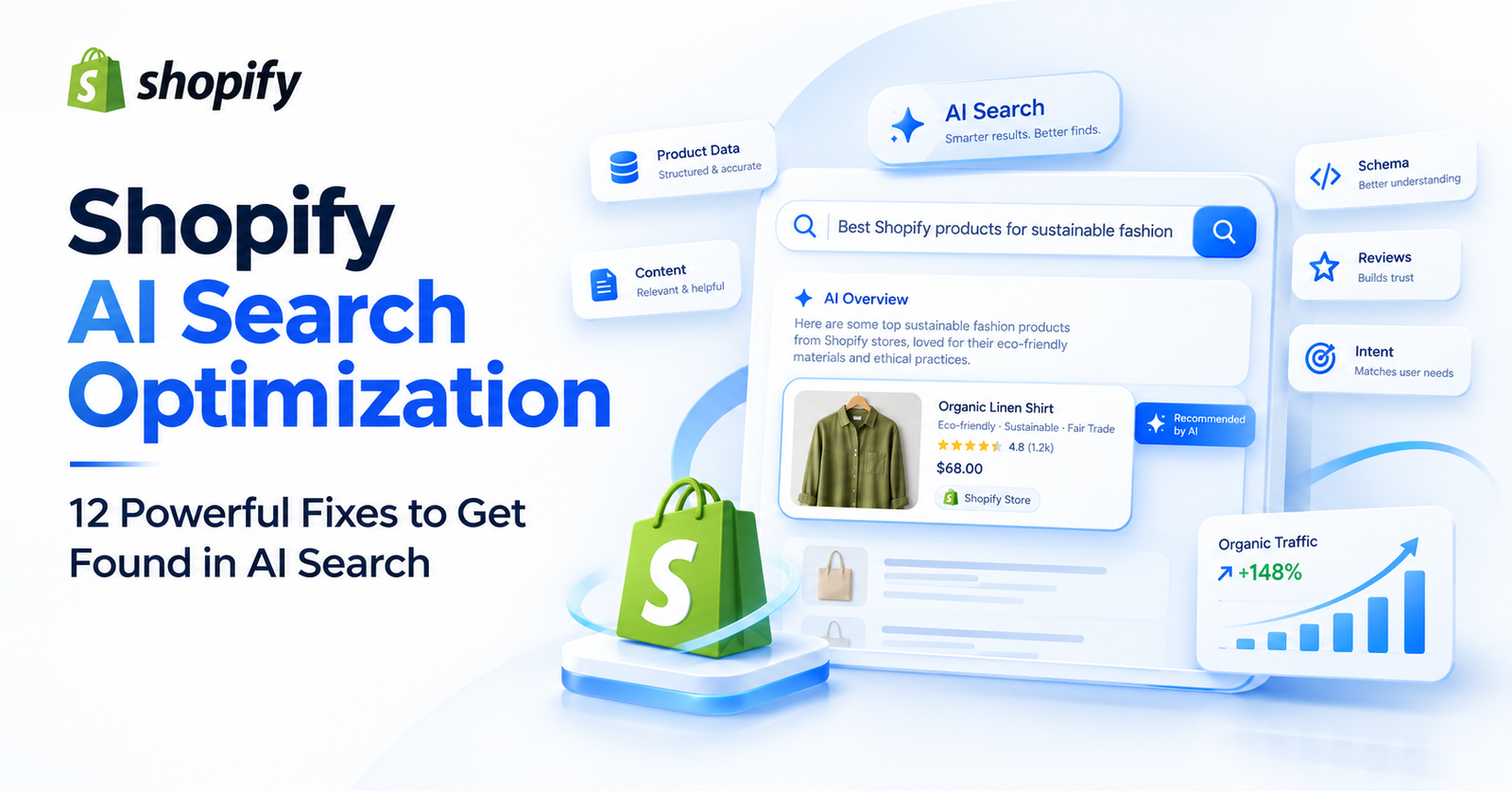
Your Shopify store ranks on Google but does not show up when someone asks ChatGPT or Perplexity for the best stores in your niche. Your store has a Shopify AI search optimization problem. And this is not about Google rankings.
AI search does not work like a directory. It picks one answer and cites a brand. To show up, your store needs bot access, structured data, and third-party mentions. A vast number of Shopify stores are built for the wrong system. Keep in mind: ranking on Google and showing up in AI searches are two different things. For this thing, you need to work on Shopify AI SEO.
According to Onely, 73% of brands sitting on Google page one get zero mentions when someone asks ChatGPT the same question. This means your Google ranking is not related to AI search at all.
In this guide, we are going to cover all of this in detail.
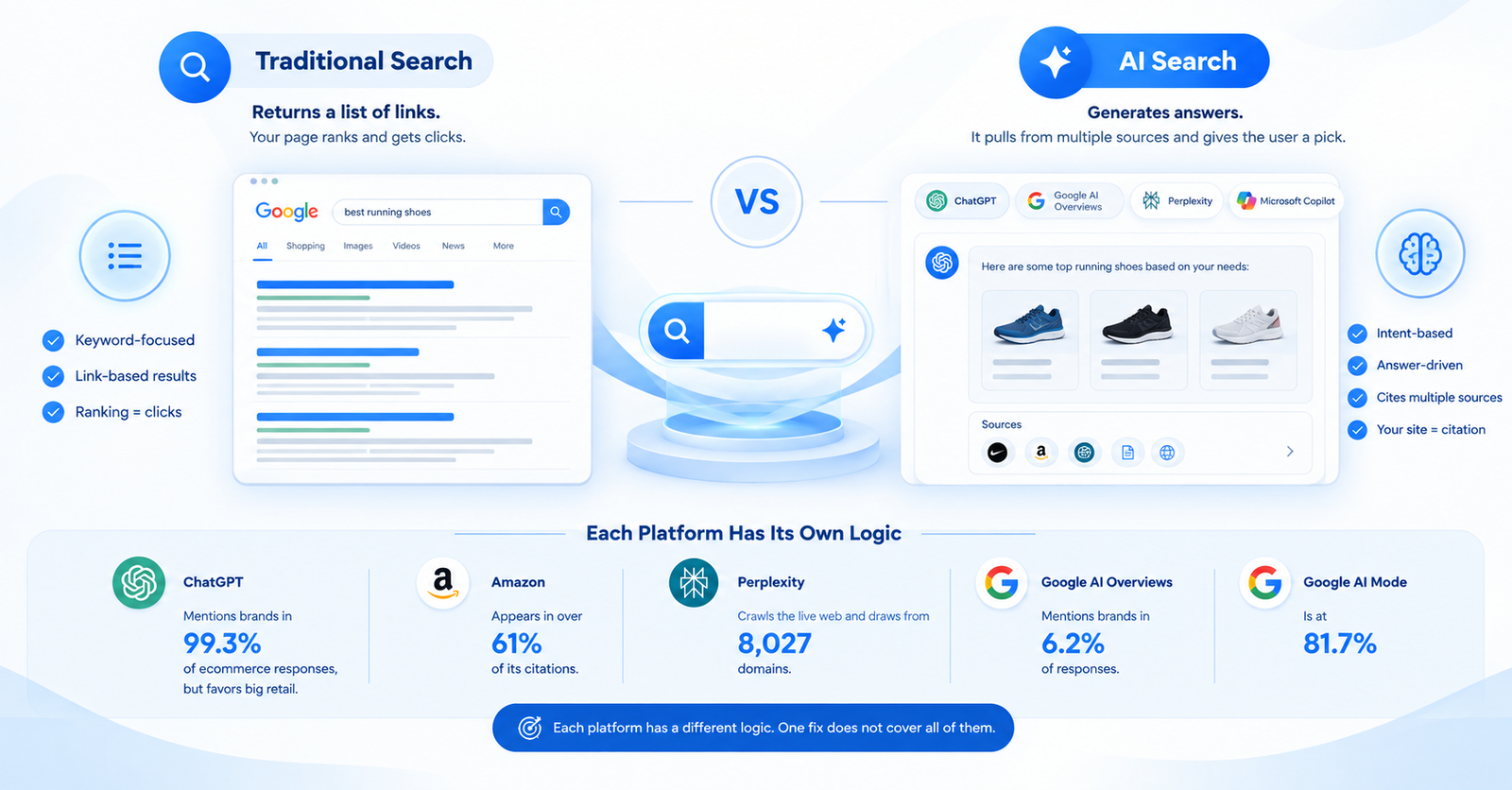
Traditional search returns a list of links. Your page ranks and gets clicks. AI search, on the other hand, generates answers. ChatGPT, Google AI Overviews, Perplexity, and Microsoft Copilot pull from multiple sources and give the user a pick. Your website is not to rank. It is to be cited.
In short: traditional search is keyword-focused. AI search is intent-based. One rewards ranking. The other rewards being cited.
Each platform has different logic.
Each one is different. Each one works differently. One fix does not cover all of them.
So why is a Shopify store not showing up in AI search results? Almost always for the same reasons: bot access, schema, content format, and brand authority outside your site.
Retrieval bots like OAI-SearchBot, ChatGPT-User, PerplexityBot, and Claude-SearchBot fetch live content for AI answers. Block these, and you vanish. Training bots like GPTBot and ClaudeBot collect data for model training. Block those without losing AI answer access.
Shopify has no built-in panel for robots.txt. You have to create a robots.txt.liquid template through Online Store, then Themes, then Edit code. WAF tools or third-party apps can block the same bots even when robots.txt is right.
According to different studies, 91% of audited Shopify stores lacked enough structured data for AI use. The single biggest problem: missing GTINs.
Shopify themes include basic schema markup. But it is not strong. When review apps add their own schema on top, you get duplicate blocks that break parsing.
Priority schema for Shopify AI search:
AI systems scan descriptions for answers they can pull out. A study of 1,000 Shopify stores found that 20% of product descriptions appear word for word on other domains, usually the maker’s site. Duplicate content causes the system to pick one version, always the maker’s.
72.4% of AI-cited posts use answer-first format. Paragraphs of 60 to 100 words are perfect.
People do not type these days in ChatGPT, Gemini, and other AI models. They use voice mode and say things like Which Shopify agency in India builds stores on a fixed budget and delivers in less than 15 days. That is how AI searches work. AI understands the complete context and then suggests answers accordingly.
This connects to the future of voice search. Voice queries are natural and question-based. AI search responses are what voice tools pull from. Stores with answer-first content get picked up in both.
Duplicate URLs are a common Shopify problem. Products appear under multiple URLs by default. Filtered pages can generate hundreds of near-same URLs that eat crawl budgets.
An llms.txt file at your domain root acts as an AI sitemap. A direct brief for AI crawlers. And stores without this are behind.
AI systems check for trust through experience, expertise, authority, and proof (E-E-A-T). A store without an About Us and Contact Us page is hard to rank well.
Signals that help: listed contact info, customer reviews naming product details, proof of skills on relevant pages, and plain-language returns and privacy policies.
91% of AI-generated answers cite third-party content. A study of 75,000 brands found brand mentions tied to AI Overview access at 0.664 Spearman. Backlinks land at 0.218. Mentions matter nearly three times more. YouTube brand mentions are the strongest signal at 0.737. Reddit accounts for 46.7% of Perplexity’s top citations.
No presence outside your own site means AI systems have no external basis to suggest you.
The question we get from Shopify store owners is almost always the same: how to optimize Shopify stores for AI search results? And AI search optimization for Shopify is not one solution. It is six steps in the right order.
Shopify AI search optimization starts with this. Check these steps carefully:
Shopify optimization for ChatGPT requires the Bing Merchant Center feed. No feed, no product access in ChatGPT Shopping.
Our ecommerce website SEO packages include schema setup for all of these. If you need help with this master, contact us now.
Brands publishing 12 posts per month achieved 200x faster AI visibility gains than those publishing 4, according to many reports. For a Shopify store, this means one pillar topic and several cluster articles around it.
Say your store sells custom Shopify themes. Your pillar could be Shopify Store Design, with clusters on:
AI systems read the full cluster and treat your store as an authority on that topic. One blog post does not do this. But a connected set does.
Per page: targeted title, answer-first description, unique content, FAQPage schema, specs, reviews, breadcrumb schema, and live pricing.
For collection pages: targeted copy above the grid, H2-structured content below.
Link from blog posts to collection pages to product pages. A blog about choosing a lab-grown diamond links to your rings collection, then to the product. That is how AI systems map your store.
Standardize brand name and contact info across all platforms.
It depends on so many things, though. But technical solutions show signals within 2 to 6 weeks. Content takes a bit longer. Authority building, that is the slow part, takes 4 to 12 months.
So, this is not a sprint. According to OmniBound, only 23% of marketers even measure GEO outcomes right now. And, in fact, that is good news for you. The stores building AI access today are doing it while everyone else ignores it.
Yes. And they are not separate strategies.
Standard SEO builds search access. And Generative Engine Optimization for Shopify builds access inside AI-generated answers. Both run on the same base: technical SEO, content quality, and authority.
The difference is where you build authority.
Shopify SEO for AI search does not replace the Google side. It completes it. And Shopify visibility in ChatGPT requires a Bing Merchant Center feed. Standard SEO never touches that.
This is why Shopify AI search optimization is one of the top questions we get. Clients have Google covered. But they are not sure about the AI side. If you want affordable ecommerce SEO services covering both, our team can help you with this.
This is something we see all the time. Shopify stores where products rank well on Google but have zero ChatGPT mentions. The setup looks fine on the surface.
That is a very common situation. And it is fixable. Appco Software runs full Shopify AI search audits. We check bot access, llms.txt, schema, content gaps, internal links, E-E-A-T signals, and brand mentions. Like, everything that decides whether AI tools cite your store or ignore it. If you want more information on this, you can check out our ecommerce SEO services in India.
Shopify’s Q1 2026 data shows AI-referred orders expanded nearly 13x over the year prior. The window in ecommerce AI SEO is open right now.
Shopify AI search optimization builds on standard SEO, adding bot access, structured data, and third-party authority. Appco Software services cover all three together. Start with technical fixes, add content, and then build authority. That is the order.
Three things are blocking you: retrieval bots are blocked, product schema is missing, and there are no third-party brand mentions.
Shopify AI SEO is, like, the process of making your store visible inside AI-generated answers from ChatGPT, Google AI Overviews, and Perplexity. Also called GEO. It covers bot access, schema, content format, and brand authority outside your own site.
Yes. But regular SEO alone is not enough. Backlinks matter far less than brand mentions and YouTube content for Shopify visibility in Google AI Overviews. You need both running at the same time.
Do the bots first. Let AI retrieval bots reach your store, add Product schema with live GTINs and stock status, and build brand presence through earned media and Reddit. In that order.
A lot, and the data backs it. Brands with Organization, Brand, and AboutPage schema are cited 3x more often in AI shopping results.
Technical solutions take around 2 to 6 weeks to show results. Topical authority takes 3 to 6 months. Brand authority takes longer. AI platforms update their citation logic often, so there is no fixed timeline.
Error: Contact form not found.
Appco Software has been around for a very long time, helping startups and established brands build iconic websites and apps. For your unique idea to be presented in a beautiful way, contact us now!