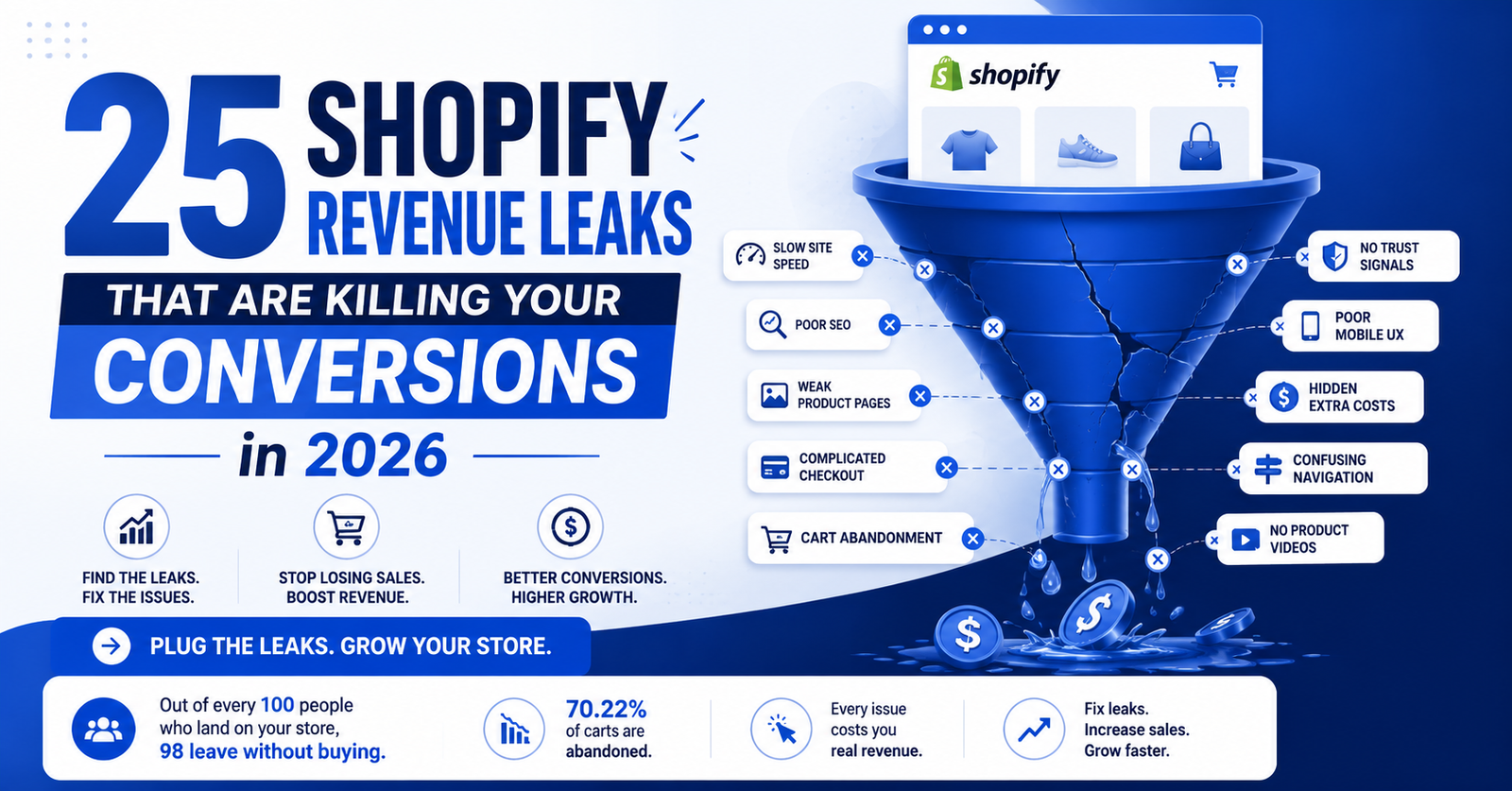
Out of every 100 people who land on your Shopify store, 98 leave without making a purchase. That is not an estimate. Baymard Institute analysed 50 studies and found 70.22% of shoppers who add something to their cart never check out.
Traffic is not the problem. What happens after they land is. These gaps between visits and revenue are Shopify revenue leaks. We found 25 of them: technical, SEO, design, and conversion issues. Let’s discuss them here today.
A revenue leak is any point where a potential customer loses interest, gets confused, or simply walks away without buying. It does not always look like a broken page.
What makes these leaks dangerous is that they are invisible. Your analytics show sessions. Your ads dashboard shows clicks. But between that click and the purchase, seven out of ten shoppers leave.
A proper Shopify store audit is how you find these leaks. Fixing them is how stores move from 1.4% conversion rates to the top 20%, which converts above 3.2%.
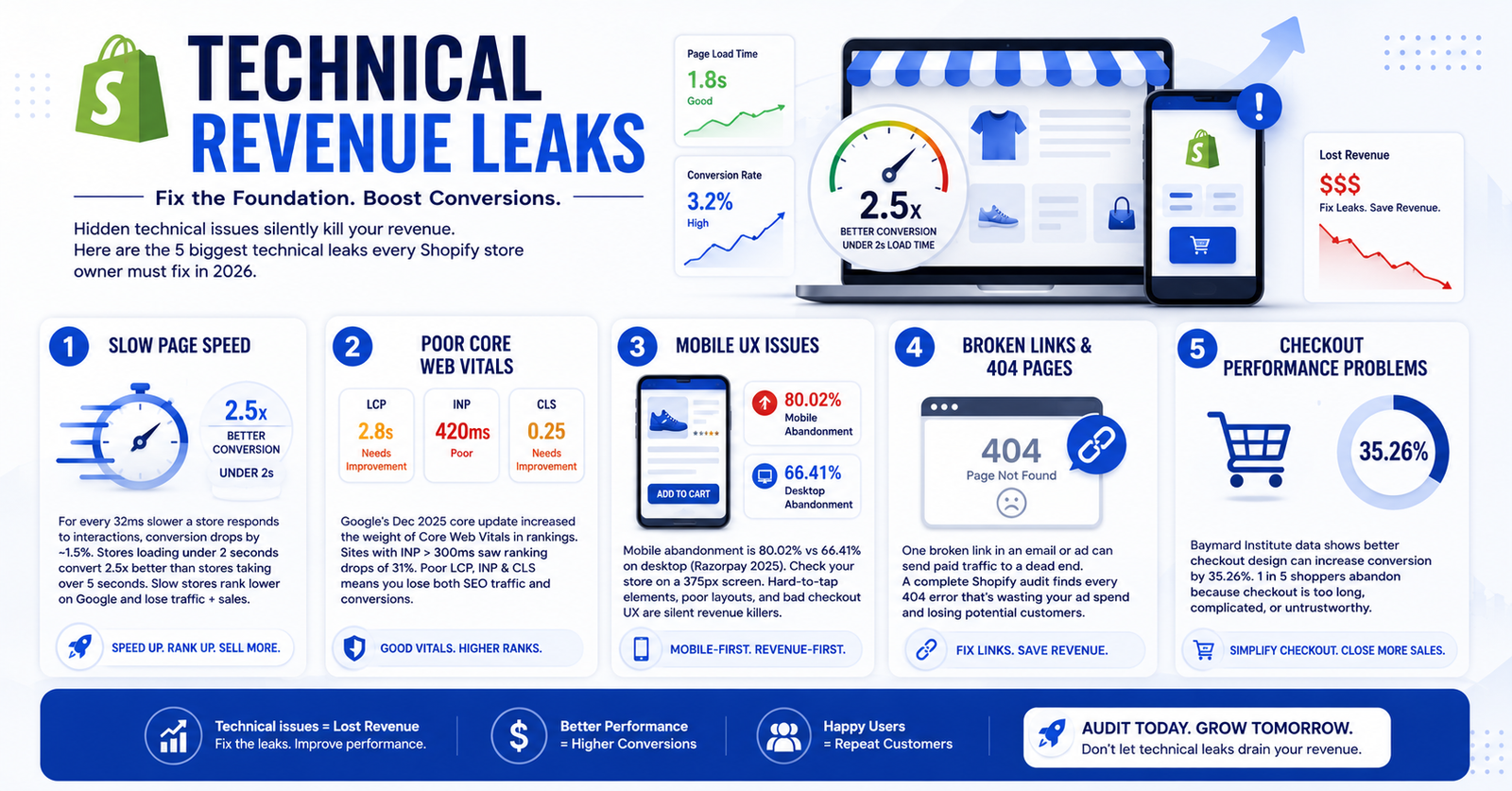
Shopify’s own 2026 commerce data shows that for every 32 milliseconds slower a store responds to interactions, conversion drops by about 1.5%. Stores loading under 2 seconds convert 2.5x better than stores taking over 5 seconds. Speed problems compound, slower stores also rank lower on Google, cutting organic traffic on top of lowering conversions. Our Shopify speed optimization services tackle both.
Google’s December 2025 core update increased the weight of Core Web Vitals in rankings. Sites with INP scores above 300ms saw ranking drops of 31%. Poor LCP, INP, and CLS scores mean you are losing SEO traffic and conversions at the same time.
According to the Razorpay 2025 report, mobile abandonment rates are around 80.02% versus 66.41% on desktop. Most store owners optimize their store on a MacBook. Check how your filters, images, sticky cart, and checkout look on a 375px screen. Anything hard to tap is a revenue leak.
One broken link in a promotional email, one outdated URL in a Google ad, and paid traffic goes straight into a dead end. A full Shopify website audit will catch every 404 that is eating into your budget.
Baymard Institute data shows that the average large ecommerce site can gain a 35.26% increase in conversion rate through better checkout design alone. One in five shoppers abandons specifically because checkout felt too long or complicated.
These leaks live in the buyer’s head. The store works technically, but something stops them from clicking Buy.
Weak CTA buttons are also a big issue when it comes to conversion rate revenue leaks. The CTA is the last thing standing between a browser and a customer. And weak CTAs quietly kill Shopify sales optimization efforts across thousands of stores.
A product page with one blurry photo and a two-line description asks buyers to take a leap of faith. Most will not. Strong product pages use multiple image angles, size charts, clear pricing, delivery timelines, and benefit-led copy. This is the biggest single win in ecommerce conversion optimization.
No reviews.
No return policy near the buy button.
No payment security badges.
For a new visitor who has never heard of your brand, these signals are the difference between placing an order and going back to Amazon.
For fashion, home decor, or any tactile product, a 15-second video showing the product in use removes more buyer hesitation than five paragraphs of text.
If a customer cannot find what they came for within 2-3 clicks, they leave. As a Shopify development company in India that has audited hundreds of stores, confusing navigation is one of the most consistent revenue leaks we find.
Collection pages that dump 100 products with no sorting or filters push customers toward analysis paralysis. A well-structured collection page surfaces the right products fast.
47% of people abandon carts because of unexpected costs like shipping or taxes appearing only at checkout.
Show shipping costs early.
Use a free shipping progress bar.
Set up abandoned cart email flows.
The average checkout flow has 5.1 steps and 11.3 form fields (Baymard Institute). The ideal is 12-14 form elements. Every extra field is another reason to abandon.
Enable Shop Pay.
Offer guest checkout.
Remove optional fields from the default flow.
Poor SEO means you pay for every visitor through ads because organic traffic dried up or never came.
Every collection and product page without a unique meta title is a missed ranking opportunity. A basic Shopify SEO audit flags this within minutes, yet it is ignored on hundreds of live stores.
Shopify’s URL structure sometimes creates duplicate pages for products appearing in multiple collections. These split your ranking signals. Our Shopify SEO experts handle this at the canonical tag level.
Schema tells Google exactly what your page contains: product name, price, availability, and reviews. Without it, your products rarely qualify for rich results, which get significantly higher click-through rates than plain blue links.
Good internal linking passes authority around your store and helps buyers discover related products. If your store was recently migrated, our blog on migrating a website to Shopify without losing SEO rankings covers how internal structure decisions affect long-term performance.
Most Shopify collection pages are just a product grid. Adding a short keyword-rich intro, an FAQ section, and proper H1/H2 structure can move a collection page from page 4 to page 1 over months.
Some stores have hundreds of pages indexed that should not be (tag pages, filter URLs) and important pages that are either blocked or orphaned. A structured Shopify SEO audit surfaces both problems together.
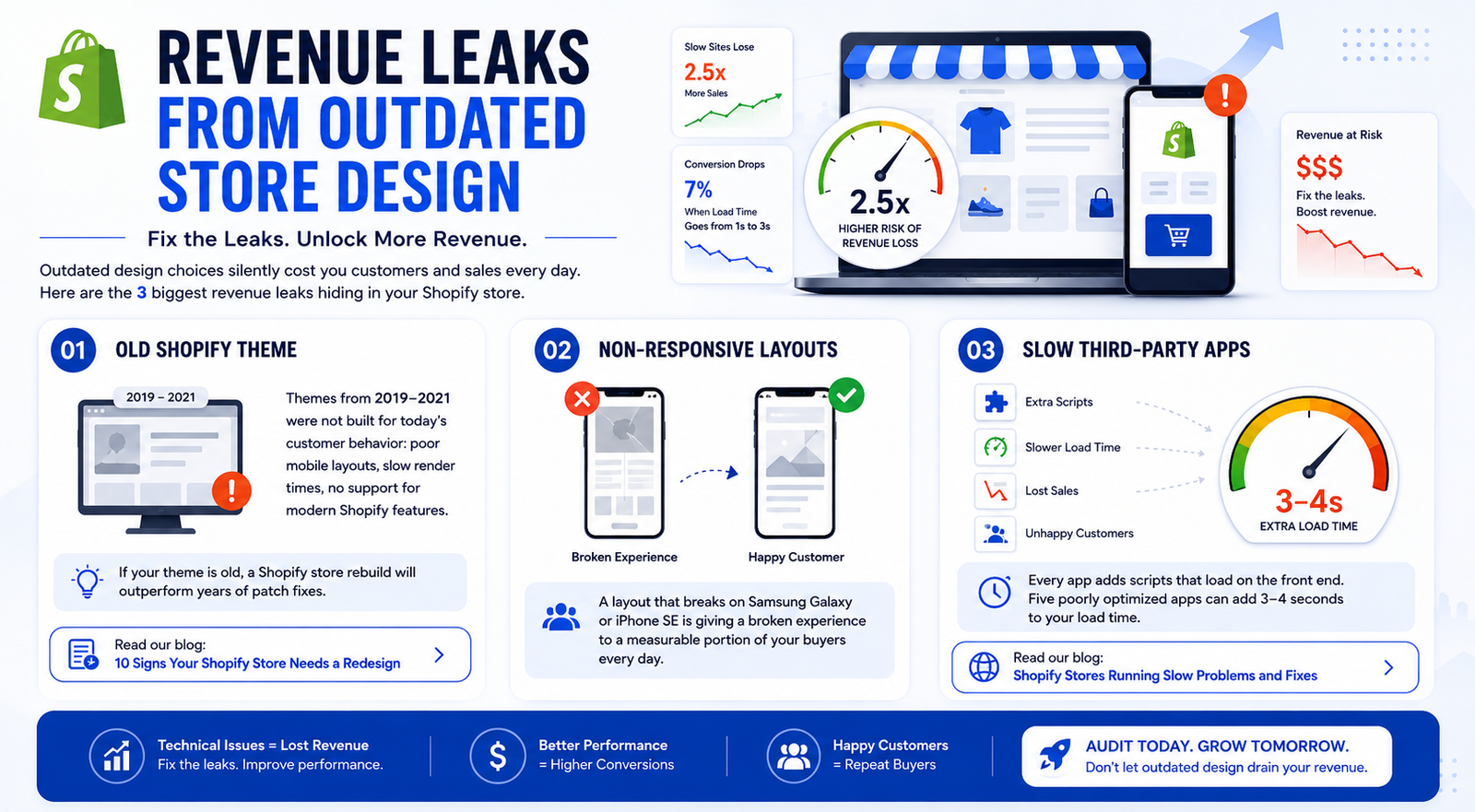
Themes from 2019-2021 were not built for today’s customer behavior: poor mobile layouts, slow render times, no support for modern Shopify features. If your theme is old, a Shopify store rebuild will outperform years of patch fixes. We covered when a rebuild makes sense in our blog on 10 signs your Shopify store needs a redesign.
A layout that breaks on Samsung Galaxy or iPhone SE is giving a broken experience to a measurable portion of your buyers every day.
Every app adds scripts that load on the front end. Five poorly optimized apps can add 3-4 seconds to your load time. Our blog on Shopify stores running slow problems and fixes breaks down exactly which app types cause the most damage and what to do about them.
Every old URL not 301 redirected after migration is a dead end for buyers and Google. Traffic that has been ranked for years disappears overnight. This is the most avoidable migration leak, and the most common mistake we see.
Beyond redirects, migrations carry over thin content, duplicate meta titles, and broken image alt tags from the old platform. A post-migration Shopify website audit should happen within the first 30 days.
Customer data, order history, and product metafields that do not transfer cleanly create downstream problems: broken loyalty programs, missing product filters, and incorrect inventory counts. Our ecommerce to Shopify migration services include a full data verification step before going live.
Most stores do not fail at one thing. They fail at several, quietly, at the same time. Use this checklist to see where your store stands and what to fix first.
| Audit Area | Revenue Impact | Fix Priority |
| Page Speed + Core Web Vitals | High | Immediate |
| Checkout Flow | High | Immediate |
| Mobile UX | High | Immediate |
| SEO (Meta, Schema, Indexing) | High | Week 1 |
| Product Pages and CRO | High | Week 1 |
| Trust Signals | Medium-High | Week 2 |
| Navigation and Collection Pages | Medium | Week 2 |
| App Audit | Medium | Week 3 |
| Theme Age | Varies | Plan for rebuild |
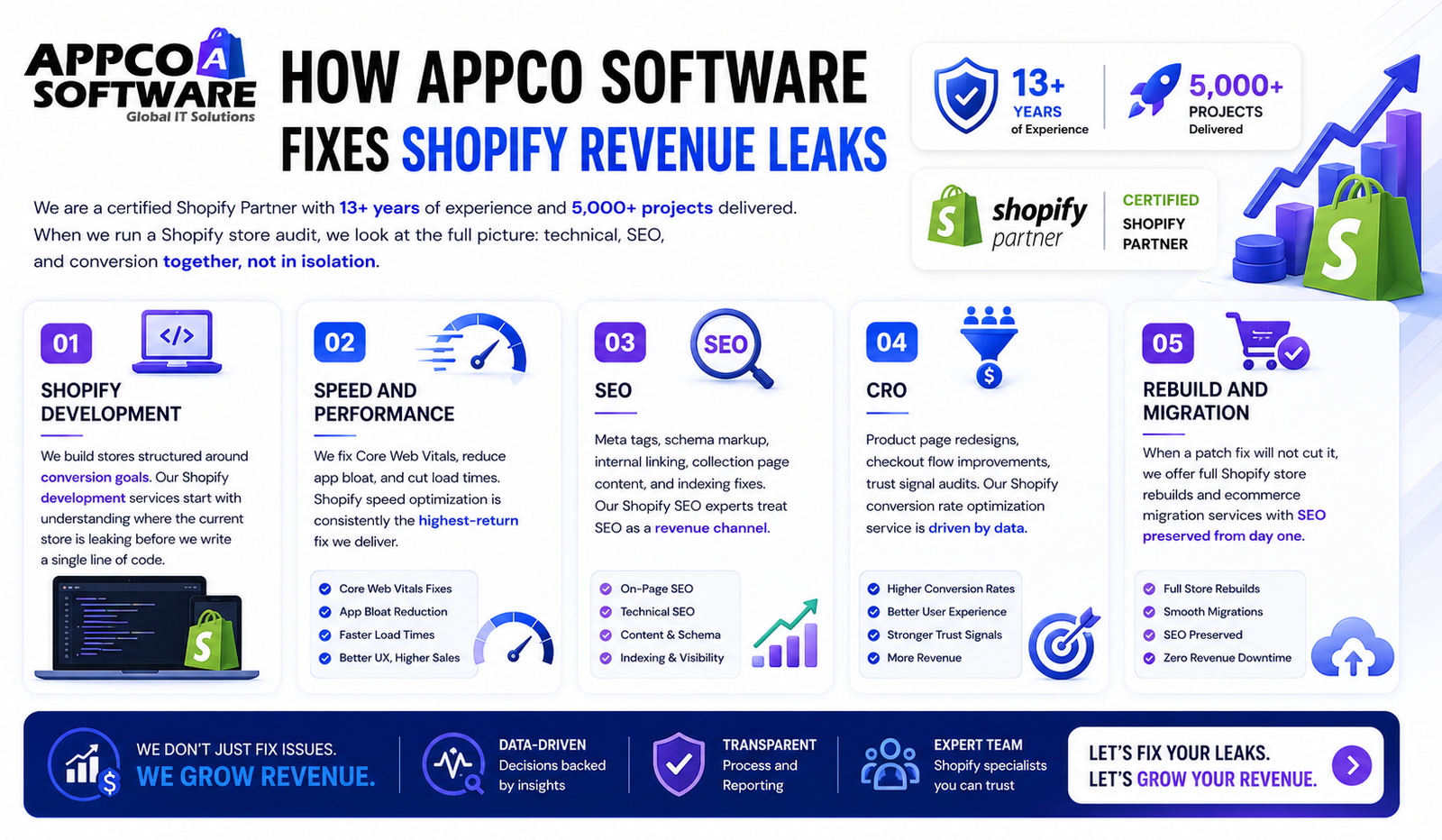
We are a certified Shopify Partner with 13+ years of experience and 5,000+ projects delivered. When we run a Shopify store audit, we look at the full picture: technical, SEO, and conversion together, not in isolation.
Traffic is not the problem for most stores that come to us. They are not short on visitors. They are short on conversions. In almost every case, the fix starts with a proper Shopify store audit that finds what is leaking and prioritizes fixes by revenue impact. If you want a free audit of your store, talk to our team, and we will tell you exactly where your store is losing money.
Shopify revenue leaks are points in your store where people leave without purchasing. Because of the slow pages, broken checkout, weak SEO, or missing trust signals.
A good Shopify conversion rate in 2026 is above 3.2%. The average store converts between 1.4% and 1.8%.
Yes, page speed directly affects Shopify sales. Shopify’s 2026 data shows every 32ms slower response cuts conversions by 1.5%.
You should run a Shopify store audit every six months. And after any theme change, app install, or conversion drop.
Yes, an outdated Shopify theme can cause revenue loss through slow load times, broken mobile sections, and missing modern features.
To find Shopify revenue leaks fast, run Google PageSpeed Insights, test your mobile checkout, and pull a crawl report for broken links.
Error: Contact form not found.

Appco Software has been around for a very long time, helping startups and established brands build iconic websites and apps. For your unique idea to be presented in a beautiful way, contact us now!